


You are typing a sentence, you reach the word that means “from one side to the other,” and you pause. Is it “accross” with two c’s, or “across” with one? It is a small word, but it trips up a surprising number of writers.
This guide settles the question of accross vs across quickly, then goes deeper. You will see why the spelling is what it is, how to use the word in a sentence, how it differs from “through” and “over,” and how to stop making the mistake for good.
Quick Answer

“Across” is the correct spelling. It has one “c” and one “s.” “Accross” is a misspelling and does not appear as a standard word in major English dictionaries.
| Spelling | Correct? | Note |
| Across | Yes | Standard in American and British English |
| Accross | No | Common typo caused by an extra “c” |
A fast way to remember it: across contains the word cross. Put one “a” in front of “cross” and you are done.
The Correct Spelling Explained
The word is spelled a-c-r-o-s-s. Six letters, one “c,” double “s” at the end.
The double letter in this word belongs at the end, not in the middle. Many people sense that the word needs a doubled letter somewhere and place it in the wrong spot. That is where “accross” comes from.
Here is the word broken into parts:
- a – a small opening syllable
- cross – the base word, meaning to go from one side to another
If you can spell “cross,” you can spell “across.”
How to pronounce it
Across is pronounced with two syllables, with the stress on the second one: uh-KROSS. Some American speakers lengthen the vowel slightly, so it sounds closer to uh-KRAWSS. The spelling stays the same either way.
What Does Across Mean in English?
“Across” is a flexible word. It works as a preposition and as an adverb, and it carries a few related meanings.
Meaning 1: From one side to the other
This is the most common sense.
- She walked across the bridge.
- They swam across the lake.
- He drew a line across the page.
Meaning 2: On the opposite side
- The bakery is across the street.
- Our neighbors live across the hall.
Meaning 3: In many places or throughout a group
- The news spread across the country.
- The company has offices across Europe.
- Prices rose across all categories.
Meaning 4: Touching or meeting by chance (with “come”)
- I came across an old photo while cleaning.
- She ran across her former teacher at the market.
Meaning 5: Being understood or communicated
- His message came across clearly.
- The speaker got her point across in five minutes.
Accross vs Across Meaning Explained
Here is the key point: there is no difference in meaning between “accross” and “across,” because “accross” is not a real word. It is simply the same word with a spelling error.
If someone writes “accross the street,” they mean exactly what “across the street” means. The reader will almost always understand. The problem is not confusion about meaning. The problem is that the error looks careless and can weaken the writer’s credibility.
So when you compare accross vs across, you are not choosing between two words. You are choosing between a correct spelling and a typo.
Why Is Across Spelled With One “C”?
The spelling reflects the history of the word. “Across” is tied to the word cross. Language references trace it to an older phrase meaning “in the form of a cross” or “crosswise,” built from an old French-influenced phrase along the lines of a croiz. Over time it was shortened and settled into the form we use today.
The practical takeaway is easy to hold onto:
- The word is built on cross.
- The prefix “a-” is a single letter.
- A single letter prefix does not need a doubled “c.”
Think of it as a + cross. There is no reason to add another “c” in the middle.
A simple memory trick
Across has one C and ends with cross.
Another version some writers like: picture a road. You do not need two “c” letters to cross a road, only one clear path.
Across vs Through vs Over: Key Differences

These three words overlap, which is why writers sometimes pick the wrong one. The table below separates them.
| Word | Core idea | Example |
| Across | Moving from one side to the other of a flat surface or area | He walked across the field. |
| Through | Moving inside something, entering at one point and leaving at another | The train went through the tunnel. |
| Over | Moving above something, or passing from one side to the other over a barrier | The cat jumped over the fence. |
When to use across
Use across when you picture a surface, a line, or a width. Think of a river, a road, a room, or a map.
- We drove across the desert.
- The scarf lay across the chair.
When to use through
Use through when you picture an enclosed or crowded space, such as a tunnel, a forest, a door, or a crowd.
- She pushed through the crowd.
- Light came through the window.
When to use over
Use over when something goes above, or when a barrier is cleared.
- The plane flew over the mountains.
- He climbed over the wall.
Where they overlap
Sometimes two words fit. “She walked across the bridge” and “She walked over the bridge” are both natural. The difference is slight: “across” stresses the journey from side to side, while “over” stresses being above what is below.
“Through” is different. You would not say “walked through the bridge” unless the bridge were a covered structure you were walking inside.
Why Do People Spell Across Wrong?
Several habits explain the “accross” error. Understanding them makes the mistake easier to avoid.
1. Pattern confusion with other “ac-” words
English has many words that begin with “ac” followed by another consonant, such as accept, accident, account, and accommodate. Writers absorb this pattern and apply it to “across,” where it does not belong.
2. Double-letter overcorrection
The word already contains a double “s.” Some writers move or duplicate doubled letters because the word “feels” like it should have them elsewhere.
3. Typing speed
When you type fast, your fingers can repeat a letter. A repeated “c” is an easy slip on the keyboard.
4. Sound-based spelling
English spelling does not always match pronunciation. Since “across” is spoken as uh-KROSS, a writer may try to spell the sound and add extra letters.
5. Relying only on autocorrect
Many tools fix “accross” automatically, so the error never gets learned. When autocorrect is off, such as in handwriting or on a form, the mistake shows up.
Accross vs Across Grammar Rules Explained
Since “accross” is a misspelling, the grammar rules apply only to across. Here is how the word behaves.
Across as a preposition
A preposition connects a noun or pronoun to the rest of the sentence. It is followed by an object.
- The ball rolled across the floor.
- A smile spread across her face.
Across as an adverb
An adverb stands alone without an object.
- The river was narrow, so we waded across.
- He reached across and grabbed the pen.
Common phrases with across
| Phrase | Meaning | Example |
| across from | opposite to | The library is across from the park. |
| across the board | applying to everyone or everything | The raise applies across the board. |
| come across | find by chance, or seem a certain way | She comes across as confident. |
| get across | communicate successfully | I tried to get my idea across. |
| across the country | in many parts of a nation | Stores opened across the country. |
Across vs “a cross”
Be careful not to split the word. “A cross” (two words) means a single cross, such as a symbol or a crossing point.
- Correct: “He wore a cross on a chain.”
- Correct: “He walked across the room.”
- Incorrect: “He walked a cross the room.”
Main Differences Between Accross vs Across
Because only one of them is a real word, the comparison is really about correctness. This table sums it up.
| Feature | Across | Accross |
| Standard English spelling | Yes | No |
| Found in major dictionaries | Yes | No |
| Number of “c” letters | One | Two |
| Part of speech | Preposition, adverb | None (error) |
| Suitable for school, work, and publishing | Yes | No |
| Acceptable in UK and US English | Yes | No |
The short version: write “across” every time.
How to Use Across in a Sentence Correctly
Seeing the word in context is the fastest way to learn it. Here are examples grouped by situation.
Everyday sentences
- The cafe is just across the road.
- She laid the blanket across the bed.
- A cat sat across from me on the train.
Travel and movement
- We flew across the ocean overnight.
- The hikers walked across a narrow ridge.
- Children ran across the playground.
Business and professional writing
- Our team collaborates across departments.
- The policy applies across all regional offices.
- Sales grew steadily across the year.
Academic and formal writing
- The results were consistent across the sample groups.
- Similar themes appear across the author’s novels.
- Opinions varied across age groups.
Tips for using it well
- Use “across” when something goes from side to side or spans a group.
- Pair it with “from” when you mean “opposite.”
- Choose “through” if the movement is inside a space.
- Read the sentence aloud. If the sentence sounds natural, the word likely fits.
Synonyms and Similar Words to Across
Sometimes you want variety. These words can replace “across” in certain contexts, though none matches it perfectly every time.
| Meaning of across | Possible alternatives | Example |
| From side to side | crosswise, transversely, athwart | The beam ran crosswise over the room. |
| Opposite | facing, opposite, directly in front of | The shop is opposite the station. |
| Throughout | throughout, all over, around | Fans throughout the nation cheered. |
| To the far side | over, beyond, to the other side | He rowed to the other side of the lake. |
| Spanning | spanning, covering, extending over | A bridge spanning the river opened today. |
Choose carefully. “Athwart” is quite formal and rare, while “all over” is casual. Match the word to your tone and audience.
Common Accross vs Across Mistakes
Here are the errors writers make most often with this word.
Mistake 1: Doubling the wrong letter
- Wrong: She looked accross the room.
- Right: She looked across the room.
Mistake 2: Dropping an “s”
- Wrong: The path went acros the field.
- Right: The path went across the field.
Mistake 3: Scrambling the letters
- Wrong: He ran acorss the street.
- Right: He ran across the street.
Mistake 4: Splitting into two words
- Wrong: They drove a cross the border.
- Right: They drove across the border.
Mistake 5: Using “cross” when “across” is needed
“Cross” is mainly a verb or noun. “Across” is the preposition.
- Wrong: He walked cross the street.
- Right: He walked across the street.
- Also right: He tried to cross the street.
Mistake 6: Choosing the wrong preposition
- Weak: He swam over the river. (This can suggest swimming above it.)
- Better: He swam across the river.
Across Spelling UK vs US: Any Difference?
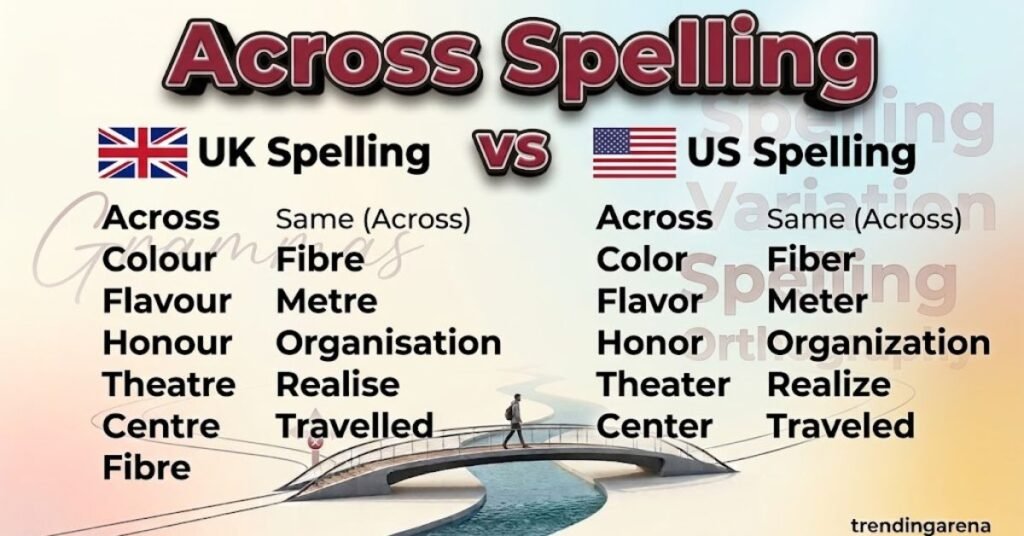
No. “Across” is spelled the same in British English, American English, Canadian English, and Australian English. There is no regional variant. “Accross” is not an accepted spelling in any of them.
The word does show one small difference in usage:
- In American English, “across from” is very common for “opposite.”
- In British English, “opposite” or “across the road from” is often preferred, though “across from” is understood.
Neither affects the spelling. If you are writing for an international audience, “across” is safe everywhere.
Is Accross Ever Correct to Use?
In standard writing, no. There is no context in which “accross” is the proper spelling.
There are only a few narrow situations where you might see it:
- Quoting someone’s typo. If you are reproducing text exactly, you may keep the error, often marked with [sic].
- Deliberate stylization. A creative writer, brand, or username might choose an unusual spelling on purpose. This is a stylistic choice, not correct English.
- Teaching examples. Lessons on common errors, like this one, show “accross” so readers can recognize it.
Outside these cases, treat it as an error and correct it.
The Impact of Spelling Errors on Writing
One misspelled word will not ruin a document. Still, small errors matter more than many writers expect.
Credibility
Readers often judge a writer’s care by the details. A typo in a resume, cover letter, or business email can make the writer seem rushed.
Clarity
Most readers will understand “accross.” Yet any error forces them to pause, even briefly, and that interrupts the flow of your message.
Professionalism
In formal settings such as job applications, reports, proposals, and academic essays, correct spelling signals attention to detail.
Search and visibility
When you publish online, misspellings can reduce the polish of your content. Clean copy tends to feel more trustworthy to readers.
Easy ways to catch errors
- Proofread slowly. Read once for meaning and once for spelling.
- Read aloud. Your ear catches things your eye skips.
- Use a spell checker, but do not depend on it. It may not catch every mistake or context error.
- Take a break. Fresh eyes spot typos more easily.
- Keep a personal list. Write down words you misspell often and review them.
Practice Session
Test yourself. Choose the correct spelling or word in each sentence. Answers follow below.
Also Read This:Casi Algo Meaning: What It Means in Love & DatingCasi Algo Meaning: What It Means in Love & Dating
Part 1: Pick the correct spelling
- They live just (across / accross) the street.
- The news spread (accross / across) the city.
- She reached (accross / across) the table.
- A smile came (across / accross) his face.
- The meeting went well, and our point got (accross / across).
Part 2: Choose across, through, or over
- The hikers walked (across / through / over) the dense forest.
- The dog jumped (across / through / over) the low fence.
- We drove (across / through / over) the wide plain.
- Sunlight streamed (across / through / over) the open window.
- The boat sailed (across / through / over) the bay.
Part 3: Fix the error
- He ran accross the field.
- She walked a cross the room.
- We came acros an old café.
Answers
- across
- across
- across
- across
- across
- through (inside a dense, enclosed space)
- over (clearing a barrier)
- across (a wide, open surface)
- through (passing through an opening)
- across (from one side of the bay to the other)
- He ran across the field.
- She walked across the room.
- We came across an old café.
If you scored 11 or more, you have this word well in hand. If not, reread the memory trick and try again.
Final Takeaway
Also Read :https://word.tips/spelling/across-vs-accross/https://word.tips/spelling/across-vs-accross/
The answer to accross vs across is simple: “across” is the only correct spelling. “Accross” is a common typo caused by an extra “c,” and it is not accepted in standard English, whether British or American.
Keep these points in mind:
- Across = a + cross. One “c” in the middle, double “s” at the end.
- Use it to mean from side to side, on the opposite side, or throughout a group.
- Pick through for movement inside a space and over for movement above something.
- Never split it into “a cross” unless you mean a literal cross.
.



Pingback: Commit vs Comit: Correct Spelling, Meaning and Usage