

Should you write “she hasn’t” or “she haven’t”? Does “they hasn’t” ever sound right? If you have paused mid-sentence over these two small words, you are in good company.
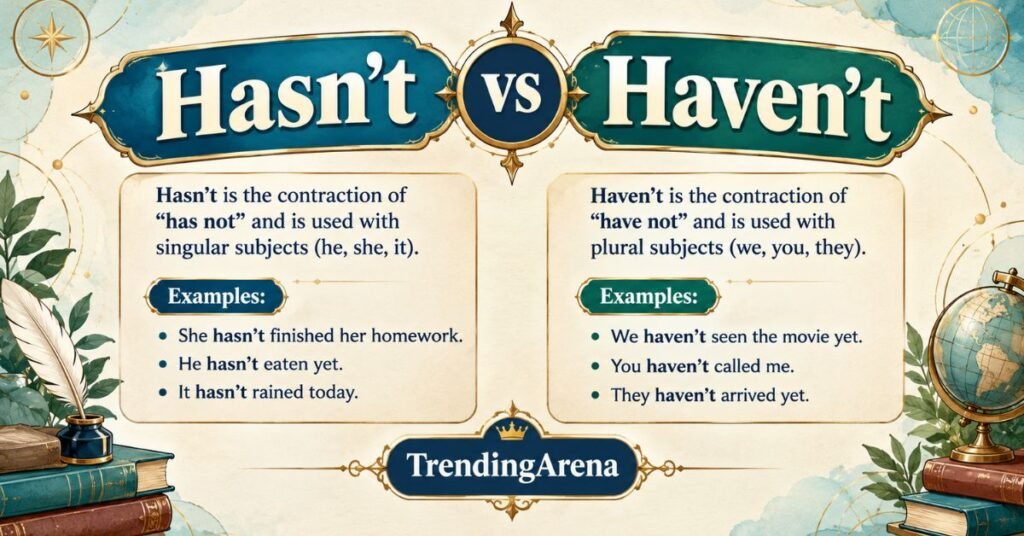
The short answer: use hasn’t with he, she, it and singular subjects. Use haven’t with I, you, we, they and plural subjects. Both are contractions of “has not” and “have not,” and both mostly appear in the present perfect tense.
This guide explains the meaning, the rule behind the choice, and the tricky cases that catch even confident writers. You will find real examples, a comparison table, memory tricks, and a printable cheatsheet at the end.
Why “Hasn’t vs Haven’t” Confuses So Many Writers
The two words look almost identical. They differ by just a few letters, they sound alike in fast speech, and they carry the same basic meaning: something has not happened.
Here is why people still mix them up:
- Fast speech blurs the sound. In casual talk, “hasn’t” and “haven’t” can sound close enough that the ear misses the difference.
- “You” feels singular. When you talk to one person, “you” seems like it should take a singular verb. It doesn’t.
- Long subjects hide the real noun. In “The list of items hasn’t been updated,” the word closest to the verb is “items,” which tempts writers toward “haven’t.”
- Collective nouns split opinion. American and British English treat words like team and government differently.
- Contractions hide the full verb. Writers who never say “has not” out loud lose the clue that would settle the question.
The good news is that one rule solves almost every case. Once you see it, the confusion fades quickly.
What “Hasn’t” and “Haven’t” Actually Mean
Both words are negative contractions of the verb have.
| Contraction | Full form | Meaning |
| hasn’t | has not | Something has not happened (singular subject) |
| haven’t | have not | Something has not happened (plural subject, I, you) |
Neither word carries a different meaning from the other. The only job of the choice is agreement: the verb must match its subject.
The two jobs these words do
Most of the time, “hasn’t” and “haven’t” work as auxiliary (helping) verbs. They team up with a past participle to form the present perfect tense.
- She hasn’t finished her report.
- We haven’t received the package.
Sometimes they work as the main verb to show possession, though this is mostly British and quite formal.
- He hasn’t a single complaint. (British, formal)
- I haven’t the faintest idea. (British, formal)
Either way, the same agreement rule applies.
The Grammar Rule That Decides Everything (Subject–Verb Agreement)
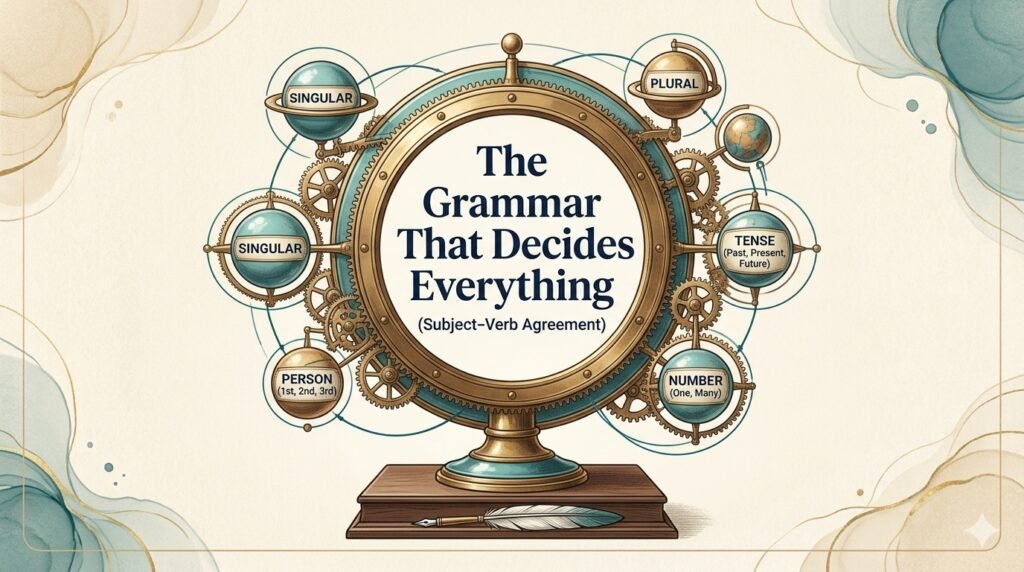
English verbs must agree with their subjects in number. This is called subject–verb agreement, and it is the whole secret behind this topic.
The rule in one line:
Singular third-person subject → hasn’t. Everything else → haven’t.
Here is how it breaks down by pronoun:
| Subject | Correct form | Example |
| I | haven’t | I haven’t eaten yet. |
| you | haven’t | You haven’t called me back. |
| he | hasn’t | He hasn’t arrived. |
| she | hasn’t | She hasn’t replied. |
| it | hasn’t | It hasn’t stopped raining. |
| we | haven’t | We haven’t decided. |
| they | haven’t | They haven’t left. |
Notice the pattern. Only he, she, and it (and anything that can be replaced by them) take “hasn’t.” That is the entire list.
A fast test you can use anywhere
Replace your subject with a pronoun in your head:
- Can you swap it for he, she, or it? Use hasn’t.
- Can you swap it for I, you, we, or they? Use haven’t.
That test works for names, nouns, phrases, and even long, messy subjects.
When to Use “Hasn’t” (With Clear, Real Examples)
Use hasn’t when the subject is one person, one thing, or one idea.
With he, she, and it
- He hasn’t checked his email today.
- She hasn’t missed a deadline all year.
- The printer hasn’t worked since Monday.
With singular names and nouns
- Maria hasn’t booked her flight.
- My brother hasn’t returned my charger.
- The manager hasn’t approved the budget.
With singular indefinite pronouns
Words like everyone, everybody, someone, nobody, each, either, and neither are grammatically singular, even when they feel plural.
- Everyone hasn’t arrived yet. (Better: Not everyone has arrived yet.)
- Nobody hasn’t noticed. (Avoid the double negative: Nobody has noticed.)
- Neither of the answers hasn’t been checked. (Cleaner: Neither of the answers has been checked.)
Since these pronouns already carry meaning, native speakers often rephrase to avoid awkward negatives. Still, when “hasn’t” fits, it is the right form.
- Each of the students hasn’t submitted the form.
- Either option hasn’t been tested properly.
With uncountable nouns
Uncountable nouns take singular verbs.
- The water hasn’t been turned on.
- Her advice hasn’t helped.
- The traffic hasn’t moved for an hour.
With gerunds and “to” phrases
When a whole activity acts as the subject, treat it as singular.
- Learning a new language hasn’t been easy.
- Waiting in line hasn’t bothered him.
With “there” and a singular noun
- There hasn’t been any news.
- There hasn’t been a single complaint.
When to Use “Haven’t” (And Why It’s More Common)
Haven’t is more common in everyday English for a simple reason: it covers five of the seven core pronouns (I, you, we, they, plus all plural subjects). “Hasn’t” covers only three (he, she, it).
With I and you
- I haven’t seen that movie.
- You haven’t changed a bit.
With we and they
- We haven’t met before.
- They haven’t paid the invoice.
With plural nouns
- The students haven’t finished the test.
- My parents haven’t visited in months.
- The emails haven’t been sent.
With compound subjects joined by “and”
Two subjects joined by and make a plural subject.
- Tom and Sara haven’t spoken since June.
- The chair and the table haven’t arrived.
With “there” and a plural noun
- There haven’t been any delays.
- There haven’t been enough volunteers.
Common time words that appear with both
Present perfect sentences often include helpful signals such as yet, already, ever, never, since, for, lately, and recently.
- I haven’t finished yet.
- She hasn’t called since Tuesday.
- They haven’t travelled for two years.
- He hasn’t been well lately.
The Special Case: Why “I Haven’t” Is Correct But “I Hasn’t” Is Always Wrong
Many learners ask why “I” takes “haven’t” when “I” is one person. The answer is that the singular form of the verb is reserved for third person.
Here is the full present-tense pattern for “have”:
| Person | Singular | Plural |
| First | I have | we have |
| Second | you have | you have |
| Third | he/she/it has | they have |
The only slot that uses “has” is third person singular. “I” is first person. “You” is second person. So neither can take “has.”
That is why:
- ✅ I haven’t forgotten.
- ❌ I hasn’t forgotten.
- ✅ You haven’t told me.
- ❌ You hasn’t told me.
Why “you” is always “haven’t”
“You” can mean one person or many. English uses the plural-style verb form for both. So even when you speak to a single friend, the right form is “you haven’t.” There is no exception, in formal or informal English.
Sentence Structures That Affect “Hasn’t vs Haven’t”
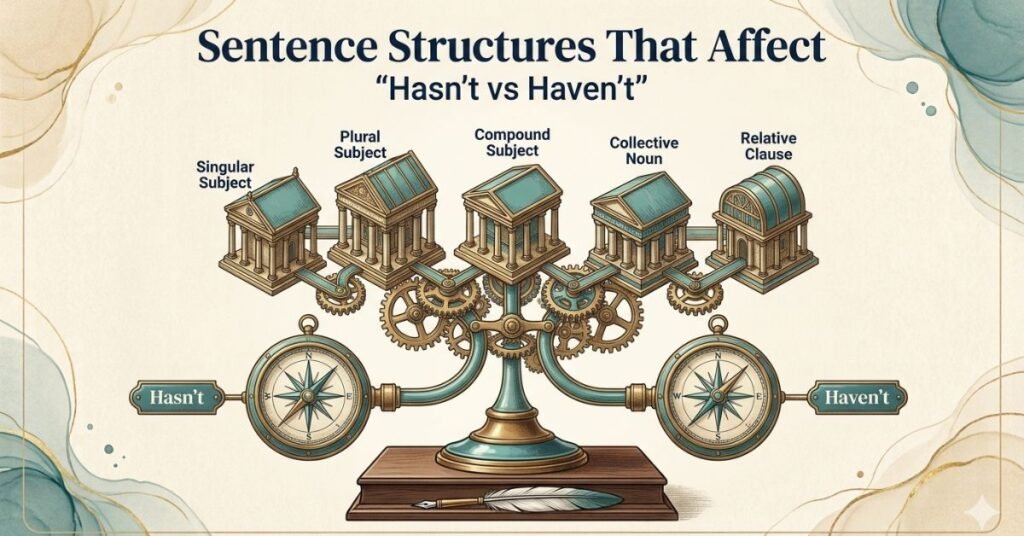
The same rule works in every sentence type. But the position of the words changes, and that sometimes causes slips.
Statements
- The team hasn’t responded.
- The players haven’t responded.
Questions
In negative questions, the contraction often sits at the start, before the subject.
- Hasn’t she called yet?
- Haven’t you finished?
- Hasn’t the package arrived?
In more formal writing, the full form splits around the subject: “Has she not called yet?” This sounds polished and a little old-fashioned.
Tag questions
Tag questions flip the verb from positive to negative, or the other way around. The tag must still agree with the subject.
- She has finished, hasn’t she?
- They have left, haven’t they?
- You have seen it, haven’t you?
When the main clause is negative, the tag becomes positive:
- He hasn’t called, has he?
- We haven’t met, have we?
Short answers
- Has he eaten? No, he hasn’t.
- Have you finished? No, I haven’t.
Sentences with “ever” and “never”
- I haven’t ever been there. (Natural alternative: I have never been there.)
- She hasn’t ever lied to me.
Advanced Usage Notes
Once you know the base rule, a few finer points make your writing sharper.
“Haven’t” and “hasn’t” as main verbs
In British English, you may see “have not” used like a main verb to show possession:
- I haven’t a car.
- She hasn’t any money.
American English usually prefers “don’t have” and “doesn’t have”:
- I don’t have a car.
- She doesn’t have any money.
Both are correct, but they belong to different regional styles. In British English, “haven’t got” is also very common: I haven’t got a car.
“Haven’t” versus “don’t have”
These two are easy to confuse, so keep the roles clear:
| Form | Tense | What it does | Example |
| haven’t + past participle | Present perfect | Shows an action not done up to now | I haven’t eaten. |
| don’t have + noun | Present simple | Shows a lack of something | I don’t have a pen. |
“Hasn’t” versus “hadn’t”
- Hasn’t = present perfect: She hasn’t left. (up to now)
- Hadn’t = past perfect: She hadn’t left when I arrived. (before a past moment)
“Haven’t” versus “didn’t”
- Didn’t (simple past) points to a finished event: I didn’t see him yesterday.
- Haven’t (present perfect) connects the past to now: I haven’t seen him this week.
Haven’t and the word “yet”
“Yet” in negative present perfect sentences tells the reader that something may still happen.
- I haven’t finished yet. (I may finish later.)
- She hasn’t answered yet. (An answer may still come.)
Contractions and the apostrophe
The apostrophe replaces the missing “o” in “not.” Always place it between the n and the t.
- ✅ hasn’t, haven’t
- ❌ has’nt, have’nt
Common Mistakes Native and Non-Native Speakers Make
Even skilled writers slip here. Watch for these seven traps.
- Using “hasn’t” with “I.” ❌ I hasn’t seen it. → ✅ I haven’t seen it.
- Using “haven’t” with he, she, or it. ❌ She haven’t called. → ✅ She hasn’t called.
- Being fooled by a phrase after the subject. ❌ The box of chocolates haven’t arrived. → ✅ The box of chocolates hasn’t arrived. (The subject is “box,” not “chocolates.”)
- Treating “data” and “media” inconsistently. Both are acceptable in modern usage, but keep your choice consistent: The data hasn’t been verified (common) or The data haven’t been verified (formal, plural).
- Making a double negative. ❌ Nobody hasn’t called. → ✅ Nobody has called.
- Mixing up “hasn’t” and “hadn’t.” ❌ She hasn’t finished before I arrived. → ✅ She hadn’t finished before I arrived.
- Misplacing the apostrophe. ❌ has’nt → ✅ hasn’t
Why the “phrase trap” is so common
When a plural noun sits right before the verb, the brain wants to match it. Strip the sentence down to the subject and its verb.
- The results of the study hasn’t been published. → Strip it to “The results haven’t been published.” (Subject = results.)
- One of my friends haven’t arrived. → Strip it to “One … hasn’t arrived.” (Subject = one.)
Quick Comparison Table: Hasn’t vs Haven’t
| Feature | Hasn’t | Haven’t |
| Full form | has not | have not |
| Used with | he, she, it, singular nouns | I, you, we, they, plural nouns |
| Verb person | Third person singular | All other persons |
| Typical use | Present perfect negative | Present perfect negative |
| Example 1 | He hasn’t called. | They haven’t called. |
| Example 2 | The dog hasn’t eaten. | The dogs haven’t eaten. |
| Question form | Hasn’t she left? | Haven’t you left? |
| Tag question | …, hasn’t he? | …, haven’t they? |
| Common mistake | Using it with “I” or “you” | Using it with “he/she/it” |
Hasn’t/Haven’t with Collective Nouns
A collective noun names a group as one unit. Examples include team, family, committee, staff, audience, government, and band. The right verb depends on whether you see the group as one body or as many individuals.
American English: usually singular
- The team hasn’t announced its lineup.
- The committee hasn’t reached a decision.
- The government hasn’t released the figures.
British English: often plural
- The team haven’t announced their lineup.
- The committee haven’t reached a decision.
- The staff haven’t received their pay.
Which one should you choose?
| Situation | Better choice | Reason |
| Group acts as one unit | hasn’t | Singular body |
| Members act separately | haven’t | Individual actions |
| Writing for a US audience | hasn’t | Standard US style |
| Writing for a UK audience | haven’t (or hasn’t) | Both accepted |
Consistency matters most. If you write “The team hasn’t announced its lineup,” do not follow with “they are nervous.” Stay with one approach throughout the piece.
Related tricky subjects
- “The number of” takes singular: The number of applicants hasn’t changed.
- “A number of” takes plural: A number of applicants haven’t replied.
- “None” can go either way: None of them has replied (formal) or None of them have replied (common).
- “Neither … nor” follows the closer subject: Neither the manager nor the employees haven’t… (avoid; rewrite for clarity).
- “Either … or” also follows the closer subject: Either Tom or his parents haven’t called.
Easy Memory Tricks That Actually Work
You do not need to memorize a long chart. These tricks cover nearly every case.
Trick 1: The “S” match
“Has” and “she” both contain an s. “He,” “she,” and “it” pair with hasn’t. Everything else gets the longer word, haven’t.
Trick 2: The “HE-SHE-IT” rule
Say it like a small chant: he, she, it — hasn’t. All the rest — haven’t.
Trick 3: The pronoun swap
Swap your subject for a pronoun. If “he,” “she,” or “it” fits, choose “hasn’t.” If “I,” “you,” “we,” or “they” fits, choose “haven’t.”
Trick 4: Say the full form
Read the contraction out loud as “has not” or “have not.” Then test whether the full version sounds right with your subject. “She have not” sounds wrong, so “she hasn’t” wins.
Trick 5: Cross out the extras
Cut away any phrases between the subject and the verb. What is left is the true pair.
- The report, along with the charts, hasn’t been sent.
- Strip down: The report hasn’t been sent.
Formality Spectrum
Contractions sit on a scale of formality. Here is how “hasn’t” and “haven’t” fit.
| Level | Preferred form | Example |
| Very formal (legal, academic) | has not / have not | The applicant has not submitted the form. |
| Business writing | Mix of both; contractions are fine in emails | We haven’t received your payment. |
| Everyday speech | Contractions | She hasn’t called me back. |
| Casual texting | Contractions, sometimes shortened | hasnt / havent (informal; skip the apostrophe only in texts) |
Practical guidance
- Academic papers: write “has not” and “have not” unless your style guide allows contractions.
- Business emails: contractions feel friendly and natural. Use them freely.
- Legal and official documents: use the full forms.
- Blogs and social media: contractions help your writing sound human.
Real-World Usage: Formal Writing vs Everyday Speech
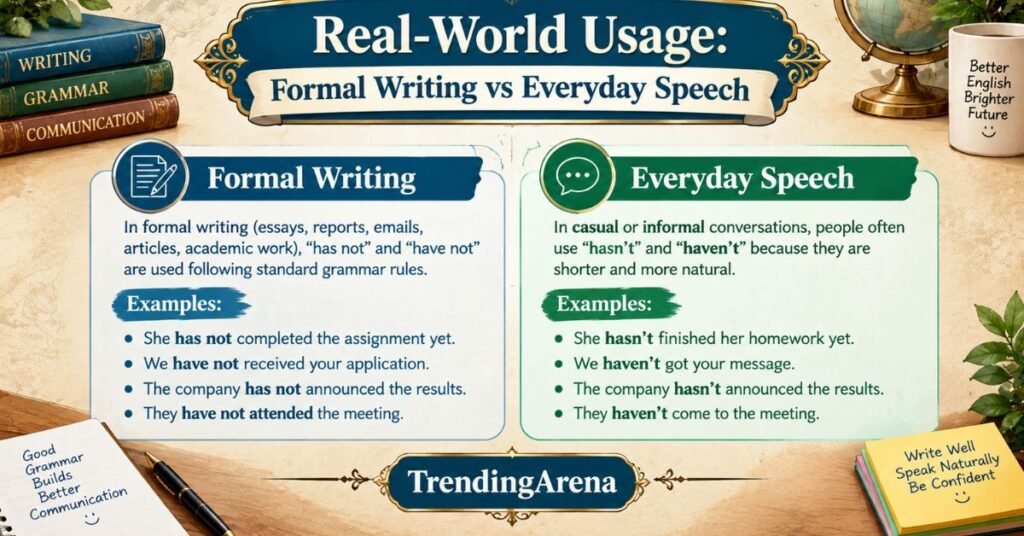
How do these words actually appear in the places you read and write every day?
In everyday speech
- “I haven’t had lunch yet.”
- “She hasn’t texted me back.”
- “They haven’t fixed the road.”
Speech favors short, relaxed forms, so contractions dominate.
In professional emails
- “We haven’t received the signed contract.”
- “The invoice hasn’t been processed.”
- “I haven’t heard back from the vendor.”
These sentences sound clear and polite without stiffness.
In formal reports
- “The committee has not reviewed the proposal.”
- “The results have not been confirmed.”
Spelling out the full form signals care and seriousness.
In fiction and dialogue
Writers use contractions to make characters sound real.
- “You haven’t changed,” she said.
- “He hasn’t said a word all night,” whispered Dan.
In news headlines
- “Talks haven’t resumed, officials say.”
- “Vote hasn’t been scheduled.”
Headlines like short forms because space is limited.
Case Study: Everyday Errors and How to Fix Them
Here are six real-style errors, with a quick diagnosis for each.
Also read this:
Really vs Realy: Which Spelling Is Correct?
| # | Incorrect sentence | Problem | Corrected sentence |
| 1 | My manager haven’t approved the leave. | “Manager” is singular | My manager hasn’t approved the leave. |
| 2 | I hasn’t received the email. | “I” never takes “has” | I haven’t received the email. |
| 3 | The files on the server hasn’t loaded. | Subject is “files” (plural) | The files on the server haven’t loaded. |
| 4 | Neither of them haven’t called. | Double negative + singular pronoun | Neither of them has called. |
| 5 | Everyone haven’t arrived. | “Everyone” is singular | Not everyone has arrived. |
| 6 | You hasn’t paid yet. | “You” takes “have” | You haven’t paid yet. |
Walking through one fix
Original: The group of students haven’t submitted the form.
- Find the true subject. It is group, not students.
- “Group” can be replaced by “it.”
- “It” takes hasn’t.
- Fixed: The group of students hasn’t submitted the form.
This habit of finding the real subject solves the majority of agreement errors.
Common Questions Students and Writers Ask
Is it “She hasn’t” or “She haven’t”?
It is always “She hasn’t.” “She” is third person singular.
Can I say “you hasn’t”?
No. “You” always takes haven’t.
Is “haven’t” ever singular?
Yes, with “I.” It is singular in meaning but uses the “have” form: I haven’t.
Is “hasn’t got” correct?
Yes. In British English, “He hasn’t got any time” is perfectly natural. American English more often says “He doesn’t have any time.”
Do I need to say “yet” with these words?
No, but “yet” is a handy partner. It signals that the action is still possible.
Is it okay to start a sentence with “Haven’t”?
In questions, yes: Haven’t you eaten? In statements, drop the subject only in very informal speech: Haven’t seen him all day.
What is the difference between “hasn’t been” and “haven’t been”?
Only the subject changes. “Hasn’t been” pairs with singular subjects, “haven’t been” with plural ones and with “I” and “you.”
Are “hasn’t” and “haven’t” interchangeable?
Never. They are not synonyms; they are two forms of one verb that must agree with their subjects.
Conclusion
“Hasn’t” and “haven’t” follow one simple rule: match the verb to the subject. Use hasn’t with he, she, it and singular subjects, and haven’t with I, you, we, they and plural subjects.
Spot the true subject and swap it for a pronoun, and the choice becomes automatic. Read your own emails and drafts aloud for a week, and the right form will soon sound natural.