
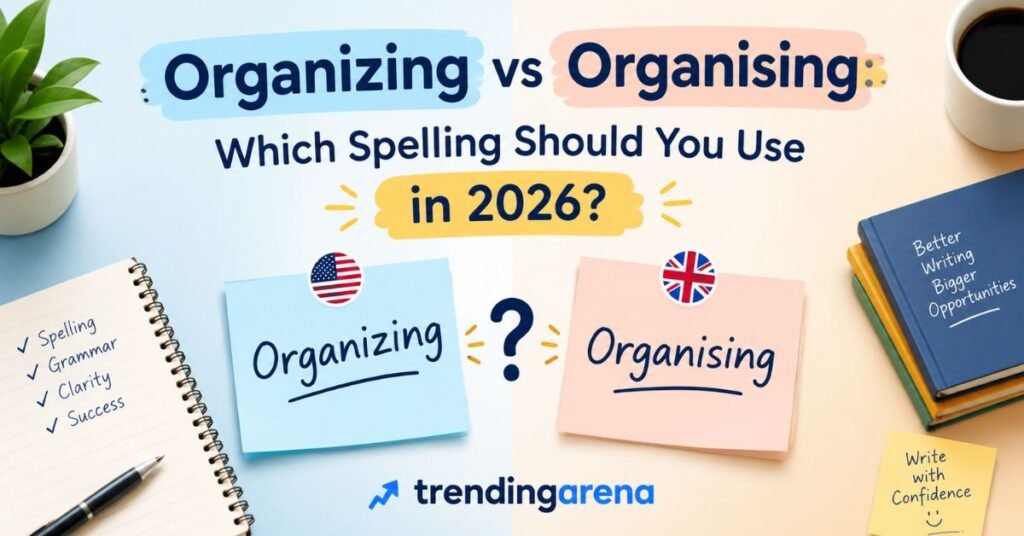

You are typing a sentence, you reach the word, and you stop. Is it “organizing” or “organising”? One looks right, the other looks right too, and your spellchecker has just underlined one of them in red.
Here is the good news: you did not make a mistake. Both spellings are correct. They are regional variants of the same word, and the one you should use depends on who is going to read your writing.
This guide explains the difference in plain language, shows which countries use which spelling, and gives you a simple way to choose every time. You will also learn why the two spellings exist, how the choice affects words like organization and organizer, and what it means for websites, business documents, and school or university work in 2026.
The Short Answer: Organizing or Organising?
Organizing (with a z) is the standard spelling in American English and Canadian English. Organising (with an s) is the standard spelling in British English and in most places that follow British conventions, including Australia, New Zealand, Ireland, India, and South Africa.
The meaning is identical. Both words are the present participle of the verb organize/organise, which means to arrange things in a structured way, to plan or coordinate an event, or to bring order to something.
The practical rule is simple:
- Writing for a mainly American or Canadian audience? Use organizing.
- Writing for a mainly British, Irish, Australian, New Zealand, Indian, or South African audience? Use organising.
- Whichever you choose, use it consistently from the first line to the last.
Organizing vs Organising at a Glance
| Organizing | Organising | |
| Spelling pattern | -ize | -ise |
| Main regions | United States, Canada | United Kingdom, Australia, New Zealand, Ireland, India, South Africa |
| Pronunciation | Same | Same |
| Meaning | Same | Same |
| Base verb | organize | organise |
| Noun form | organization | organisation |
| Person who does it | organizer | organiser |
| Past tense | organized | organised |
| Correct? | Yes | Yes |
Pronunciation does not change at all. In both spellings the ending sounds like “eyes”, so you would say OR-guh-nye-zing either way. Only the spelling on the page is different.
What Does “Organizing” Actually Mean?
Before going deeper into spelling, it helps to be clear about the word itself. To organize (or organise) something means to put it into a planned, orderly arrangement. The word shows up in several everyday senses:
- Arranging physical things: organizing a closet, a garage, or a desk drawer.
- Arranging information: organizing files, notes, research, or a spreadsheet.
- Planning an event or activity: organizing a wedding, a conference, or a school fundraiser.
- Bringing people together for a cause: organizing a community group, a campaign, or a union.
- Managing time and tasks: organizing your week, your inbox, or your to-do list.
The spelling question applies equally to every one of these. It does not matter whether you are tidying a kitchen or running a political campaign: the same American-versus-British split applies.
Why Two Spellings Exist
The split goes back centuries, and it is less dramatic than people sometimes make it sound.
The word traces back to the Greek organon, meaning a tool or instrument. It passed through Latin and then Old French, where the verb became organiser. English borrowed it in the late Middle Ages. Because the French form used an s, many English writers spelled the verb with -ise.
Meanwhile, the Greek ending -izein (to do or make) had its own influence. Scholars who wanted English spellings to reflect the Greek origin of such verbs preferred -ize. For a long time, both forms were used side by side in Britain.
In the early 1800s, the American lexicographer Noah Webster pushed for simpler, more phonetic spellings in his dictionaries. He favoured -ize and dropped the u in words like colour. His dictionaries were hugely influential in the United States, which is why American English settled firmly on organize. British publishers, drifting toward French-influenced forms, increasingly preferred -ise.
So the difference is not a case of one side getting it right and the other getting it wrong. It is two branches of the same language that made different choices at different times.
Which Countries Use Which Spelling?
This is the question most readers really want answered. The table below summarizes the general pattern. Keep in mind that usage is a tendency, not a law, and individual publishers and organizations make their own style decisions.
| Country or region | Typical spelling | Notes |
| United States | organizing | Universal in American publishing and education |
| Canada | organizing | Canadian English mixes American -ize with British spellings like colour |
| United Kingdom | organising | -ize also appears in some academic and Oxford-style publishing |
| Ireland | organising | Follows British conventions closely |
| Australia | organising | Australian government style guidance favours -ise |
| New Zealand | organising | Follows the British pattern |
| India | organising | Indian English generally follows British spelling, though American forms are increasingly common online |
| South Africa | organising | Follows the British pattern |
| Pakistan, Singapore, Hong Kong, Malaysia | mostly organising | Mixed in practice; check the specific publication or organization |
The Canadian Exception
Canada is the region that most often surprises people. Canadian English uses -ize (organize, realize, recognize), but keeps British-style spellings such as colour, centre, and cheque. So a Canadian writer will typically write “organizing” but also “neighbour”.
If you are writing for Canadians, use organizing. Choosing organising would look out of place to most readers there.
What About Global or Mixed Audiences?
Online, the lines blur. A reader in Mumbai may see American spelling on a website, and a reader in Manchester may be used to -ize from software menus and international brands. Even so, the safest approach is to match your primary audience, which we cover in the decision guide below.
The Full Word Family: Organize, Organization, Organizer, and More
The spelling choice does not stop at the -ing form. Once you pick one pattern, it should carry through every related word. Here is how the whole family lines up:
| American / Canadian (-ize) | British and others (-ise) |
| organize | organise |
| organizes | organises |
| organized | organised |
| organizing | organising |
| organizer | organiser |
| organization | organisation |
| organizational | organisational |
| reorganize | reorganise |
| reorganization | reorganisation |
| disorganized | disorganised |
| well-organized | well-organised |
| self-organizing | self-organising |
| organizable | organisable |
A sentence that mixes the two looks careless. For example, “Our organisation is organizing a charity run” combines both patterns in one line. Readers may not consciously spot it, but it weakens the polish of the text.

The Oxford Spelling Twist
Here is a detail that many short articles skip, and it is one of the most useful things to know.
There is a style called Oxford spelling, sometimes described as -ize with British spelling elsewhere. It is used by Oxford University Press and by many academic and scientific publishers. Under this convention, you write organize and organization with a z, but you still write colour, centre, and defence in the British way.
Two important points follow from this:
- “-ize” is not purely American. In British academic writing, it is often a deliberate, accepted choice rather than an Americanism.
- The Greek-based reasoning is real. Oxford’s preference comes from the word’s etymology, which is why you will see -ize in many British-published journals.
That said, most British newspapers, government bodies, and general-interest publishers use -ise. If you are unsure which a British reader expects, -ise is the safer default for everyday and business writing.
How to Choose the Right Spelling in 2026: A Practical Decision Guide
Stop worrying about which spelling is “better”. Instead, work through these steps.
Step 1: Identify Your Main Reader
Ask where most of your readers live. A blog aimed at American homeowners should use organizing. A newsletter for a London charity should use organising. If your analytics show a clear majority from one region, follow that region.
Step 2: Check for Required Style Guides
If you are writing for an employer, publisher, university, or client, there is probably a style guide already. Look for a line about spelling or “English variant”. It will usually say American, British, or Oxford. Follow it, even if you personally prefer the other.
Step 3: Match the Rest of Your Spelling
If you already use colour, favourite, and centre throughout a document, pair them with organising (or Oxford -ize). If you use color, favorite, and center, pair them with organizing. A consistent set of choices reads as professional.
Step 4: Set Your Tools Accordingly
Set the language in your word processor, browser, and writing tools to the variant you chose. This prevents autocorrect from quietly flipping your spelling halfway through a document.
Step 5: Stay Consistent
Consistency is more important than which side you pick. A document that uses one spelling throughout is better than one that jumps between both.
Quick Decision Table
| Situation | Best choice |
| American company or customer base | organizing |
| Canadian audience | organizing |
| UK business, news, or government content | organising |
| Australian or New Zealand content | organising |
| Indian, Irish, or South African audience | organising |
| Academic paper for an Oxford-style journal | organizing (with other British spellings) |
| Global website with no clear primary audience | choose one and apply it everywhere |
| Following a client’s or publisher’s style guide | whatever the guide says |
Does the Spelling Affect SEO?
If you publish online, you may wonder whether picking organising over organizing changes your search visibility. Here is a grounded answer.
Search engines are generally good at recognizing that spelling variants like these refer to the same thing. A page about organising your home office can often appear for searches that use organizing, and the reverse is true too. You should not assume it is a hard barrier either way.
However, search results are often tailored by location and language. People in the United States tend to search with organizing, and people in the United Kingdom tend to search with organising. That has a few practical consequences:
- Match your audience. If your readers search with one spelling, using the same form in your title, headings, and opening paragraph feels natural to them and can improve click-through rates.
- Do not stuff both spellings. Repeating “organizing/organising” over and over looks awkward and does not help readers. One consistent spelling is better.
- Use language and region signals. If you run a site for multiple countries, language tags such as en-US and en-GB, along with separate regional versions, help search engines show the correct version to the right people.
- Think about your keyword data. Keyword research tools usually show search volume for each variant by country. Check them before deciding on a title for a high-priority page.
- Write for people first. A reader who sees their own spelling convention feels the page was written for them, which supports trust.
If you run a single-language site with a global audience, it is perfectly acceptable to pick one variant. Many large publishers do exactly that.
also read this:Patients or Patient’s? Meaning, Rules, and Examples for 2026
Words Ending in -ise That Never Change
A common source of confusion is that some words end in -ise in both American and British English. They are not variants of an -ize form, so you should never change them to -ize.
These words always use -ise:
- advertise
- advise
- compromise
- despise
- devise
- exercise
- improvise
- revise
- supervise
- surprise
- televise
- enterprise
- franchise
- premise
This is why a blanket “replace every -ise with -ize” approach fails. If you convert advise to advize or surprise to surprize, you have created errors in both varieties of English.
A related pair worth knowing is analyse (British) and analyze (American). The ending there is -yse versus -yze, a similar but separate pattern, and it also follows your regional choice.
Other Common -ize/-ise Pairs
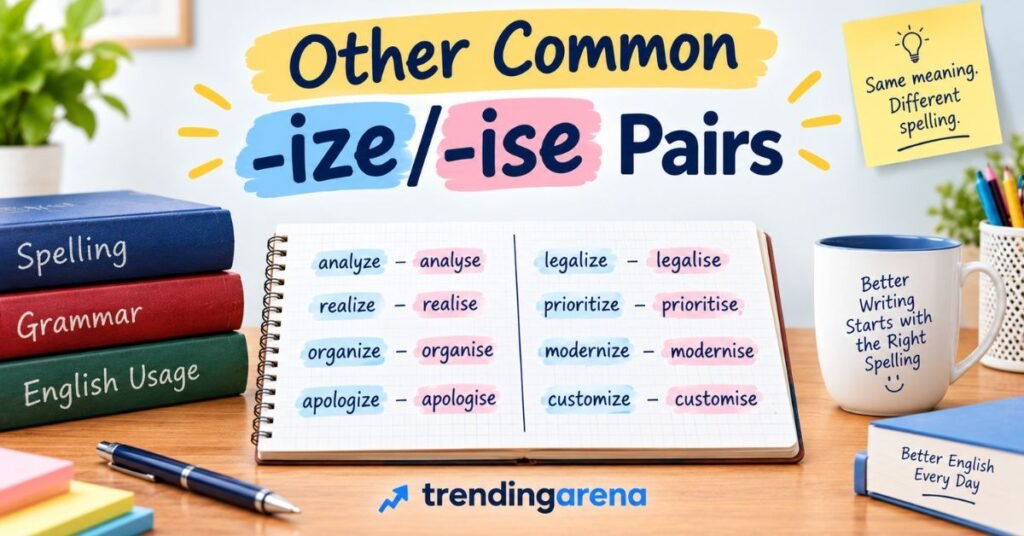
Once you know the rule for organize, the same logic applies to dozens of other words. Here are some of the ones you are most likely to type:
| American / Canadian | British and others |
| realize | realise |
| recognize | recognise |
| apologize | apologise |
| prioritize | prioritise |
| minimize | minimise |
| maximize | maximise |
| optimize | optimise |
| summarize | summarise |
| authorize | authorise |
| customize | customise |
| categorize | categorise |
| specialize | specialise |
| finalize | finalise |
| organize | organise |
If your document says prioritise and recognise, it should say organise too. Aligning the whole set is the easiest way to look consistent.
Proper Nouns and Official Names Keep Their Own Spelling
There is one exception to “stay consistent”, and it is a big one. When you write the official name of an organization, product, law, or title, you should reproduce it exactly as the owner spells it, regardless of your general spelling choice.
A few examples show why this matters:
- The World Health Organization uses a z in its name, even though it is headquartered in Switzerland and publishes in British-influenced English. It follows the Oxford style mentioned earlier.
- The Organisation for Economic Co-operation and Development uses an s in its name.
- A company or charity might be registered as “Green Space Organisation” or “Green Space Organization”, and that registered spelling is the one to use.
So in an American-style article, you might write “organizing” in your own sentences but still refer to the Organisation for Economic Co-operation and Development with its original s. In a British-style article, you would still write World Health Organization with a z.
When in doubt, check the organization’s own website for its official name.
Common Mistakes to Avoid
Most errors with this word are about inconsistency, not about getting one spelling “wrong”. These are the slip-ups that come up most often:
- Mixing -ize and -ise in one document. This is the single most common issue. It often happens when text is copied from different sources.
- Using American spelling for a British audience, or the reverse. Not an error in grammar, but it can feel off to local readers.
- Letting autocorrect decide. If your device language is set to American English, it may change organising to organizing without telling you.
- Changing every -ise word to -ize. As shown above, words like advise and surprise never use a z.
- Altering official names. Rewriting a proper noun to match your spelling can make it incorrect.
- Assuming one spelling is more formal. Neither is more formal or more educated. Both are standard.
- Mixing the base word with a different pattern. Writing organising alongside color is a mismatch if you intend to use British spelling.
Organizing vs Organising in Real Sentences
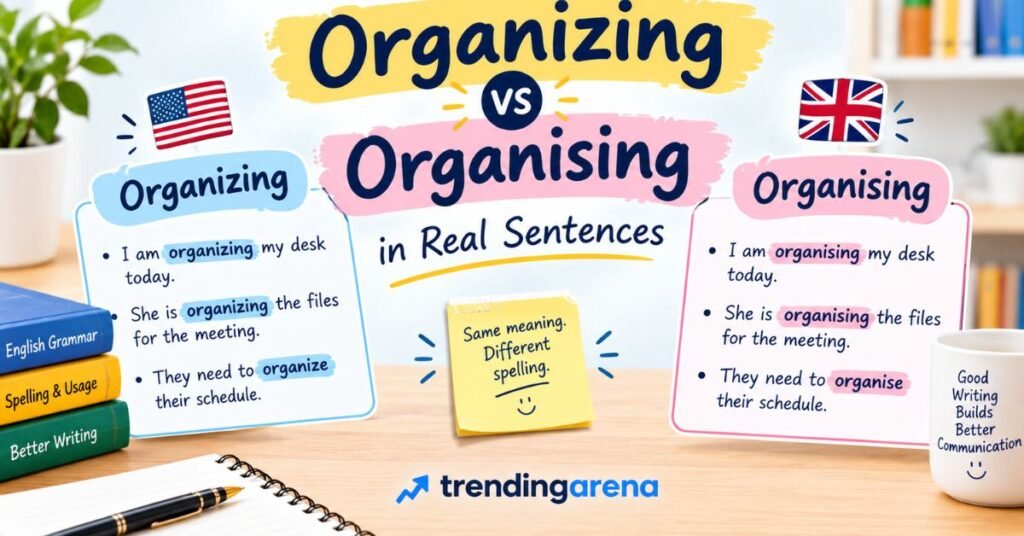
Seeing the word in context makes the pattern easier to remember. Here are the same sentences written in each variant.
American / Canadian English
- “I spent the weekend organizing my garage.”
- “She is organizing a neighborhood cleanup for Saturday.”
- “The organization hired a new event organizer.”
- “His desk is always disorganized.”
- “We are reorganizing the sales team next quarter.”
British, Australian, and similar English
- “I spent the weekend organising my garage.”
- “She is organising a neighbourhood clean-up for Saturday.”
- “The organisation hired a new event organiser.”
- “His desk is always disorganised.”
- “We are reorganising the sales team next quarter.”
Notice that the -ise version of “neighborhood” also becomes “neighbourhood”. That is not a coincidence. A British-style document will usually have both changes, and an American-style document will have neither.

Related Terms You Might Mix Up
People searching for this spelling question sometimes confuse a few nearby terms, so here is a quick clarification.
- Organizer vs organiser: Same person or tool, different region. A “wedding organizer” in the US is a “wedding organiser” in the UK.
- Organized vs organised: Both describe something in order. “Organized crime” (US) is “organised crime” (UK).
- Organization vs organisation: The noun for a group or the act of arranging. Usually the most visible form in business writing.
- Organizational vs organisational: The adjective, as in “organizational skills” or “organisational culture”.
- Organise yourself vs get organized: Both are fine; the second is more common in American speech and writing.
Tips for Staying Consistent in Your Writing
Here are some practical habits that make this much easier, especially if you write often or work with a team.
- Set your language variant first. In your word processor, choose English (US), English (UK), English (Canada), or English (Australia) before you start typing.
- Create a mini style note. For a team or a website, write down a few lines such as “We use American spelling: organize, color, center.” It prevents long debates later.
- Run a search before publishing. Do a quick find for “ise” and “ize” to catch stray variants. Remember the exceptions like advise and surprise.
- Check pasted content. Text pulled from other sources may follow a different spelling. Review it after pasting.
- Proofread with the audience in mind. Reading your text as if you were your reader helps you catch details that feel off.
- Keep a running list for clients. If you work with writers or freelancers, share which variant to use up front. That saves editing time later.
Easy Ways to Remember the Difference
If you want a quick mental shortcut, these may help:
- Z for the Americas. Both the United States and Canada use z, which is a handy way to remember the organizing pattern.
- S for the rest of the Commonwealth. The UK, Australia, New Zealand, India, and South Africa generally use s.
- Match your other words. If you use color, use organize. If you use colour, lean toward organise.
- Check the first sentence. Whichever you type first sets the tone for the whole document. Scroll back and keep it consistent.
None of these are perfect, because Canada and Oxford spelling are exceptions to any simple rule. They are meant as memory aids, not strict laws.
So, Which One Is Right in 2026?
Both. The question is not which spelling is correct, but which one fits your audience and context. The best choice is the one that your readers expect, and that you apply consistently.
Language conventions keep evolving, and online content moves across borders faster than ever. American spelling appears widely in international software, apps, and platforms, which has made -ize more familiar to readers everywhere. At the same time, British and Commonwealth readers continue to use -ise in their own publishing, education, and government writing. Neither pattern is going away, and there is no sign that one will replace the other.
FAQ
Is it organizing or organising?
Both are correct. Organizing (with a z) is standard in American and Canadian English. Organising (with an s) is standard in British, Irish, Australian, New Zealand, Indian, and South African English. Choose the one that matches your audience and use it consistently.
Is “organising” a misspelling in American English?
It is not a misspelling, but it will look unfamiliar to most American readers, and American spellcheckers will usually flag it. If your audience is in the United States, use organizing.
Is “organizing” wrong in British English?
No. Oxford University Press and many British academic publishers use the -ize ending as a deliberate style choice. That said, most British newspapers, government bodies, and general publishers prefer -ise, so organising is the safer default for everyday British writing.
Which spelling does Canada use?
Canada uses organizing. Canadian English follows the -ize pattern but keeps British-style spellings such as colour, centre, and neighbour.
Which spelling is used in Australia and New Zealand?
Both countries typically use organising, following the British pattern.
Which spelling is used in India?
Indian English generally follows British conventions, so organising is common. You will also see organizing online, especially on international websites and in software, so check the style guide of the publication you are writing for.
Do organizing and organising mean the same thing?
Yes. The meaning, pronunciation, and grammar are identical. Only the spelling differs.
What is the correct spelling of organization?
Organization is the American and Canadian spelling. Organisation is the British and Commonwealth spelling. The same rule applies to organizer/organiser, organized/organised, and organizational/organisational.
Does the spelling affect SEO?
Search engines generally understand that the two spellings refer to the same thing, so neither is a hard barrier. However, people in different countries tend to search with their local spelling. Matching your main audience’s spelling in your title, headings, and opening paragraph feels more natural to readers, and keyword research tools can show you the search volume for each variant by country. Avoid repeating both spellings together in the same text.
Should I use both spellings on one page to catch more searches?
No. Using both usually reads awkwardly and rarely helps. Pick one spelling for your primary audience and apply it throughout. If you serve several countries, consider separate regional versions of your content.
Can I mix -ize and -ise in the same document?
You should not. Mixing them looks inconsistent. The one exception is official names, such as the World Health Organization (with a z) or the Organisation for Economic Co-operation and Development (with an s), which keep their own spelling regardless of your style.
Do all words ending in -ise change to -ize in American English?
No. Words like advise, surprise, exercise, revise, supervise, compromise, and enterprise end in -ise in both American and British English. Only verbs that are true -ize/-ise variants, such as organize, realize, and recognize, change with the region.
Which spelling should I use on a global website?
Choose the variant that matches your largest audience (your analytics will show this), then apply it consistently across the whole site. If you have no clear primary audience, either is acceptable as long as you stay consistent.
How do I set my spellchecker to the right version?
In Microsoft Word, Google Docs, and most other editors, set the proofing language to English (US), English (UK), English (Canada), or English (Australia). This stops autocorrect from silently switching your spelling.
Which spelling is more professional or formal?
Neither. Both are standard and equally formal. What matters is consistency and matching your readers’ expectations.
Conclusion
The choice between organizing and organising is a matter of regional convention, not correctness. Here is everything you need to remember:
- Organizing (with z) is standard in the United States and Canada.
- Organising (with s) is standard in the United Kingdom, Ireland, Australia, New Zealand, India, South Africa, and many other places.
- Oxford spelling uses -ize with British spellings elsewhere, common in academic publishing.
- Consistency matters most. Use the same pattern across organize, organizer, organization, and every related word.
- Some -ise words never change, including advise, surprise, exercise, and revise.
- Official names stay as written, so always copy a proper noun exactly.
- For SEO, match your main audience’s spelling and avoid stuffing both versions into one page.