


You are typing an invoice, a market flyer, or a purchase order, and you stop on one word. Is it vender or vendor? Both look right. Both get read the same way. One of them might make a client or editor pause.
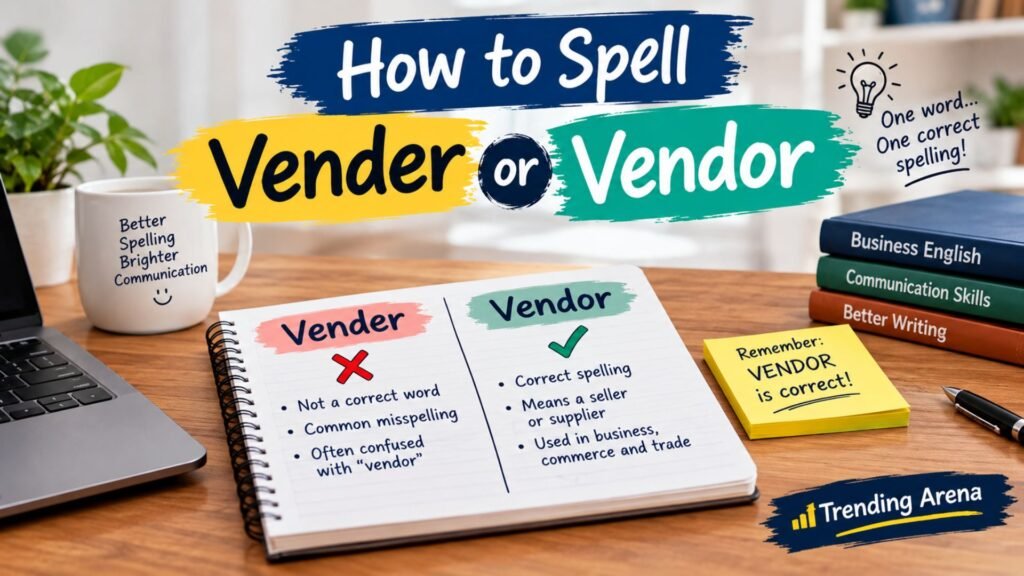
Here is the short version. Vendor is the standard spelling in modern English. Vender is a real but much less common variant that major dictionaries list as an alternative form. If you want the safe choice for business, legal, academic, or everyday writing, pick vendor and move on.
This guide goes further than that. You will see why the two spellings exist, where each one came from, how they behave in the US and the UK, which mistakes to watch for, and how to decide in a few seconds the next time the question comes up.
Quick Answer
Vendor is the correct spelling for almost every situation. Vender is an accepted but uncommon variant with the same meaning.
Both words describe a person or business that sells something. Merriam-Webster lists vendor as the main entry and gives vender as a less common variant. The Online Etymology Dictionary traces both forms to the 1590s and notes that vendor is the more common choice in legal writing.
Here is what that means in practice:
- Use vendor in contracts, emails, résumés, reports, websites, and anything a stranger will read.
- Treat vender as a spelling you will recognize in older books, some newspapers, and casual writing, but not one you need to produce.
- Do not use either spelling for the machine that dispenses snacks. That is a vending machine.
Why People Confuse Them

The confusion is not a sign of bad spelling. It comes from how English handles words that end in an unstressed vowel sound.
Say the word out loud: VEN-der. The last syllable is weak. Your mouth makes the same soft sound whether the letters are -er or -or. English has hundreds of words like this, and the spelling has to be memorized because the sound gives no clue.
Three things make this pair especially slippery.
First, the verb it comes from is vend. Words built from a verb often take -er, as in teacher, driver, or baker. So vender feels like the logical result of vend plus -er. That reasoning is exactly how the variant spelling appeared in the first place.
Second, English borrowed many sellers and buyers from legal French. Words in that family often end in -or: grantor, lessor, mortgagor, vendor. The -or ending signals a formal, transactional role, which is why vendor sits comfortably in contracts.
Third, spell checkers do not always object. Some tools accept both. Others quietly flag vender. Since the red underline does not appear every time, people assume both are equal.
A fourth reason is language overlap. In Spanish and Portuguese, vender is the ordinary verb meaning to sell. Writers who speak either language may reach for that shape without noticing. In English, though, vender is a noun, never a verb.
Is Vender Ever Correct Today?
Yes, but with limits.
Vender is not a typo. Dictionaries including Merriam-Webster, American Heritage, and Collins record it. Wiktionary labels it an alternative spelling of vendor. It has been in use since roughly the same period as vendor, and older literature uses it often. Wordnik’s collection of historical citations includes vender in the sense of a seller in a market, a street, or a shop.
Still, correct and advisable are not the same thing. Three practical points matter.
- It reads as dated or unusual. Many readers will assume you made a mistake, even if a dictionary supports you.
- It is weak in professional settings. Procurement teams, legal departments, and accounting software almost always use vendor. Your document will look more consistent if you match them.
- It splits your keywords. On a website, a page that says “vendor management” will rank and read better than one that says “vender management,” because that is what people actually type into search boxes.
A few writers and publications choose vender on purpose, usually for house-style reasons or because they like the agent-noun pattern. If you work for one of them, follow the style guide. Otherwise, stay with vendor.
How to Spell Vender or Vendor
If you want a reliable way to remember it, use one of these.
The -or trick. Think of the legal pair vendor and vendee. The seller is the vendor, and the buyer is the vendee. Both belong to the same family of contract words, so the seller takes the formal ending.
The OR means “or business” trick. Vendor ends in OR, and a vendor is often a company or organization. It is a slightly silly cue, but it sticks.
The search-box test. Type the word into a search engine. If it suggests a correction, you will see which spelling most people expect.
The company test. Look at the invoice or website of any large business that sells to other businesses. You will see “vendor portal,” “vendor agreement,” and “approved vendor list.” You will almost never see the other spelling.
Plural and related forms follow the same pattern:
| Form | Standard spelling | Rare variant |
| Singular | vendor | vender |
| Plural | vendors | venders |
| Possessive | vendor’s | vender’s |
| Related verb | vend | none |
| Related noun (selling) | vending | none |
Key Differences At A Glance
Because both spellings mean the same thing, the real differences are about frequency, tone, and setting. This table gives you the practical picture.
| Feature | Vendor | Vender |
| Status | Standard, preferred spelling | Accepted variant |
| Frequency | Very common | Uncommon |
| Meaning | A person or business that sells | The same |
| Tone | Neutral to formal | Slightly old-fashioned or informal |
| Legal writing | Strongly favored | Rarely used |
| Business and tech | Default term | Very rare |
| Search visibility | High | Low |
| Spell checker | Accepted | Sometimes flagged |
| Safe in a contract | Yes | Not recommended |
The pattern is clear. The two words do not mean different things. One spelling simply won the popularity contest.
Are They the Same Word?
Yes. Vender and vendor are two spellings of one English noun. They share the same pronunciation, the same definition, the same origin, and the same dictionary entry in most references.
The confusion comes from people treating them like a pair of near-synonyms, similar to affect and effect or principal and principle. Those pairs do differ in meaning. This one does not. There is no sentence where vendor is correct and vender means something else.
That makes this question easier than many spelling dilemmas. You do not have to analyze context or grammar. You only have to choose a spelling and stay consistent.
There is one small wrinkle. Some dictionaries record two senses of the word:
- A person or company that sells goods or services.
- A machine that dispenses items for money, as in a vending machine.
The second sense is real, but it is not how most people speak or write today. Say vending machine instead, and the ambiguity disappears.
Another related distinction deserves a mention. In everyday business writing, vendor is often used interchangeably with supplier, though some teams separate them. A common convention treats the vendor as the seller who delivers a finished product or service, and the supplier as the source of raw materials or components further back in the chain. Others use both words for the same relationship. If precision matters in your contract, define the term in the document.
Also Read This Babys or Babies? Correct Spelling and Plural Rules
US vs UK Preference
Both American and British English accept vendor as the standard form. You will not find a case where vender is the “British” spelling and vendor the “American” one. The usual regional differences, such as color and colour or center and centre, do not apply here.
What does differ is usage by field.
In American English, vendor appears constantly in retail, event planning, food service, and technology. Phrases like street vendor, food vendor, vendor booth, and software vendor are everyday vocabulary. Merriam-Webster and Dictionary.com both present vendor as the main entry.
In British English, vendor is also standard, and it has an especially strong place in property law. When a house changes hands, the seller is the vendor and the buyer is the purchaser. Estate agents and solicitors use these terms daily. Outside property, British writers often say seller, stallholder, or trader for the same idea, depending on the situation, but vendor remains understood and correct.
In international business English, vendor is the default. Global companies, software firms, and procurement platforms use it across regions, so a single consistent spelling avoids confusion for readers in different countries.
The takeaway: you do not need to think about region. Choose vendor and it will be right on both sides of the Atlantic.
Which Spelling Should You Use?
Use this short decision list.
- Writing for work, school, or publication? Use vendor.
- Writing a contract, invoice, or legal notice? Use vendor.
- Writing for a website you want people to find? Use vendor, because it matches what searchers type.
- Quoting an older text that uses vender? Keep the original spelling inside the quotation.
- Following a style guide that prefers vender? Follow the guide and stay consistent.
- Not sure? Use vendor.
Consistency matters as much as choice. If a document uses vendor in the first paragraph and vender in the fifth, readers will assume one of them is an error. Pick one and apply it throughout, including headings, captions, and file names.
Where the Word Vendor Actually Comes From

The story starts with Latin. The verb vendere meant to sell. It was itself a contraction of an older phrase, venumdare, which combined venum (for sale) with dare (to give). In plain terms, to sell was originally to give something up for sale.
From vendere came the Latin agent noun venditor, meaning seller. That word passed into French. In the Anglo-French of medieval and Renaissance legal and commercial documents, the seller appeared as vendour or vendur, built on the verb vendre plus the agent ending -our.
English picked up the word in the late sixteenth century. Merriam-Webster dates the first known use of vendor to 1594. Dictionary.com places the borrowing slightly earlier, in the span of 1585 to 1595. The Online Etymology Dictionary traces vender to the 1590s as well, describing it as an agent noun formed from the English verb vend.
That detail explains why both spellings exist. Vendor arrived through French and legal channels, carrying the -or ending of formal transaction words. Vender arose when English speakers built the noun directly from the English verb vend, adding the familiar -er. Two routes, one meaning, and eventually one winner.
The verb itself is a bit younger. Etymonline records vend in the 1620s with the sense of being disposed of by sale, and in the 1650s as a transitive verb meaning to dispose of by sale. The term vending machine is recorded from 1889, which helps explain why the machine sense of the word attached itself to selling gear so easily.
Over the centuries, the legal world kept vendor as its preferred form. Etymonline notes it has been more common in legal use than vender, and American Heritage says the same. Business English followed the law, then technology followed business, and today vendor dominates almost every context.
When One Spelling Looks Wrong
Sometimes you will notice one spelling and feel instantly that it is off. That feeling is useful. Here is why it happens.
Vender looks wrong to most readers because they have seen vendor far more often. Reading is pattern recognition. Your brain stores the common spelling, and anything that deviates feels like an error even when it is technically allowed.
Vendor can look wrong to people who learned the verb first. If you think of vend as the base and add -er the way you do with teach and teacher, vendor seems like an odd exception. It is not odd, though. It belongs to the -or family of legal and commercial nouns.
Spell checkers can reinforce the doubt. One tool may accept both, another may highlight vender. If you see inconsistent signals, trust the dictionary and the spelling most professional writers use.
What should you do when something looks wrong?
- Check a current dictionary entry for the headword. Vendor is the main entry in major references.
- Search your own document or website for the other spelling and unify it.
- Check your organization’s style guide, if one exists.
- When it is a quotation, a trademark, or a proper name, preserve the original form.
Common Mistakes (and Quick Fixes)
These errors appear often in real writing. Each has a simple repair.
| Mistake | Why it happens | Quick fix |
| “Vender” in a business email | Built from vend plus -er | Use vendor |
| “Vender machine” | Confusing the seller with the device | Say vending machine |
| Mixing both spellings in one document | Autocorrect or copy and paste | Search and replace to one form |
| “Vendar” | Weak vowel sound in the last syllable | Remember the -or ending |
| Using vender as a verb in English | Carrying over from Spanish or Portuguese | Use sell or vend |
| “Vendor’s” vs “vendors” mix-ups | Apostrophe confusion | Use vendor’s for possession, vendors for plural |
| Treating vendor and vendee as the same | Similar spelling | Vendor sells, vendee buys |
| “Venders” in the plural on a site | Variant plural | Use vendors |
A few of these deserve a closer look.
The vending machine slip. People say “vender machine” because they picture the machine as a seller. Both words share a root, but the established phrase is vending machine, and anything else will look like a mistake in print.
The Spanish and Portuguese carryover. In those languages, vender is the verb to sell. English writers who also speak them sometimes write “I want to vender my car.” In English, that is wrong. Use “I want to sell my car.”
The apostrophe problem. A vendor’s stall belongs to one vendor. The vendors’ stalls belong to several. The vendors are setting up simply refers to more than one seller. Keep possession and plural apart.
The contract risk. In legal drafting, a single inconsistent term can raise questions about whether two parties are being described. If your agreement defines “Vendor” with a capital V, use the same form every time.
Everyday Examples
Seeing the word in context helps more than a rule. Here are realistic situations.
At a farmers market. A fruit vendor sets up a stand at dawn. Customers ask about prices. The market manager keeps a list of approved vendors so every stall has a permit.
At a street festival. Food vendors line the sidewalk. A street vendor sells roasted corn from a cart. The organizers collect a booth fee from each vendor before the weekend begins.
In an office. Procurement asks the team to compare three software vendors before renewing a license. The accounting department sets up a vendor account so invoices can be paid. A vendor portal tracks every open purchase order.
In a house sale. The vendor, meaning the seller of the property, signs the contract. The purchaser pays a deposit. The solicitor confirms that the vendor has legal title.
On a website. An online marketplace lets third-party vendors list their goods. Customers can filter by vendor, read vendor ratings, and message a vendor directly.
In a factory. A manufacturing plant relies on a small number of vendors for parts. The quality team audits each vendor once a year.
In a casual sentence. “The coffee vendor outside the station knows my order by now.”
Notice that none of these examples would improve with the other spelling. That is how settled the standard form has become.
Dictionary-Style Word Details

This section collects the formal details you might expect from a dictionary entry, in one place.
Headword: vendor Variant spelling: vender Pronunciation: VEN-dur (the second syllable is weak; a few speakers stress it as ven-DOR in the legal sense) Part of speech: noun, with a rare technical verb use Plural: vendors
Verb
In general English, there is no verb spelled vender. The related verb is vend, meaning to sell, especially in small quantities or through a machine, and also in formal legal contexts. Its forms are vend, vends, vended, and vending.
There is also a specialized verb use of vendor in software engineering. In that field, to vendor means to bundle a project’s dependencies directly into its own source, so that the program carries its own copy of them. You will see “vendoring” in developer documentation. Outside programming, this use is rare, and you should not apply it in ordinary writing.
Noun
Vendor is a countable noun with a few related senses.
- A person or business that sells goods or services. This is the main meaning, covering everyone from a hot dog seller on a corner to a global software company.
- A seller of property, especially real estate. This sense is strong in law and in British usage, where the buyer is the purchaser.
- A machine that dispenses goods for payment. This sense is recorded in some dictionaries but is rarely used now. Vending machine is the clear choice.
Synonyms
Choosing the right synonym depends on the setting. This table shows how they differ.
| Synonym | Best used when |
| Seller | You want the plainest, most general word |
| Merchant | The sale is part of a trade or business, often a formal one |
| Retailer | The seller deals directly with consumers in a shop or online |
| Wholesaler | The seller supplies goods in bulk to other businesses |
| Supplier | The seller provides materials or components to a business |
| Trader | Buying and selling is the person’s regular activity |
| Dealer | The seller specializes in a category, such as cars or antiques |
| Hawker | A street seller who calls out to customers |
| Stallholder | A seller who runs a market stall, common in British English |
| Provider | The business offers a service rather than a physical product |
| Contractor | The seller performs work under an agreement |
Related terms from the buying side include buyer, purchaser, customer, and vendee.
Example Sentences
Each sentence below uses vendor in a different setting.
- The street vendor handed me a paper cone of roasted chestnuts.
- We asked three software vendors to demonstrate their products before choosing one.
- Every vendor must submit a tax form before receiving payment.
- The vendor agreed to repair the fence before the sale closed.
- Local vendors filled the plaza with handmade soap, candles, and woven baskets.
- Our vendor management policy requires an annual review of every supplier contract.
- The festival lost two food vendors after the storm and found replacements by noon.
- She switched vendors when the delivery times kept slipping.
- The vendor’s price included installation and a two-year warranty.
- A reliable vendor answers questions before the sale, not only after it.
Word History
The core facts, in order:
- Latin venum dare meant to give for sale.
- This contracted to vendere, to sell.
- The agent noun venditor meant seller.
- Anglo-French produced vendour and vendur.
- English adopted vendor in the late 1500s, with Merriam-Webster giving 1594 as the first known use.
- English also built vender from the verb vend in the same period.
- Vending machine appeared in 1889.
- Over time, law, commerce, and technology settled on vendor.
Phrases Containing Vendor
Common collocations and set phrases you are likely to meet:
- street vendor
- food vendor
- market vendor
- ice cream vendor
- newspaper vendor
- software vendor
- hardware vendor
- cloud vendor
- third-party vendor
- approved vendor
- preferred vendor
- authorized vendor
- independent vendor
- vendor management
- vendor agreement
- vendor contract
- vendor invoice
- vendor portal
- vendor lock-in
- vendor neutral
- vendor onboarding
- vendor risk assessment
- vendor selection
- vendor stall
- vendor booth
Two of these deserve a short explanation. Vendor lock-in describes a situation where switching away from a supplier is so costly or difficult that a customer feels stuck. Vendor neutral describes a standard, tool, or recommendation that does not favor any particular seller.
FAQs
Is it vender or vendor?
Vendor is the standard spelling and the one to use in almost every situation. Vender is a less common variant listed in major dictionaries.
Is vender a real word?
Yes. Vender is recorded as an alternative spelling of vendor in dictionaries such as Merriam-Webster and Wiktionary. It is not a typo, but it is uncommon and can look like a mistake to many readers.
Do vender and vendor mean the same thing?
Yes. Both mean a person or business that sells goods or services. The meaning, pronunciation, and origin are identical. Only the spelling differs.
Which spelling is correct in American English?
Vendor. American dictionaries list it as the main entry and treat vender as a variant.
Which spelling is correct in British English?
Vendor again. It is also the standard term in British property law, where the seller of a house is the vendor and the buyer is the purchaser.
Which spelling should I use in a contract or business document?
Use vendor. It is the established term in contracts, procurement systems, and accounting software. Define it once and keep it consistent throughout the document.
What is the difference between a vendor and a supplier?
Many people use them interchangeably. Where teams separate them, a vendor usually sells finished products or services, while a supplier provides raw materials or components. If the distinction matters, define it in your agreement.
Is it “vender machine” or “vending machine”?
Vending machine. That is the established phrase for a machine that dispenses items for payment.
Is vender a verb?
Not in English. The verb is vend, as in “they vend snacks.” In Spanish and Portuguese, vender is the verb meaning to sell, which is a common source of mix-ups.
What is the plural of vendor?
Vendors. The possessive is vendor’s for one seller and vendors’ for several.
Where does the word vendor come from?
It comes from Anglo-French vendour, which came from Latin venditor, meaning seller, built on vendere, to sell. Merriam-Webster dates the first known English use to 1594.
What does vendor lock-in mean?
It describes a situation where switching away from a seller is so costly or difficult that a customer feels stuck with that seller.
Conclusion
The vender versus vendor question has a clean answer. They are two spellings of the same word, and vendor is the one to use. It is the main entry in major dictionaries, the form that fills contracts and procurement systems, and the spelling readers expect in both American and British English.
Vender is not an error in the strict sense. It has a long history and a place in dictionaries as an accepted variant. But it is uncommon today, it can look like a slip to many readers, and it offers no benefit that vendor does not already provide.
To keep it simple, remember four things:
- Choose vendor for work, school, legal, and web writing.
- Keep the spelling consistent within a document.
- Say vending machine when you mean the machine.
- Do not use vender as a verb in English. Use sell or vend.