
You are typing a message about your team lineup, or maybe a coffee shop review, and you pause. Is it roster or roaster? The two words look alike, sound close, and share a common ancestor. Yet they mean very different things.
This guide gives you the answer fast, then goes deeper. You will learn where each word came from, how each one works in a sentence, which mistakes people make most often, and how to remember the difference for good.
Quick Answer: Roster or Roaster?
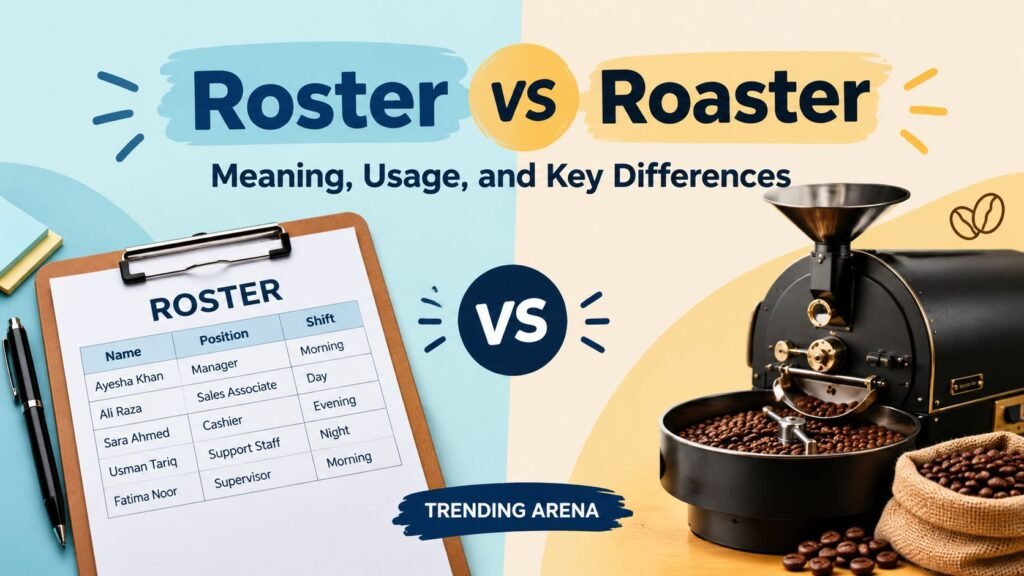
A roster is a list of names. It usually shows the members of a team, the staff on a shift, or the people assigned to a duty.
A roaster is a person, a machine, or a pan that roasts something. It can also be a chicken sold for roasting, or a person who makes jokes at a comedy roast.
The simple test:

- If it is a list of people, write roster.
- If it cooks, heats, or jokes, write roaster.
| Word | Core meaning | Quick example |
| Roster | A list of people, often with duties or turns | “She made the team roster.” |
| Roaster | A person, device, or pan that roasts | “He bought a new coffee roaster.” |
That is the whole difference in two lines. The rest of this article explains why, so you never have to guess again.
The Origin of Roster and Roaster
These two words are not strangers. They grew from the same root, and that shared history explains why they look so similar.
Where “Roast” Comes From
The verb roast entered English in the late 1200s. It came through Old French rostir, meaning to roast or burn. That French word traces back to a Frankish form related to German rösten and Middle Dutch roosten. Originally, it described cooking food on a grate or gridiron.
Over time, English speakers added new meanings. By the early 1300s, roast could describe being exposed to great heat. By 1724, it was used for coffee beans. And by 1710, it meant to tease someone in a humorous way for the amusement of a group.
How “Roaster” Was Born
Roaster is the easy one. It is simply roast plus the suffix -er, the same ending that turns bake into baker and paint into painter. It appears in English around the mid-1400s, first for a person who roasts meat. Later it described cooking equipment. The oven sense is recorded from 1799. The sense of an animal or food suited to roasting goes back to the 1680s.
How “Roster” Took a Different Road
Roster followed a stranger path. English borrowed it from Dutch around 1727. In Dutch, rooster meant a gridiron, and it also came to mean a table or list.
Why would a cooking grate become a list? The most accepted explanation is visual. A gridiron has parallel bars. A ruled sheet of paper, used to write out names and duties, looks like those bars. People started using the cooking word for the paper.
In English, roster first appeared in a military setting. It described a list showing who was due for duty and in what order. By 1858 it showed up in police language. By 1881 it had broadened to mean any list of names, whether or not turns of duty were involved.
So here is the neat twist. A modern team roster is, at the deepest level of word history, a cousin of the barbecue grill. Both roster and roaster come back to the idea of roasting on a grate.
There is also a small curiosity. Wiktionary notes that roster was once used, rarely, in Late Middle English as a variant of roaster. That old overlap is long gone, but it shows how close the two words have always been.
British English vs American English: Spelling and Usage
Here is something worth stating clearly. There is no British spelling and American spelling of these words. Both countries spell them roster and roaster. Unlike colour and color, you will not find a regional split in the letters.
The differences are in how the words are used and pronounced.
Pronunciation Differences
| Word | Typical American sound | Typical British sound |
| Roster | RAH-ster or ROH-ster | ROSS-ter |
| Roaster | ROH-ster | ROH-ster |
Merriam-Webster lists more than one pronunciation for roster in American English, including versions that start with the “ah,” “aw,” or “oh” sound. This is exactly why people confuse the words. When someone says roster with a long “o,” it sounds almost identical to roaster. In speech, you cannot always tell them apart without context.
British speakers typically say roster with a short “o” sound, like the first sound in rocket. That makes the two words sound further apart in British English than in some American accents.
Alright Meaning in Text: Definition, Usage, and Real-Life Chat Examples
Usage Differences
Roster has a few regional habits:
- In the United States, roster is strongly tied to sports. Players on a team, students in a class, and employees on a payroll are all said to be on a roster.
- In the United Kingdom, Australia, and New Zealand, roster is also very common for work schedules. A hospital might publish a nursing roster. A café might post a weekend roster. The word rota is a popular British alternative.
- As a verb, British and Australian writing uses to roster and rostering more often, as in “She was rostered on for the night shift.”
Roaster has its own regional note. Britannica’s learner dictionary marks the “young chicken suitable for roasting” meaning as chiefly American. In British shops, you are more likely to see the term roasting chicken or just chicken on the label.
Roster Meaning in Detail
Now let us look at each word on its own. Start with roster.
Core Definition
According to Merriam-Webster, a roster is a roll or list of personnel. It can also be a list that shows the order in which a duty is to be performed. In a wider sense, it is any itemized list.
Dictionary.com describes it in much the same way. It is a list of persons or groups, and in its broadest meaning, any list, roll, or register. It notes that the word is most commonly used for the official list of players on a sports team.
The Main Meanings of Roster
- A team list. The players who belong to a sports team or squad.
- A duty schedule. A chart showing who works when, such as a staff or shift roster.
- A group of people or things. A roster of speakers, clients, products, or projects.
- A class or membership list. Names of students in a course or members of a club.
Roster as a Verb
Roster also works as a verb, especially in British and Australian English.
- Present: They roster volunteers each weekend.
- Past: She was rostered on for Friday.
- Continuous: The manager is rostering extra staff for the holiday.
The noun forms include rosters (plural) and the activity noun rostering.
Related Terms and Synonyms
If you want to avoid repeating the word, here are close alternatives:
- List
- Roll
- Register
- Lineup
- Squad
- Panel
- Slate
- Rota
- Schedule
- Directory
- Staff list
- Personnel list
Not every synonym fits every case. A lineup usually means the players on the field right now, while a roster is the whole group under contract. A rota stresses rotating turns. A schedule is about times rather than people.
Roaster Meaning in Detail
Next, roaster. This word has a wider spread of meanings, which is one reason it deserves careful attention.
Core Definition
Vocabulary.com lists four senses. A roaster can be a cook who roasts food, a special cooking pan for roasting, the flesh of a large young chicken suitable for roasting, or a harsh or humorous critic. Dictionary.com adds the guest speaker at a roast, and even the astronomy term hot Jupiter.
The Main Meanings of Roaster
- A person who roasts. A coffee roaster, a nut roaster, or a chef who prepares roasted meats.
- A machine or appliance. Coffee roasters, electric roasters, and commercial nut roasters all fit here.
- A roasting pan. A large covered or open pan for the oven.
- A chicken or other food for roasting. In North America, a roaster is a larger bird, usually older than a broiler or fryer.
- A comedy roaster. Someone who delivers jokes at a roast event.
- A hot Jupiter. A technical term used in astronomy for a large gas planet very close to its star. This is the rarest sense and mostly shows up in science writing.
Coffee: The Most Common Modern Use
If you search the word online today, much of what you see relates to coffee. A coffee roaster may be a person who prepares the beans, a business that sells them, or the machine that does the work. News stories about the coffee trade regularly use the word in all three ways. You will see it in headlines about prices, tariffs, and local shops.
That popularity matters for writers. When a sentence mentions beans, cafés, or brewing, roaster is almost always the right word.
Usage Comparison: Roster vs Roaster
Seeing both words side by side makes the choice easier. Here is a practical breakdown.
| Feature | Roster | Roaster |
| Part of speech | Noun and verb | Noun |
| Core idea | A list of people or duties | One who or that which roasts |
| Typical setting | Sports, work, school, military | Kitchen, coffee shop, comedy event |
| First English use | 1727 | Mid-1400s |
| Origin | Dutch rooster | English roast + -er |
| Number of syllables | Two | Two |
| Plural | Rosters | Roasters |
| Verb forms | Rostered, rostering | None |
| Related words | Rota, lineup, register | Oven, grill, roast |
| Can it be a person? | Only as a listed member | Yes, one who roasts |
How to Choose in Seconds
Ask yourself two questions:
- Is this about names or turns? Choose roster.
- Is this about heat, beans, a pan, or jokes? Choose roaster.
If both questions seem to apply, rethink the sentence. For example, “The coffee shop posted its weekend roaster” mixes the ideas. You mean a schedule of staff, so the word is roster. A different sentence, “The coffee shop installed a new weekend roaster,” would be about a machine.
Key Insight: Same Roots, Different Jobs
The central lesson is simple. Roster and roaster are cousins, not twins. Both descend from the idea of roasting on a grate. But English gave each one a separate task.
- Roaster stayed close to its cooking roots. It describes the one who roasts or the tool that does it.
- Roster moved far away from the kitchen. It became a word for organized lists of people.
Because the first four letters, r-o-s-t, are shared, your eye can slide past the difference. The extra a in roaster is your signal. Whenever you see that a, think of cooking.
Another insight worth remembering: spelling errors involving these words almost always come from sound, not from ignorance. When you say them out loud, they overlap. That is why careful proofreading matters more than memorizing rules.
Comparison Table: All Word Variations
Here is a full reference for every form you may meet.
| Word | Type | Meaning | Example |
| Roster | Noun | A list of people or duties | “The roster has 25 names.” |
| Rosters | Noun (plural) | Several lists | “Both rosters were posted.” |
| Roster | Verb | To place on a list | “They roster staff weekly.” |
| Rostered | Verb (past) | Placed on a list | “He was rostered for Sunday.” |
| Rostering | Verb / noun | The act of making a roster | “Rostering takes hours.” |
| Roaster | Noun | One who or that which roasts | “The roaster is hot.” |
| Roasters | Noun (plural) | Several roasting people or devices | “Local roasters sell fresh beans.” |
| Roast | Verb / noun | To cook with dry heat; a meat joint; a comedy event | “We roast peppers.” |
| Roasting | Verb / adjective | Cooking with heat; very hot | “It is roasting outside.” |
| Roasted | Adjective / verb | Cooked this way | “Roasted almonds.” |
| Rooster | Noun | An adult male chicken | “The rooster crowed.” |
| Rota | Noun (British) | A rotating duty list | “Check the rota.” |
Notice the last two rows. Rooster is a third lookalike. It means a male chicken, and it has nothing to do with lists. Do not mix it up with roster. Etymonline notes that rooster appeared in American English by the 1800s, and it is a separate word from roster, even though they look alike.
Which Spelling Should You Use?
The answer depends on what you mean, not on where you live. Use this decision guide.
Choose “Roster” When You Mean:
- A sports team’s players
- A list of employees or volunteers
- A schedule showing who works which shift
- A class attendance list
- A directory of approved speakers, vendors, or experts
- The act of assigning people to duties
Choose “Roaster” When You Mean:
- A person who roasts coffee, nuts, or meat
- A roasting oven or machine
- A roasting pan
- A chicken meant for roasting
- A joke-teller at a comedy roast
A Few Tricky Cases
Restaurants and cafés. The word you need depends on the object. A list of staff is a roster. The machine in the back is a roaster.
Sports. Always roster. A “roaster” of players would sound like a team that cooks things.
Comedy. Use roaster for the person delivering the jokes, and roast for the event.
Business writing. Use roster for staff and client lists. Use roaster only if the business actually roasts something.
Common Mistakes with Roster and Roaster (and Quick Fixes)
Here are the errors that show up most often, along with easy corrections.
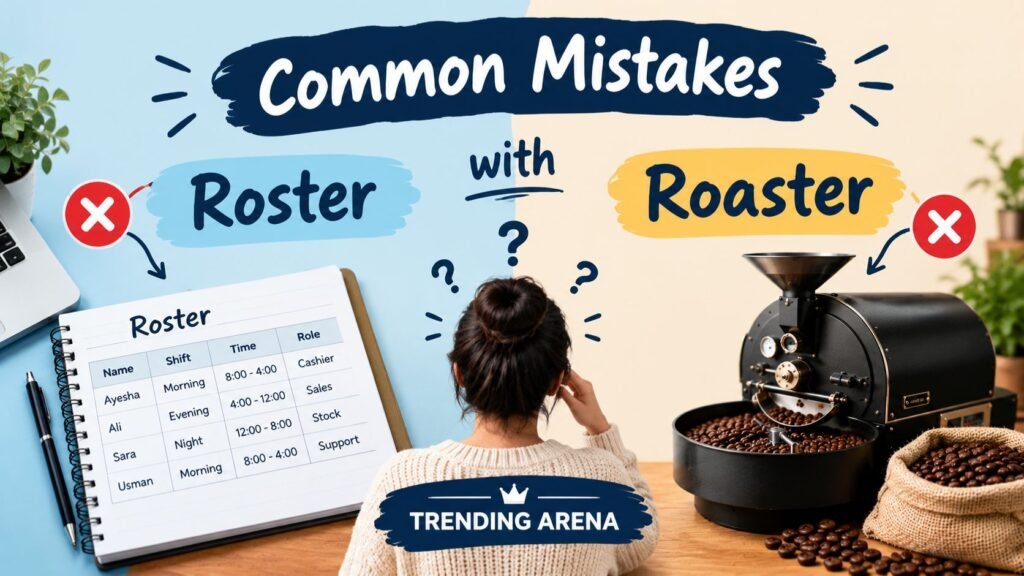
Mistake 1: Using “Roaster” for a Team List
❌ The team announced its final roaster on Friday. ✅ The team announced its final roster on Friday.
Fix: If the sentence is about players, names, or turns, there is no cooking involved. Drop the a.
Mistake 2: Using “Roster” for Kitchen Equipment
❌ We bought a stainless steel roster for the holidays. ✅ We bought a stainless steel roaster for the holidays.
Fix: If the item cooks, it has an a.
Mistake 3: Confusing Roster with Rooster
❌ The roster crowed at dawn. ✅ The rooster crowed at dawn.
Fix: A rooster has two o‘s and lives on a farm. A roster has one.
Quick Self-Check Checklist
Before you publish, run through these points:
- Does the sentence mention people, turns, or names? Use roster.
- Does it mention heat, beans, pans, or jokes? Use roaster.
- Does it involve a farm animal? You may need rooster.
- Say the sentence out loud. Does the meaning still make sense?
Everyday Examples
Real sentences teach faster than rules. Here are examples across common settings.
Roster in Sports
- “The coach trimmed the roster to 15 players.”
- “Three new signings joined the roster this week.”
- “He did not make the final roster.”
- “Injuries have thinned the squad’s roster.”
- “Each club must submit its roster before the deadline.”
Roster at Work
- “The manager posted the new staff roster on Monday.”
- “I checked my work roster against my class schedule.”
- “She was rostered on for the early shift.”
- “We rotate the cleaning roster every month.”
- “The hospital uses software to build its nursing roster.”
Roaster in the Kitchen
- “She placed the turkey in the roaster at noon.”
- “An electric roaster frees up oven space.”
- “The recipe calls for a heavy roasting pan.”
- “We bought a roaster chicken for Sunday dinner.”
Roaster in Coffee
- “The local roaster sells beans from three countries.”
- “The café installed a small drum roaster.”
- “A good roaster controls time and temperature closely.”
- “He trained for years to become a master roaster.”
Sentences That Use Both Words
Seeing both together may help the contrast stick.
- “The café’s staff roster lists who works the coffee roaster each morning.”
- “The new roaster joined the team roster as head of production.”
- “Before the comedy night, the host checked the roster of roasters.”
That last one is fun. A roster of roasters is a list of people who will deliver jokes at a roast.
Dictionary-Style Word Details
For reference, here are the standard details for each word, in dictionary format.
Roster
- Pronunciation (US): RAH-ster, also ROH-ster
- Pronunciation (UK): ROSS-ter
- Part of speech: Noun; transitive verb
- Plural: Rosters
- Verb forms: Rosters, rostered, rostering
- Definition 1: A list of people, often showing turns of duty
- Definition 2: The people on such a list
- Definition 3: Any itemized list
- First known use: 1727
- Origin: Dutch rooster, “gridiron, list,” from Middle Dutch roosten, “to roast”
- Synonyms: list, roll, register, lineup, squad, rota, panel, slate
- Collocations: team roster, duty roster, active roster, class roster, roster spot
- Example: “Her name was added to the roster.”
Roaster
- Pronunciation: ROH-ster in both US and UK English
- Part of speech: Noun
- Plural: Roasters
- Definition 1: A person who roasts food or beans
- Definition 2: A device or pan used for roasting
- Definition 3: A chicken or other food suitable for roasting
- Definition 4: A person who delivers jokes at a roast
- Origin: Roast plus -er, from the Old French rostir
- First use: Mid-1400s
- Synonyms: oven, roasting pan, cook, chef, grill
- Collocations: coffee roaster, electric roaster, small-batch roaster, roaster oven
- Example: “The roaster is preheating.”
Usage Patterns and Frequency Data
Since you may be wondering which word people use more, here is what the available evidence suggests. This section sticks to what can be supported rather than guessing at search charts.
What the Dictionaries Show
Pronunciation tools that track word frequency place roaster at a very low rate in general English. One estimate puts it at roughly 0.3 occurrences per million words, which is a C2-level word on the CEFR scale. In plain terms, it is a specialist word that most people meet in cooking and coffee contexts.
Roster, in contrast, shows up constantly in news reporting. Sports coverage alone produces a steady stream of phrases like “active roster,” “roster move,” and “roster cuts.” Merriam-Webster’s own live examples are full of professional sports, college athletics, and even combat sports.
What This Means for Writers
- If you write about sports, work, or events, you will use roster far more often.
- If you write about food, coffee, or home cooking, you will use roaster more often.
- If you write about both, pay special attention. Cafés and restaurants are the places where both words can appear in the same paragraph.
Memory Tricks That Actually Work
Rules are good. Tricks are better. Try these.
Trick 1: The “A” for Appliance
Roaster contains an extra a. Think a for appliance, aroma, or apron. If the thing belongs in a kitchen, it earns the a.
Trick 3: Roast Is Hidden Inside
Look for the word roast inside roaster. You can spot it clearly: roaster. If you cannot find roast inside the word you wrote, you may have picked the wrong one for a cooking sentence.
Trick 4: The “Sign Up” Test
You sign up for a roster. You plug in a roaster. Ask which action fits the sentence.
Trick 5: The Gridiron Link
Remember the shared history. A roster is a list that looks like a grill. A roaster is the grill’s cooking cousin. Both belong to the roasting family, but only one holds names.
Conclusion
Roster and roaster share a family tree but have very different jobs. A roster is a list, usually of people, teams, or duties. It came into English from Dutch in the 1700s, and it has stayed busy ever since in sports, workplaces, and classrooms. A roaster is something or someone that roasts: a coffee professional, an oven, a pan, a chicken, or even a comedian at a roast.
There is no British or American spelling split here. The real differences are in pronunciation and everyday habits. The British and Australian habit of using roster as a verb is one example, and the chiefly American use of roaster for a chicken is another.
When in doubt, remember the simple test. If it is a list of names, write roster. If it heats, cooks, or jokes, write roaster. Add the memory tricks from this guide, read your sentence aloud, and you will get it right every time.