
You are typing a message about a horror movie, a dark alley, or a spooky Halloween costume. Your fingers hesitate. Is it “scary” with one R, or “scarry” with two? It is a tiny spelling question, but it trips up students, writers, and professionals every single day.
The short version is simple. “Scary” is the word you want when something causes fear. “Scarry” does exist, but it is rare, and it almost never means what people think it means.
This guide gives you the answer fast, then goes deeper. You will see where the word comes from, how British and American writers handle it, which spelling rules apply, and why so many people get it wrong. You will also find real-life examples for emails, fiction, social media, and academic writing, plus a clear look at what “scarry” actually is.

Quick Answer
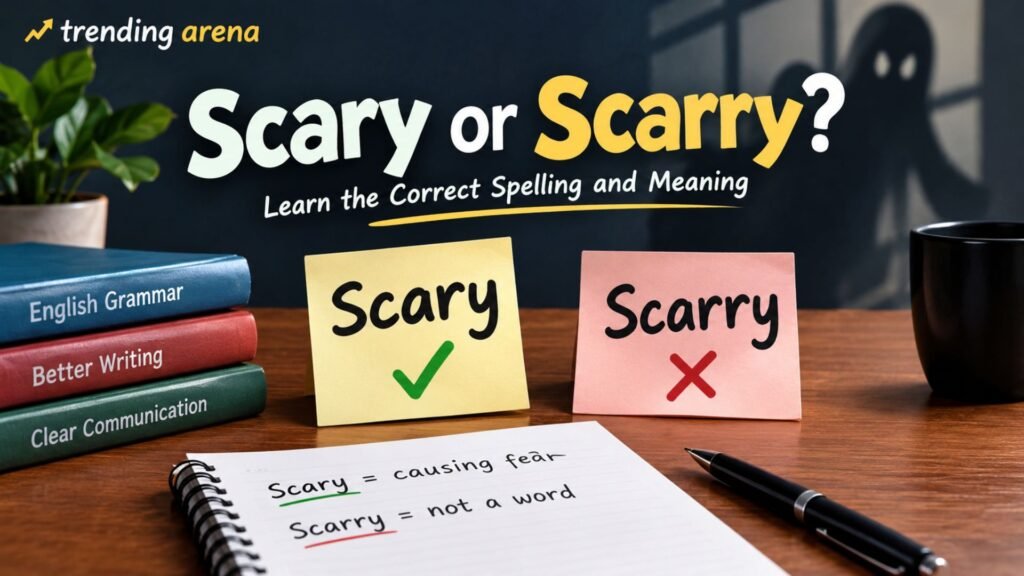
“Scary” is the correct spelling when you mean frightening. It is an adjective. It describes anything that causes fear, alarm, or unease.
“Scarry” is not a spelling variant of “scary.” It is a separate and uncommon word. It is also a surname, best known from the children’s author Richard Scarry.
Here is the fastest way to remember it:
- Scary = scare + y. The “e” drops, and you are left with one R.
- If you can swap in “frightening” and the sentence still works, use scary.
- If you are naming a person called Scarry, keep the double R and capitalize it.
That covers about 99 percent of situations. The rest of this article explains why.
Examples
Seeing the word in context is the quickest way to lock in the right spelling. Each sentence below uses the correct form.
Correct uses of “scary”:
- The haunted house at the end of our street is genuinely scary.
- She told a scary story around the campfire, and nobody slept well.
- Speaking in front of three hundred people felt scary at first.
- That was the scariest roller coaster I have ever ridden.
- It is scary how quickly the weekend disappeared.
Incorrect spellings to avoid:
- The movie was really scarry.
- What a scarry costume!
- He had a scarry moment on the highway.
Correct uses of “Scarry” (the name):
- My daughter loves every Richard Scarry book on the shelf.
- Elaine Scarry wrote about pain and language.
Notice the difference. In the second group, “Scarry” is capitalized and refers to a real person. In the first group, a lowercase “scarry” is simply a typo.
The Origin of Scary vs Scarry
To understand the spelling, it helps to know the family tree.
“Scary” grows out of the verb scare. Scare entered English in the Middle Ages and is linked to Old Norse words meaning to frighten or to shrink back from something. Over time, English speakers attached the friendly “-y” ending to make an adjective, in the same way they made “stormy” from “storm” and “shiny” from “shine.”
Dictionaries do not agree on the exact date the adjective first appeared. Some sources trace it to the late 1700s, while Merriam-Webster lists an earlier first known use. What they all agree on is that the word is long established and fully legitimate. Some old usage guides once frowned on it as too casual, but modern dictionaries treat it as standard English.
“Scary” has also carried two meanings for centuries. One is “causing fear,” as in a scary movie. The other is “easily frightened,” as in a scary horse that spooks at its own shadow. The second sense is rarer today, and it is mostly North American.
“Scarry” has a completely different history. The noun “scar” is the root here, meaning a mark left by a wound. Dictionary.com records “scarry” as an adjective meaning marked with scars, first recorded in the mid-1600s. It also lists a second, older adjective meaning full of steep, rocky places, which dates back to Middle English. These are both real words, but you will almost never meet them in everyday writing.
So the two words share a sound, not a source. One comes from “scare.” The other comes from “scar.”
British English vs American English Spelling
Here is some good news. Unlike “color” and “colour,” this word does not split along the Atlantic. Both British and American writers spell it scary.
The difference lies in the sound, not the spelling.
| Feature | American English | British English |
| Standard spelling | scary | scary |
| Typical pronunciation | SKER-ee | SKAIR-ee |
| Comparative | scarier | scarier |
| Superlative | scariest | scariest |
| Dated variant | scarey (rare) | scarey (rare) |
You may sometimes see “scarey” in older British writing or on informal signs. Wiktionary labels it a dated alternative form, and dictionaries treat it as a variant at best. For modern writing, skip it. “Scary” is accepted everywhere, including formal editing, school exams, and publishing.
The pronunciation also explains part of the confusion. In some American accents, “scary” and “Scarry” sound almost identical, because of a vowel merger that makes “Mary,” “marry,” and “merry” sound alike. That is why Richard Scarry’s surname is pronounced just like “scary,” even though it is spelled differently. Your ear cannot help you here, which means your memory has to.
Comparison Table
Use this quick table as a reference whenever you are unsure.
| Scary | Scarry | |
| Is it standard spelling for “frightening”? | Yes | No |
| Part of speech | Adjective (also informal adverb) | Rare adjective, or proper noun |
| Core meaning | Causing fear or alarm | Marked with scars; or a surname |
| Root word | Scare | Scar |
| Typical use | Movies, stories, daily speech | Names, rare dictionary entries |
| Capitalized? | Only at the start of a sentence | Yes, when it is a surname |
| Safe for formal writing? | Yes | Only as a name |
Spelling Rules for Scary vs Scarry
English spelling can feel random, but this one follows clear patterns. If you learn the rules below, you will not need to guess again.
Rule 1: Drop the silent E before adding Y
When a word ends in a silent “e,” you usually remove it before adding a suffix that starts with a vowel. The “-y” ending counts.
- scare + y = scary
- shade + y = shady
- bone + y = bony
- noise + y = noisy
Because the “e” disappears and nothing doubles, you end up with a single R.
Rule 2: Doubling the final consonant needs a short vowel
The doubling rule applies to short words with a single short vowel before one final consonant. Think of “run” becoming “runny” or “fun” becoming “funny.” But “scare” does not fit this pattern. It ends in a silent “e” and has a long vowel sound, so no doubling happens.
By contrast, “scar” does fit the short-vowel pattern. That is why “scar” plus “y” gives you “scarry.” It is a spelling that follows the rule, but for a different word.
Rule 3: Check the forms
Once you have “scary,” the other forms follow naturally:
- scary (base adjective)
- scarier (comparative)
- scariest (superlative)
- scarily (adverb)
Every form keeps a single R in the middle, followed by “i” or “y.” If you ever type a double R in one of these, you have probably made the same slip.
A simple memory trick
Think of the word “scare.” It has one R. Its adjective, “scary,” keeps that one R. You are simply swapping the “e” for a “y.” That is it.
Why People Misspell Scary as Scarry
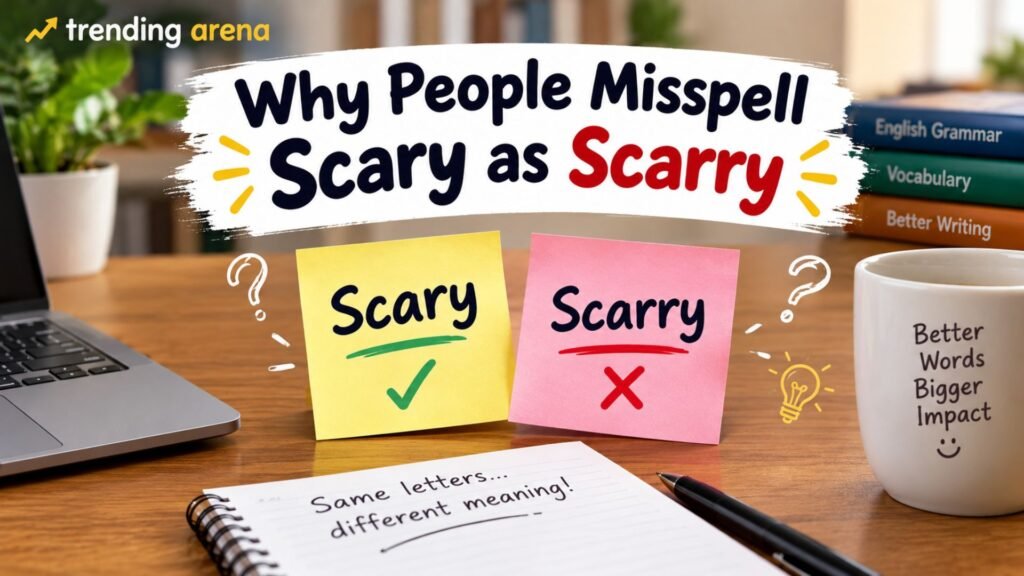
Misspellings are not random. They usually come from understandable habits. Here are the most common reasons people write “scarry.”
The word sounds like it has a double consonant
Many English words with a short vowel sound have a double consonant, like “carry,” “marry,” “hurry,” and “worry.” Your brain has seen that pattern thousands of times, so it expects it here too. When you say “scary” out loud, the middle sounds short and sharp, which feels like a doubled R.
Autocorrect and speed typing
When you type quickly on a phone, a stray extra letter slips in easily. If your keyboard does not flag “scarry,” because it is a real surname and a real, if obscure, word, the error can sail straight through.
Confusion with “scar”
People connect the idea of fear to the sight of a scar, and the two words look similar. Some writers assume a “scarry” movie is one that leaves a mark. The mind makes a guess, and the spelling follows.
The influence of a famous name
Richard Scarry’s books are found in homes, libraries, and classrooms around the world. Children and parents see the double-R spelling often and pronounce it “scary.” That makes the wrong spelling feel familiar, even if the name is unrelated to fear.
Common Mistakes with Scary vs Scarry
Let us look at the errors that show up most often, so you can catch them in your own work.
Mistake 1: Doubling the R in the base word
- Wrong: scarry movie
- Right: scary movie
Mistake 2: Doubling the R in the comparative
- Wrong: scarrier, scarriest
- Right: scarier, scariest
Some dictionaries list “scarrier” and “scarriest” for the obscure adjective “scarry,” which makes this mistake feel even more convincing. But in normal usage, you want “scarier.”
Mistake 3: Adding an extra E
- Wrong: scarey
- Right: scary
This version looks plausible because it echoes “scare.” It is listed as a dated variant, but it is best avoided.
Mistake 4: Mixing up scary, scared, and scaring
These three are related but not interchangeable:
| Word | Meaning | Example |
| Scary | Causes fear | The movie was scary. |
| Scared | Feels fear | I was scared of the dark. |
| Scaring | The act of frightening | You are scaring me. |
A good test: if something makes you afraid, it is scary. If you feel afraid, you are scared. People often write “I am scary of spiders” when they mean “scared.”
Mistake 5: Lowercasing the surname
If you are writing about Richard Scarry, always capitalize it and keep the double R. Writing “richard scary” is a name error, not just a spelling error.
Why People Get Confused
Confusion goes beyond simple typos. Several features of English make this word pair especially slippery.
1. Sound does not match spelling. English has many words that sound alike but are spelled differently. Linguists call these homophones, and in many accents “scary” and “Scarry” fall into that group.
2. Real words hide in plain sight. Because “scarry” is in the dictionary, spellcheckers may not catch it. A typo that happens to be a real word is the hardest kind to notice.
3. Suffix rules are inconsistent. Learners see “scare” become “scary,” but “care” becomes “caring” and “fare” becomes “fairy” in a different pattern. It is easy to mix up which rule applies to which word.
4. Two meanings in one word. “Scary” can describe something frightening or someone timid. When a word has more than one sense, people start doubting its spelling too.
5. Familiar names compete with common words. Names such as Scarry, Carey, and Barry look similar on the page. Our eyes pick up the pattern and suggest the wrong match.
The best fix is to slow down on this single word, apply the silent-E rule, and move on.
Also Read This In Summer or In the Summer? Learn the Difference
Scary in Everyday Examples
Knowing the rule is one thing. Using it naturally is another. Here is how “scary” appears in different kinds of writing, and how tone changes with the setting.
Emails
In professional email, “scary” is casual but acceptable, especially for colleagues you know well. For clients or senior leaders, consider a more formal alternative.
- Casual: “The deadline is a bit scary, but we can make it.”
- Formal: “The deadline is demanding, but achievable.”
- Casual: “That server outage was scary for a minute.”
- Formal: “The server outage caused considerable concern.”
Whichever you choose, double-check the spelling before you hit send. A typo in a subject line is hard to unsee.
Stories / Fiction
In fiction, “scary” works, but strong writers often show fear instead of just naming it. Compare these two:
- Telling: “The basement was scary.”
- Showing: “The basement stairs creaked under each step, and the air smelled of damp stone.”
Use “scary” when a character, especially a child, would naturally say it. It is a simple, honest word, and in dialogue it sounds real.
- “Mom, the dark is scary,” whispered Lily.
- “It’s not that scary,” he said, though his voice shook.
If you write horror, mix “scary” with sharper words like “chilling,” “eerie,” and “sinister” so the vocabulary stays fresh.
Social Media
On social media, “scary” shows up constantly. It appears in captions, comments, hashtags, and reviews, often alongside Halloween content and horror fandom.
- “Just watched the scariest movie of the year. I can’t sleep.”
- “Scary good coffee at this little place downtown.”
- “Is it just me, or is how fast time passes scary?”
Notice that “scary” is also used as an intensifier, as in “scary good” or “scary fast.” This informal adverb use is listed in dictionaries and feels natural in casual posts. Just keep the single R, because a misspelled hashtag can hurt discoverability.
Academic / Formal Writing
In academic writing, “scary” is usually too informal. Replace it with precise vocabulary that fits your field.
| Informal | Academic alternative |
| scary | alarming, concerning, distressing |
| scary statistics | troubling statistics |
| scary experience | traumatic or distressing experience |
| scary thought | disquieting prospect |
If you are quoting a participant in a study, you can keep “scary” in quotation marks. And if you are citing Elaine Scarry or Richard Scarry, you will of course use the double R in the name. In both cases, accuracy matters more than anything else.
Scary vs Scarry – Comparison Table
This longer table puts everything side by side, so you can see how the two words differ in meaning, sound, grammar, and use.
| Category | Scary | Scarry |
| Standard English word for “frightening” | Yes | No |
| Spelling pattern | scare, drop E, add Y | scar plus Y |
| Number of Rs | One | Two |
| Part of speech | Adjective; informal adverb | Adjective (rare); proper noun |
| Main meaning | Causing fear; easily frightened | Marked with scars; rocky and steep; a surname |
| Comparative and superlative | scarier, scariest | scarrier, scarriest (rare) |
| Pronunciation (US) | SKER-ee | SKAR-ee in some dictionaries; often SKER-ee as a surname |
| Pronunciation (UK) | SKAIR-ee | SKAIR-ee as a surname |
| Everyday frequency | Very high | Very low |
| Typical examples | A scary movie, a scary thought | Richard Scarry, Elaine Scarry |
| Safe to use in a school essay? | Yes, with care for tone | Only as a name |
| Common error | Writing it with two Rs | Treating it as a spelling of “scary” |
The key takeaway: if your sentence is about fear, the answer is always the single-R word.
Is Scarry a Real Word?
Yes, but with caveats. Let us break it down clearly.
As a common word
Dictionary.com lists two adjective entries for “scarry.” The first means marked with the scars of wounds, and it dates to the mid-1600s. The second means full of rocky, precipitous places, and it traces back to Middle English. Both are rare and mostly historical. You will seldom read them in modern articles, and most speakers have never used them.
As a surname
This is where “scarry” truly lives today. It appears as a surname, and there is a well-known bearer of the name.
- Richard Scarry (1919 to 1994) was an American children’s author and illustrator. He published more than 300 books, and his animal characters in Busytown became familiar to generations of readers. His book Best Word Book Ever first appeared in 1963.
- Elaine Scarry is a scholar whose writing on pain and language is widely cited in academic circles.
- Mike Scarry (1920 to 2012) was an American football player and coach.
According to a surname database drawing on the 2020 US Census, only a few hundred Americans carry the name, which shows how uncommon it is.
What this means for you
If you are describing something frightening, “scarry” is not a real choice. If you are writing a name, it is the only correct choice. The difference is context, and the capital letter usually gives it away.
Google Trends & Usage Data
Search behavior tells an interesting story about this word pair. While I cannot reproduce live Google Trends numbers here, you can see the pattern yourself by comparing the two terms on Google Trends, and the general shape is predictable.
What the data typically shows:
- “Scary” dominates. As an everyday adjective, it is searched and used many times more often than any misspelling.
- Seasonal spikes in October. Interest rises sharply in the weeks before Halloween, which fits with costumes, decorations, horror films, and haunted attractions. Since today is October 18, you are reading this at the peak of that season.
- Misspellings follow the same curve. When “scary” searches rise, searches for “scarry” tend to rise with them, because more people are writing the word and more of them are unsure of it.
- “Scarry” searches often relate to the name. Many queries for the double-R spelling are really about Richard Scarry, his books, or the Busytown characters, not about fear.
How to check it yourself:
- Open Google Trends.
- Enter “scary” and “scarry” as two comparison terms.
- Set the region to your country and the time range to five years.
- Watch for the October peaks and the large gap between the two lines.
What this means for writers and bloggers:
If you publish seasonal content, double-check every instance of the word. Readers notice a misspelled headline right away, and search engines can read it as a quality signal. A single wrong letter in a title can make a page look careless, no matter how good the rest of it is.
FAQs
Is it scary or scarry?
It is scary, with one R. “Scarry” is a rare word and a surname, not a spelling of “scary.”
Is “scarey” correct?
No. Dictionaries list “scarey” as a dated variant, so use “scary” in all modern writing.
What is the comparative of scary?
The comparative is scarier and the superlative is scariest. Both keep a single R.
How do you pronounce scary?
Americans say “SKER-ee” and British speakers say “SKAIR-ee.” The surname Scarry sounds the same.
What is the difference between scary and scared?
“Scary” describes what causes fear, while “scared” describes how a person feels. A scary movie makes you scared.
Is scarry ever correct?
Yes, but only as a capitalized surname, such as Richard Scarry, or in rare dictionary senses meaning scarred or rocky.
Conclusion
The answer to the question is clear. “Scary” is the correct spelling for anything frightening, alarming, or unsettling. It comes from “scare,” follows the silent-E rule, and keeps a single R in every form: scary, scarier, scariest, and scarily.
“Scarry” is a different word. It is an obscure adjective rooted in “scar,” and, much more often, it is a surname, most famously Richard Scarry. If you are not naming a person, you almost certainly do not need it.
Here is a quick recap to keep with you:
- Scare loses its E and gains a Y, so you get scary.
- One R, always, in the base word and its forms.
- Capitalize Scarry only when it is someone’s name.
- Do not confuse scary (causes fear) with scared (feels fear).
- In formal writing, swap “scary” for a more precise word like “alarming.”
Spelling is a small detail, but it shapes how readers see you. Getting this one right takes a few seconds, and it protects your credibility in every email, story, post, and essay you write. The next time that spooky season rolls around and your fingers pause over the keyboard, you will know exactly what to type.