
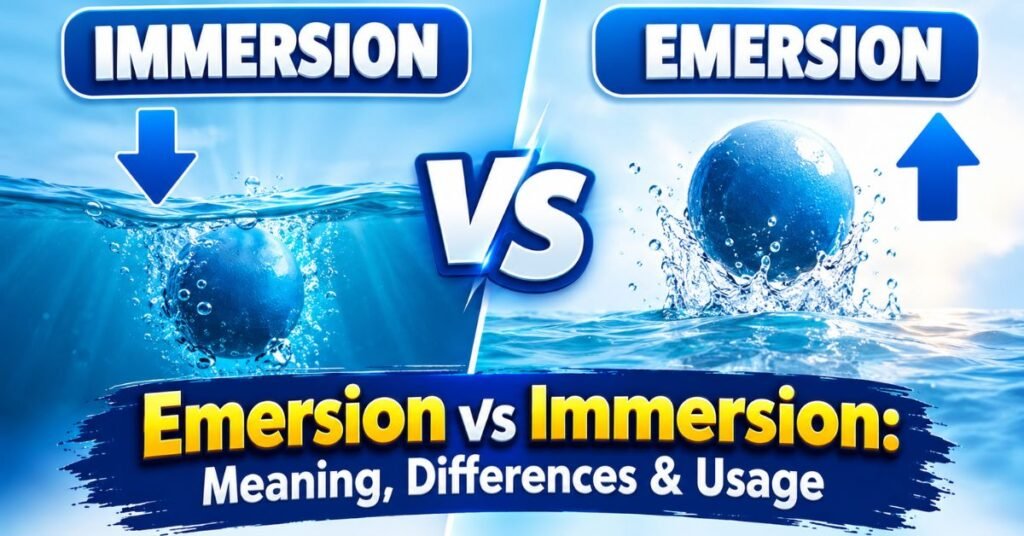

Emersion and immersion look almost identical on the page. They sound alike, they share a Latin ancestry, and they describe opposite movements. One is about going in. The other is about coming out.
Mixing them up is easy, and many writers assume “emersion” is just a typo. It isn’t. It is a real word with a specific meaning, used mostly in science. This guide explains emersion vs immersion in plain language, with definitions, examples, pronunciation tips, and a memory trick so you never confuse them again.
Quick Answer

Emersion is the act of coming out of something, such as water, shadow, or a hidden state, and becoming visible again. Immersion is the act of going into something, such as a liquid, an environment, or an activity, so that you are surrounded or deeply absorbed.
In short:
- Immersion = going in
- Emersion = coming out
If you are describing someone learning a language by living abroad, you want immersion. If you are describing a moon reappearing from behind a planet’s shadow, you want emersion.
Emersion vs Immersion: A Quick Comparison
| Feature | Emersion | Immersion |
| Core idea | Coming out, reappearing | Going in, being surrounded |
| Direction | Outward, upward | Inward, downward |
| Common context | Astronomy, geology, biology | Education, technology, daily life |
| Frequency in everyday English | Rare | Very common |
| Typical tone | Technical or literary | General and widely understood |
| Example | The star’s emersion after the eclipse | Language immersion program |
Emersion: Meaning, Definition and Scientific Context
Emersion is a noun. It refers to the act or process of emerging, or rising out of something that was covering or hiding the subject.
The word has two main layers of meaning:
- The literal sense: rising out of a liquid or reappearing after being hidden.
- The figurative sense: coming out of a difficult, concealed, or dormant state.
Most dictionaries treat it as a less common word than “emergence.” In scientific writing, though, it keeps a precise role. When a specialist says emersion, they usually mean the moment or process when something that had disappeared comes back into view.
How Emersion Differs from Emergence
The two words are related but not interchangeable in technical writing.
- Emergence is the broad, general term. It covers anything that comes into being or becomes visible.
- Emersion is narrower. It usually implies something that was previously covered, submerged, or hidden, and is now reappearing.
A butterfly’s emergence from a chrysalis is a standard phrase. A planet’s moon returning to sunlight after passing through the planet’s shadow is better described as emersion.
Scientific Fields Where Emersion Is Used
Emersion is most at home in technical settings. Here are the main fields where you will see it.
Astronomy
In astronomy, emersion describes a celestial body reappearing after it has been hidden. This can happen during an eclipse, when a body leaves the shadow of another, or during an occultation, when one object passes in front of another and then moves away.
Its counterpart in the same field is immersion, which marks the moment the body disappears. Together, the two terms mark the start and end of a hidden period. Observers have long timed these events, including the disappearance and reappearance of Jupiter’s moons in Jupiter’s shadow.
Geology and Geography
Geologists use emersion to describe land that rises out of the sea or a lake, whether through falling water levels or uplift of the land itself. The opposite process, where land sinks below the water, is often called submergence or, in some contexts, immersion.
Biology and Ecology
In biology, emersion can describe organisms or body parts that are exposed to air after being underwater. A common example is life on a shoreline, where tides expose some creatures twice a day. The period of exposure to air is the emersion period, and the period under water is the immersion period.
Plant scientists also use the related adjective emersed for aquatic plants that grow with their leaves or stems above the waterline.
Physiology and Water-Based Research
Research on the human body in water often distinguishes between being in the water and leaving it. Studies that look at what happens when a person enters water, stays in it, and then exits it naturally use immersion for the first part and emersion for the exit.
Origin and Etymology of Emersion
Both words come from Latin, which explains why they look so similar.
- Emersion traces back to the Latin emersus, the past participle of emergere, meaning “to rise out” or “to come forth.” The prefix e- (a form of ex-) means “out.”
- Immersion comes from the Latin immergere, meaning “to plunge into” or “to dip in.” The prefix in- (which becomes im- before certain consonants) means “in” or “into.”
This gives you a built-in clue. One prefix points out, the other points in. The shared root, mergere, means “to dip” or “to plunge,” and it also gave English the words merge, submerge, and emerge.
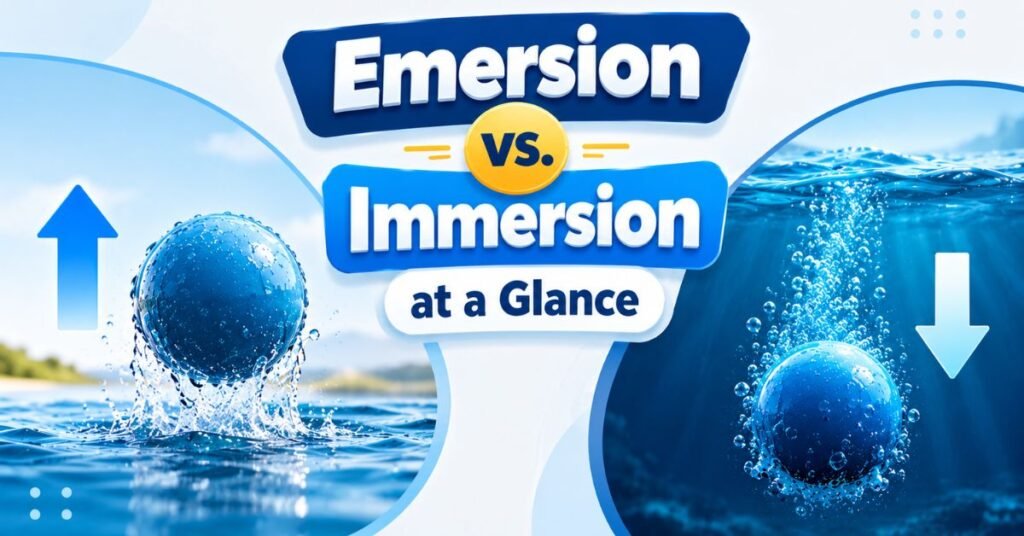
Emersion vs. Immersion at a Glance
If you only need the essentials, this list covers them.
- Immersion is entering, surrounding, or absorbing.
- Emersion is exiting, rising, or reappearing.
- Immersion is common in everyday English. Emersion is mostly technical or literary.
- Both can be literal (water, shadow) or figurative (a culture, a mindset).
- The two are linked: you usually need immersion before emersion can happen.
That last point matters. Emersion only makes sense when something has first been covered, hidden, or submerged.
Emersion in Literature and Metaphorical Use

Writers sometimes use emersion as a metaphor, and it can be a striking choice because so few people use the word.
In figurative writing, emersion often signals one of these ideas:
- Recovery: a person rising out of grief, illness, or hardship.
- Revelation: a truth coming to light after being hidden.
- Awakening: a character or society emerging from ignorance or isolation.
- Renewal: a fresh beginning after a long period of dormancy.
Here are two original examples:
- After months of silence, her emersion from the shadow of that loss felt slow but certain.
- The village’s emersion from isolation began the day the new road opened.
A note of caution. Because the word is rare, many readers will assume it is a mistake. In general-audience writing, “emergence” or “rising” is often safer. Use emersion when the sense of coming out of something that covered you is exactly what you want to convey.
Immersion: Definition and Meaning
Immersion is a noun with two core meanings.
- Physical immersion: the act of placing something fully into a liquid. Think of an immersion heater, an immersion blender, or baptism by immersion.
- Figurative immersion: deep involvement in an activity, environment, or subject. Think of a reader lost in a novel or a student surrounded by a new language.
The second meaning is the one most people encounter. It suggests that you are not just touching a subject. You are surrounded by it, and your attention is fully engaged.
Common Phrases with Immersion
- Total immersion
- Cultural immersion
- Language immersion
- Immersive experience
- Immersion program
- Immersion therapy (used in some psychological contexts)
- Immersion cooling (used in computing and electronics)
Immersion in Technology and Digital Environments

Technology is where “immersion” has become a buzzword. In digital design, it describes how fully a person feels surrounded by or absorbed in a virtual environment.
Virtual and Augmented Reality
Virtual reality headsets aim to create a sense of presence, where the user feels as if they are inside the digital world. Designers talk about immersion when they discuss visuals, spatial audio, motion tracking, and responsive controls. Augmented reality blends digital elements with the real world, which can also feel immersive when done well.
Gaming and Interactive Media
Game designers use “immersion” to describe the feeling of being absorbed in a game world. Strong storytelling, believable sound design, and smooth interaction all support it. Anything that reminds the player they are looking at a screen, such as lag or confusing menus, can break the effect.
Immersive Storytelling
Museums, theaters, and brands now build immersive exhibits and shows where the audience moves through the story instead of watching from a distance.
Technical Uses
Outside entertainment, immersion has literal uses in technology. Immersion cooling, for example, places electronic components in a special non-conductive liquid to manage heat. This is a case where the original, physical meaning of the word is still very much alive.
Main Differences Between Emersion vs. Immersion
The differences come down to direction, context, and usage.
1. Direction of Movement
Immersion moves inward. Emersion moves outward. This is the single most reliable way to tell them apart.
2. Frequency of Use
Immersion appears in classrooms, offices, advertising, and conversation. Emersion appears mainly in scientific papers, specialized writing, and occasional literary prose.
3. Sense of Experience
Immersion often implies engagement, absorption, or surrounding. Emersion implies release, reappearance, or recovery.
4. Typical Subjects
Immersion usually involves people, learners, users, or objects placed into something. Emersion usually involves a body, object, or state that was covered and is now visible again.
5. Risk of Confusion
People often write “emersion” by accident when they mean “immersion,” especially in phrases like “language immersion.” That is almost always an error.
Emersion vs Immersion: Key Differences
This table gives a more detailed side-by-side view.
| Aspect | Emersion | Immersion |
| Part of speech | Noun | Noun |
| Literal meaning | Rising out of or reappearing from cover | Plunging into or being covered by a liquid |
| Figurative meaning | Coming out of a hidden or difficult state | Being deeply absorbed in a subject or setting |
| Prefix meaning | e- = out | im- = in |
| Used in astronomy | Reappearance after eclipse or occultation | Disappearance into shadow or behind a body |
| Used in education | Rarely, if ever, as a formal term | Widely, for immersion programs |
| Used in technology | Almost never | Frequently (VR, gaming, cooling) |
| Common mistake | Mistaken for a typo | Used correctly most of the time |
| Safer alternative | Emergence, reappearance | Absorption, engagement |
Emersion vs Immersion in Education
In education, immersion is a well-established concept. Emersion is not a recognized teaching method.
Immersion in the Classroom
Immersion education usually means teaching academic subjects in a second language. Students might study math, science, or history in that language while also developing fluency in it. Programs vary in design, and some commonly discussed types include:
- Full immersion: most or all instruction happens in the target language.
- Partial immersion: instruction is split between the target language and the students’ first language.
- Two-way immersion: native speakers of two different languages learn together, each group helping the other.
Where Emersion Fits
There is no standard educational model called “emersion.” If you see the word in a school context, it is either a typo for “immersion” or a figurative use, such as a student emerging from a period of struggle. Writers should be careful to make that intention clear.
Immersive Learning Beyond Languages
Immersion also appears in other kinds of teaching, such as simulations, field trips, role-play, and virtual labs. The shared idea is that learners absorb more when they are surrounded by the subject, not just reading about it.
Emersion vs Immersion Pronunciation
The two words sound very similar, which is part of the confusion.
- Immersion is typically pronounced ih-MUR-zhun (or ih-MUR-shun in some accents).
- Emersion is typically pronounced ih-MUR-zhun or ee-MUR-zhun, depending on the speaker and dictionary.
In many accents, the two can be near-homophones. That means you often cannot tell which one a speaker means without context. This is one reason emersion is easy to misread in spoken language and why writers should favor clear context in sentences.
A practical tip: if you want to stress the difference when speaking, you can emphasize the opening vowel. Saying “ee-mersion” can help signal the out-going word, though this is a deliberate emphasis and not a strict rule.
Emersion vs Immersion in Language Learning
Language learning is where most people meet the word “immersion,” and also where most spelling errors happen.
What Language Immersion Means
Language immersion means surrounding yourself with a language so that you hear it, read it, speak it, and think in it as much as possible. This can happen in several ways:
- Living in a country where the language is spoken
- Attending an immersion school or program
- Surrounding yourself with media in the target language, such as films, podcasts, and books
- Speaking with native speakers regularly
- Changing your phone and apps to the target language
Is There “Language Emersion”?
Not as a formal concept. Language teachers and researchers use “immersion,” not “emersion.” If you hear someone say “language emersion,” they almost certainly mean immersion.
Some writers use “emersion” informally to describe the moment a learner starts to speak confidently after a long period of absorbing the language, the point where the language “comes out.” This is a creative use rather than an established term, so it is best explained when used.
Why Immersion Works for Many Learners
Immersion tends to help because it creates constant, meaningful exposure. Instead of memorizing lists in isolation, learners see how words work in real situations. It can be tiring at first, but regular exposure often builds listening skills and comfort over time. Results vary from person to person.
Emersion vs Immersion in Psychology
Psychology uses both ideas, though immersion is far more established.
Immersion and Absorption
In psychology and media studies, immersion refers to the mental state of being deeply absorbed in an activity or experience. Researchers discuss related ideas such as presence (the feeling of “being there” in a virtual space) and flow (a state of focused engagement). These concepts are connected but not identical.
Exposure and Immersion Approaches
Some therapeutic approaches use gradual or direct exposure to feared situations. In casual writing this is sometimes described as immersion, though professionals typically use more specific clinical terms. If you are researching a treatment, rely on a qualified practitioner or reputable medical source rather than a general definition.
Emersion as a Psychological Metaphor
In everyday writing, emersion can describe the process of coming out of an intense state. For instance, someone might describe their emersion from a deep period of focus, or from emotional numbness. This is figurative language, not a formal psychological term, so it works best in essays, reflective writing, and creative work.
How to Remember Emersion vs. Immersion
You don’t need to memorize definitions. A few simple tricks make the difference stick.
- Look at the first letter. Emersion begins with E, as in exit. Immersion begins with I, as in in.
- Think of the prefixes. E- means “out.” Im- means “in.”
- Pair them with their roots. Emerge gives you emersion. Immerse gives you immersion.
- Picture water. Diving into a pool is immersion. Climbing out is emersion.
- Use the sequence. First comes immersion, then emersion.
Emersion vs Immersion Examples
Seeing the words in sentences is often the fastest way to understand them.
Examples of Emersion
- The telescope captured the moon’s emersion from the planet’s shadow.
- Low tide revealed the emersion of the rocky shelf and the creatures living on it.
- The emersion of the island, once covered by the sea, changed the coastline.
- Her emersion from months of exhaustion was gradual but real.
- The study compared the body’s response during immersion in water and after emersion.
Examples of Immersion
- The school offers a Spanish immersion program for young learners.
- He chose total immersion, moving abroad to learn Japanese.
- The museum’s immersive exhibit surrounds visitors with sound and light.
- The immersion heater warmed the water in just a few minutes.
- The game’s immersion was broken by constant loading screens.
Examples Using Both
- The satellite’s immersion into Earth’s shadow lasted a short time, followed by its emersion back into sunlight.
- After a deep immersion in her research, the writer felt a quiet emersion into the real world again.
Cultural Immersion Through Travel
Also Read This:Transferred vs Transfered: Which Is Correct?
Cultural immersion is one of the most popular uses of the word. It means experiencing a place by living like the people who live there, not just visiting its landmarks.
What Cultural Immersion Can Look Like
- Staying with a local family or in a neighborhood guesthouse
- Eating where residents eat and learning how dishes are prepared
- Joining local festivals, markets, and community events
- Learning basic phrases in the local language
- Taking classes in crafts, cooking, music, or dance
- Using local transport instead of private tours
- Volunteering or working on community projects
Why Travelers Seek It
Many travelers say immersion gives them a deeper understanding of how people live, think, and celebrate. It encourages curiosity, patience, and respect for differences.
A Responsible Approach
Cultural immersion works best when it is respectful. Ask before photographing people, follow local customs, support local businesses, and avoid treating communities as entertainment. Immersion is about learning, not performing the role of a local.
And Emersion?
When a traveler returns home and slowly steps back into their old routine, some might describe that as emersion. Again, this is a figurative use, but it fits the movement: going in, then coming out.
Memory Trick for Emersion vs Immersion
Here is a simple phrase to carry with you:
Immersion = In. Emersion = Exit.
Or use the water picture. You immerse a tea bag into hot water, and later you lift it out in emersion. The first letters tell the story.
If you ever doubt which word to use, ask one question: “Is something going in, or coming out?” The answer will point you to the right word.
Final Thoughts
Emersion and immersion are two sides of the same movement. Immersion is the plunge, whether into water, a new language, a culture, or a virtual world. Emersion is the return, the moment something rises out of cover and comes back into view.
For most writers, immersion is the word you will use daily. Emersion is the rarer word, best saved for scientific contexts or deliberate, figurative writing where “coming out of” is the exact idea. When in doubt, remember the prefixes: im- for in, e- for out.
Choose the word that matches the direction of movement, give your reader enough context, and you will never mix up emersion vs immersion again.