

You have probably seen it a hundred times. A referee holds up a coin, a friend says “pick a side,” and someone calls out “heads!” It is one of the oldest and simplest ways to settle a choice, and almost nobody needs it explained.
Yet the phrase carries more than most people notice. “Heads or tails” is a game, a decision-making shortcut, a small probability lesson, and the source of several English expressions. Some of those expressions, like “can’t make heads or tails of it,” have nothing to do with flipping a coin at all.
This guide explains the heads or tails meaning in plain language. You will learn what each side of a coin is called, how the game works, where the phrase came from, whether a coin toss is truly fair, and how to use the expression correctly in conversation and writing.
Heads or Tails Meaning: The Short Answer
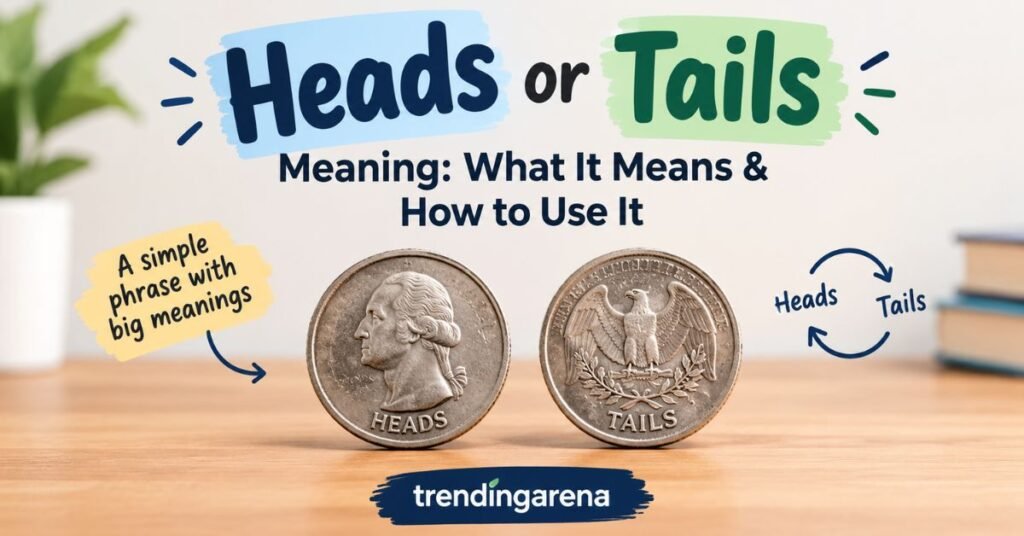
“Heads or tails” is the call you make before a coin is flipped. “Heads” refers to the side of the coin that usually shows a portrait or head. “Tails” refers to the opposite side. Whichever side lands face up decides the result.
In everyday English, the phrase is used in three ways:
- As a question: “Heads or tails?” asks someone to choose a side before the flip.
- As a method: Settling a choice between two options with a coin toss.
- As part of idioms: Expressions such as “heads I win, tails you lose” and “can’t make heads or tails of something.”
The core idea is the same each time. Two outcomes, no preference, and chance makes the call.
What “Heads” and “Tails” Actually Refer To
People often assume “heads” and “tails” are arbitrary labels. They are not. Each word describes something real about how coins have traditionally been designed.
Heads: The Obverse Side
The “heads” side is the front of the coin, which coin collectors call the obverse. For centuries, the obverse carried the portrait of a ruler, a god, or a national figure. Because the main image was a head, people started calling that side “heads.”
On a U.S. quarter, for example, heads shows George Washington. On British coins, heads shows the reigning monarch.
Tails: The Reverse Side
The “tails” side is the back of the coin, known as the reverse. It usually carries an emblem, a building, an animal, a denomination, or another design. The word “tails” is simply the natural opposite of “heads.” Think of the back end of an animal compared with its head. The coin does not literally show a tail.
Quick Comparison
| Feature | Heads | Tails |
| Technical name | Obverse | Reverse |
| Typical design | Portrait or main figure | Emblem, scene, or value |
| Position | Front of the coin | Back of the coin |
| Role in a flip | One of two possible outcomes | The other possible outcome |
What If a Coin Has No Head on It?
Many modern coins do not feature a portrait. Some show a building, a plant, or a national symbol on both sides. In these cases, “heads” is just a convention.
The usual approach is to treat the side with the main design, the date, or the more prominent image as heads. If that is unclear, the better solution is to agree before the flip. Say something like, “The side with the date is heads.” This avoids arguments after the coin has landed.
How the Heads or Tails Game Works
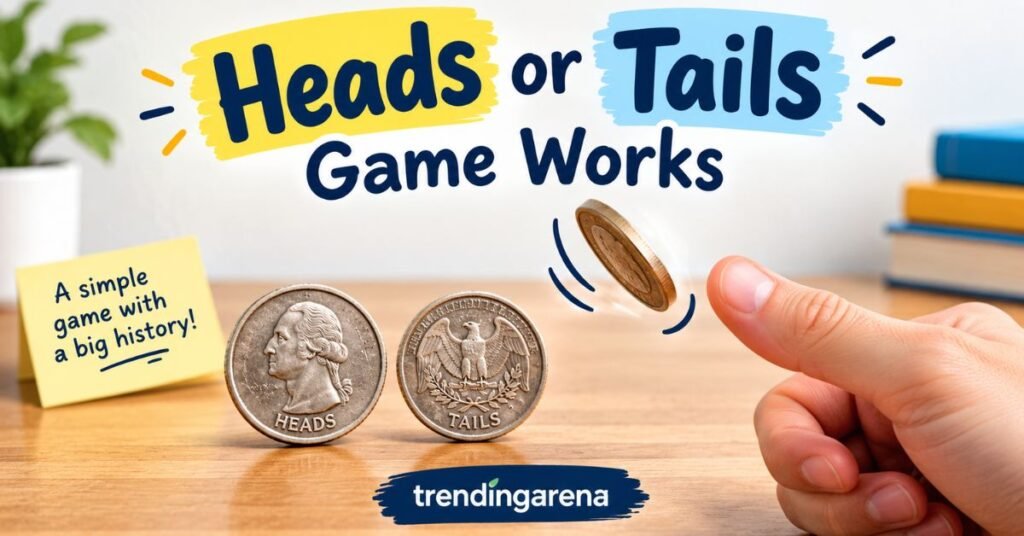
The basic game takes about ten seconds and needs only a coin and two people. Here is the standard process.
- Agree on what is being decided. Two clear options work best, such as who goes first or which restaurant to choose.
- Assign a side to each person. One person calls “heads,” and the other automatically gets tails. Alternatively, one person flips and the other calls it in the air.
- Flip the coin. Toss it upward with a spin so it rotates several times.
- Let it land. Catch it, or let it fall on a flat surface.
- Read the result. The side facing up decides the winner.
Rules That Keep the Toss Fair
- Call the side before the coin leaves the hand, or while it is still in the air.
- Make sure the coin spins and flips. A coin that only tilts or wobbles can behave predictably.
- Do not look at the coin before the call is made.
- If the coin lands on the floor and rolls out of sight, flip again.
- Agree in advance whether the result is final, or whether you play best of three.
The point of the ritual is that everyone accepts the outcome, even when it is disappointing. A coin toss only works as a fair method if both people respect the result.
Heads or Tails as a Children’s Game
Outside of formal decisions, heads or tails is also a simple game for children. It teaches turn-taking, handling disappointment, and early ideas about chance. Some classrooms use it for early probability lessons, letting students flip a coin twenty times and compare what they predicted with what actually happened.
Where the Phrase “Heads or Tails” Comes From
Flipping a coin to decide something is ancient. The phrase we use today is much more recent, but its roots go back a long way.
Ancient Rome: “Ship or Head”
The Romans had a coin-flipping game, usually described by its Latin name, navia aut caput, which means “ship or head.” Early Roman bronze coins showed the head of a god on one side and the prow of a ship on the other. Players called one or the other, much like we do now.
That is why the idea of “head” as one outcome is so old. The coin’s face became a shorthand for a choice.
Medieval England: “Cross and Pile”
In medieval and early modern England, people played a similar game called “cross and pile.” Many English coins of that era carried a cross on one side. The other side was called the “pile,” a word linked to the punch or die used in stamping coins. Players called “cross” or “pile” the way we call heads or tails.
The cross eventually fell out of fashion on coins, and portraits of monarchs became standard. The older terms faded.
The Rise of “Heads or Tails”
By the 1600s and 1700s, English speakers were calling the portrait side “head” and the opposite side “tail.” Over time the plural forms “heads” and “tails” became the standard call. By the time modern coinage was widespread, the phrase “heads or tails” was part of everyday speech.
The exact date of the first use is hard to pin down, because casual speech was rarely written down. What is clear is that the expression grew naturally out of how coins looked, not from any formal rule.
Is a Coin Toss Really 50/50?
In theory, a fair coin has two sides and two equally likely outcomes, so heads and tails each have a 50% probability. In practice, the answer is slightly more interesting.
What the Research Says
In 2007, mathematician Persi Diaconis, along with Susan Holmes and Richard Montgomery, published a well-known study on the physics of coin flipping. They found that a coin tossed in the usual way has a small bias: it tends to land on the same side it started on, about 51% of the time.
A much larger experiment, published by a team of researchers led by František Bartoš, backed this up. Using hundreds of thousands of recorded flips, the team found a similar tendency, with the coin landing on its starting side around 50.8% of the time.
The bias is small. For casual decisions, it makes no practical difference. It would only matter over thousands of flips, or if one person could control how the coin starts.
Can a Coin Land on Its Edge?
Yes, though it is extremely rare. Physicists have estimated that a standard U.S. nickel landing on its edge is roughly a 1-in-6,000 event. For thicker coins the chance goes up, and for thin coins it drops. If it happens, the standard answer is to flip again.
The Gambler’s Fallacy
One of the most common mistakes people make with coin flips is believing that past results change the next one. If a coin lands on heads five times in a row, many people feel tails is “due.”
It is not. Each flip is independent. The coin has no memory, so the next flip is still about 50/50.
Simple Probability Table
| Scenario | Probability |
| Heads on a single flip | 50% |
| Heads twice in a row | 25% |
| Heads three times in a row | 12.5% |
| Heads five times in a row | 3.125% |
| At least one heads in two flips | 75% |
| Exactly one heads and one tails in two flips | 50% |
These numbers explain why a streak of heads feels remarkable but is not actually suspicious. Over enough flips, streaks are normal.
also read this:Thursdays or Thursday’s? Correct Usage Explained
Heads or Tails in Sports and Official Decisions
The coin toss is not just for friends deciding who picks the movie. Many sports and formal settings use it because it is quick, neutral, and widely understood.
Common Sporting Uses
- American football: The referee flips a coin before the game and before overtime. One team captain calls heads or tails while the coin is in the air. The winner chooses whether to receive the ball or choose another option.
- Soccer: A toss decides which team kicks off and which end each team defends.
- Cricket: The two captains toss to decide who bats or bowls first. This is one of the best-known examples of a coin toss shaping the strategy of a match.
- Tennis: A toss, or a racket spin, decides who serves first or which side to start on.
Famous Decisions Settled by a Coin
Some of the best-known coin tosses had real consequences.
- Portland, Oregon: In the 1840s, two founders, Asa Lovejoy and Francis Pettygrove, disagreed on a name for their new town. Lovejoy wanted Boston and Pettygrove wanted Portland. A coin toss settled it, and Portland won.
- The Wright brothers: Before their first powered flight attempts in December 1903, Wilbur and Orville Wright tossed a coin to see who would try first. Wilbur won the toss, but his attempt failed. Orville made the first successful flight a few days later.
- European Championship 1968: In the semifinal, Italy and the Soviet Union were tied after extra time. A coin toss decided who advanced, and Italy went through. Penalty shootouts replaced this method in later years.
These examples show why the toss survives. It is fast, understood by everyone, and takes human preference out of the picture.
Heads or Tails Idioms and Expressions
The phrase has grown beyond coins. English uses “heads” and “tails” in several expressions, and some are easy to confuse.
“Heads I Win, Tails You Lose”
This phrase describes a deal that is rigged. No matter how the coin lands, the speaker comes out ahead. It is used in business, politics, and everyday life.
- “The contract is heads I win, tails you lose. They keep the profits, and we take all the risk.”
The phrase is often attributed to older sayings about unfair bets, and it has been in common use for a long time.
“Can’t Make Heads or Tails of It”
This is the version that confuses learners most. It has nothing to do with a coin toss. It means you cannot understand something, usually because it is confusing, badly explained, or poorly organized.
- “I read the instructions three times and still can’t make heads or tails of them.”
- “Her handwriting is so messy that I can’t make heads or tails of this note.”
The origin is not settled. A common explanation is that the phrase suggests you cannot tell the beginning from the end, or the top from the bottom, of something. Whatever the source, the idiom is widely understood and still very common.
“Flip a Coin”
When someone says, “Let’s flip a coin,” they mean they will use a toss to decide. It is a polite way to avoid an argument.
- “We can’t agree on where to eat, so let’s flip a coin.”
“Toss-Up”
A toss-up is a situation where two outcomes seem equally likely. It borrows the image of a coin in the air.
- “The election race is a toss-up right now.”
“Two Sides of the Same Coin”
This expression describes two ideas that seem opposite but are closely connected.
- “Creativity and discipline are two sides of the same coin.”
Idioms at a Glance
| Expression | Meaning | Related to a coin toss? |
| Heads or tails? | Choose a side before a flip | Yes |
| Heads I win, tails you lose | A rigged deal with no fair outcome | Yes, figuratively |
| Can’t make heads or tails of it | Unable to understand something | No |
| Flip a coin | Decide by chance | Yes |
| Toss-up | Two equally likely outcomes | Yes, figuratively |
| Two sides of the same coin | Opposite ideas that are linked | Yes, figuratively |
Using Heads or Tails to Make Decisions
People flip coins for small choices all the time. The more interesting question is whether it helps with bigger ones.
The Coin Flip as a Mirror
Many people say that the real value of a coin toss has nothing to do with the result. It is the moment while the coin is in the air. In that second, you often realize which outcome you are hoping for. If you feel a flash of disappointment when the coin lands, that tells you something.
This is not a scientific claim on its own, but there is research on the topic. Economist Steven Levitt ran a large online experiment in which people facing real life dilemmas, such as whether to quit a job or end a relationship, let a coin flip nudge their decision. When people followed a flip that told them to make a change, they were more likely to make it. Six months later, those who made the change reported being happier than those who stayed put.
The study does not prove that coin flips are wise. It suggests that many people stay stuck in the status quo longer than they should, and that a push can help.
When It Works Well
A coin toss is a good tool when:
- Both options are roughly equal in value.
- The stakes are low or moderate.
- You have already done your research and are simply stuck.
- You want to move on rather than keep debating.
When It Is a Bad Idea
A coin flip should not replace careful thinking when:
- One choice is clearly safer or better for your health, finances, or safety.
- The decision affects other people who deserve a say.
- Legal, medical, or major financial consequences are involved.
- The options are not actually equal, and you are using the coin to avoid facing that.
A useful rule: use the coin to break a tie, not to avoid thinking.
How to Use “Heads or Tails” in a Sentence
Here are natural examples for each common use of the phrase, so you can see how it works in real English.
As a Question
- “Heads or tails? Winner picks the movie.”
- “Call it in the air: heads or tails?”
- “Okay, heads or tails for who goes first?”
As a Statement
- “I called heads, but it came up tails.”
- “We settled it with heads or tails.”
- “The team captain won the toss and chose tails.”
In a Figurative Sense
- “Heads or tails, the outcome is the same for me.” (Meaning: it makes no difference.)
- “It was heads I win, tails you lose from the start.”
- “I can’t make heads or tails of this report.”
Writing Tips
- Use lowercase unless the phrase starts a sentence or appears in a title.
- Use plural forms. “Heads” and “tails” are standard. Avoid “head or tail” unless you are quoting something older.
- Keep idioms distinct. If you write “heads or tails” for a coin and “can’t make heads or tails” for confusion, make the context obvious.
- Match your tone. The phrase is casual. In formal writing, “a coin toss” or “a toss of a coin” can sound more polished.
Heads or Tails Around the World
Other languages use their own versions of the phrase. Many describe the same two sides in different ways.
| Language | Phrase | Literal meaning |
| Spanish | Cara o cruz | Face or cross |
| French | Pile ou face | Pile or face |
| German | Kopf oder Zahl | Head or number |
| Italian | Testa o croce | Head or cross |
| Portuguese | Cara ou coroa | Face or crown |
Notice how several languages echo old patterns. The “cross” side in Spanish and Italian reminds us of the cross that used to appear on many coins, which connects back to the old English “cross and pile.” German “Zahl” refers to the number or value shown on the reverse.
These parallels show that the idea is almost universal. Wherever coins circulated, people invented a name for each side and used them to make quick choices.
Common Mistakes People Make With Heads or Tails
Even a simple ritual can go wrong. Here are the most common issues.
- Calling the side after the flip. This invites cheating and arguments. The call should come first.
- Using a coin that does not spin. If the coin barely turns, the result may depend on how it started.
- Believing in streaks. After several heads in a row, tails is not more likely. Each flip stands alone.
- Mixing up the idioms. “Heads I win, tails you lose” is about unfair deals. “Can’t make heads or tails of it” is about confusion. They are not interchangeable.
- Skipping agreement on the stakes. If the people involved do not agree to honor the result, the toss is meaningless.
- Confusing sides on unusual coins. With euro coins or other designs that lack an obvious portrait, agree on which side counts as heads.
Frequently Asked Questions
What does heads or tails mean?
It is the call made before flipping a coin. Heads is the side that usually shows a portrait. Tails is the opposite side. The side facing up after the flip decides the result.
Why is it called heads and tails?
The front of most coins traditionally showed a head, such as a ruler or national figure. The back was named “tails” as the natural opposite. The terms came from how coins were designed, not from any animal imagery.
Is heads or tails truly 50/50?
Very close to it. Studies suggest a tossed coin lands on its starting side slightly more often, about 50.8% to 51% of the time. For everyday decisions, that difference is too small to matter.
What does “can’t make heads or tails of it” mean?
It means you cannot understand something. The idiom is used for confusing instructions, messy writing, or unclear explanations. It is unrelated to flipping a coin.
Should I choose heads or tails?
There is no better choice. Each side has roughly the same chance. If you want a small edge, some people pick the side the coin starts on, though the advantage is minimal and only helps if you know how it will be tossed.
Can a coin land on its side?
Yes, but it is very unlikely. For a typical coin, estimates put it at about 1 in 6,000. If it happens, flip again.
Conclusion
The heads or tails meaning is simple on the surface, but it has depth. “Heads” is the front of a coin, usually carrying a portrait. “Tails” is the back. Together, they give two people a quick, fair way to settle a choice.
The idea is ancient, tracing back to Roman “ship or head” games and medieval “cross and pile.” Modern studies show that a coin toss is very nearly 50/50, with a tiny bias toward the starting side. Sports, history, and daily life all show how useful the method is when a quick, neutral decision is needed.
The phrase has also grown into everyday English. “Heads I win, tails you lose” warns of a rigged deal. “Can’t make heads or tails of it” describes confusion. “Flip a coin” and “toss-up” are familiar shortcuts for uncertainty.