
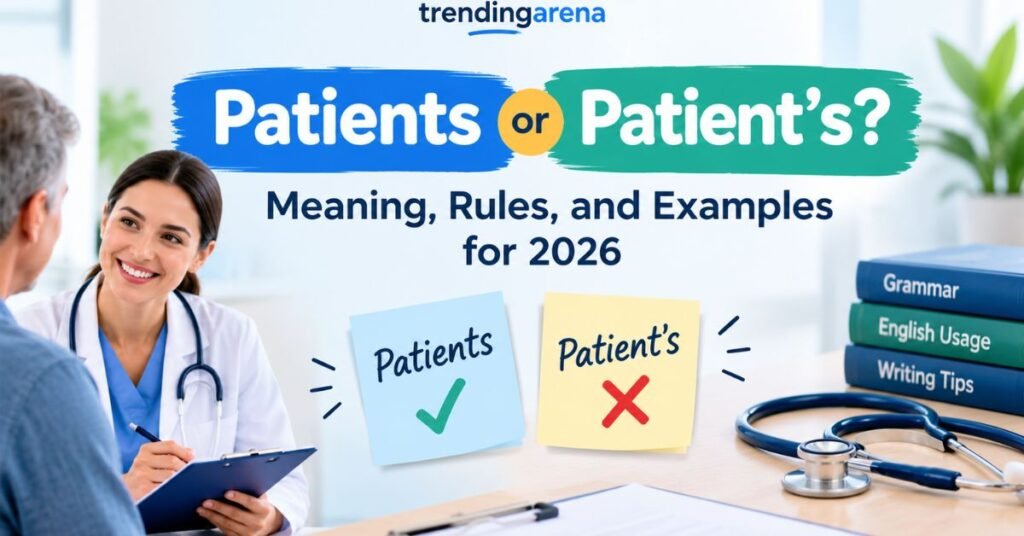

You’re typing a note, a report, or a patient handout, and you freeze. Is it “the patients records,” “the patient’s records,” or “the patients’ records”? One tiny apostrophe changes who the sentence is about, and in healthcare writing that can matter more than it does in a casual email.
This guide explains the difference between patients and patient’s (and its close cousin, patients’) in plain language. You’ll find clear definitions, side-by-side examples, a few quick tests to settle any doubt, and the mistakes people make most often. By the end, you should be able to choose the right form in seconds.
The Short Answer: Patients vs. Patient’s
Patients is the plural of “patient.” It means more than one person receiving medical care. It has no apostrophe, because nothing belongs to anyone.
Patient’s is the singular possessive. It shows that something belongs to, or is connected with, one patient.
Patients’ is the plural possessive. It shows that something belongs to, or is connected with, more than one patient.
Here is the same idea in three sentences:
- The patients arrived early. (more than one person, no ownership)
- The patient’s chart was missing. (the chart belongs to one person)
- The patients’ charts were missing. (the charts belong to several people)
If you remember only one rule, remember this: an apostrophe signals ownership or a contraction, never a plural.
What Does “Patients” Mean?
“Patient” is a noun for a person who receives medical care, treatment, or advice from a doctor, nurse, dentist, therapist, or other healthcare professional. Add an s and you get “patients,” the plural form.
Use “patients” when you’re simply talking about a group of people receiving care and you’re not attaching anything to them.
Examples:
- The clinic sees about forty patients a day.
- Several patients reported mild side effects.
- Nurses check on patients every two hours.
- The study followed 1,200 patients over five years.
In every sentence above, “patients” is the subject or object of the verb. Nobody owns anything. If you could swap “patients” for “people” or “individuals” and the sentence still works, plain “patients” is almost certainly correct.
What Does “Patient’s” Mean?
“Patient’s” is the possessive form of the singular noun. The apostrophe plus s tells the reader that something belongs to, comes from, or relates to one patient.
Examples:
- The patient’s blood pressure was normal.
- Please confirm the patient’s date of birth.
- The doctor listened carefully to the patient’s concerns.
- A patient’s consent is required before the procedure.
Notice that each sentence has exactly one patient in mind. “A patient’s consent” refers to the consent of any single patient in general. It’s still singular.
The Contraction Meaning of “Patient’s”
There is a second, less common use. “Patient’s” can also be a contraction of “patient is” or “patient has.”
- The patient’s waiting in room 4. (the patient is waiting)
- The patient’s been stable all night. (the patient has been stable)
This is fine in spoken language and informal messages, such as a quick chat between colleagues. In formal clinical documentation, it’s better to write the full words. It keeps the meaning unambiguous, and it avoids a reader mistaking a contraction for a possessive.
What Does “Patients'” Mean?
“Patients'” (apostrophe after the s) is the plural possessive. Use it when something belongs to, or is connected with, more than one patient.
Examples:
- The nurses updated all the patients’ records.
- The hospital respects its patients’ privacy.
- The waiting room has a table for patients’ belongings.
- Researchers analyzed the patients’ responses to the survey.
The rule behind it is simple. When a plural noun already ends in s, you add only an apostrophe to make it possessive. You don’t add another s. That’s why “patients’s” is never correct.
Patients vs. Patient’s vs. Patients’: Side-by-Side Comparison
This table puts the three forms next to each other so the differences are easy to see.
| Form | Number | Shows ownership? | Example sentence |
| patient | Singular | No | The patient signed the form. |
| patients | Plural | No | The patients signed the forms. |
| patient’s | Singular | Yes | The patient’s signature is missing. |
| patients’ | Plural | Yes | The patients’ signatures are missing. |
A useful way to read the table: the position of the apostrophe tells you how many people you mean. An apostrophe before the s points to one patient. An apostrophe after the s points to several.
How to Choose the Right Form: Three Quick Tests
When you’re not sure, don’t guess. Run one of these checks.
Test 1: Does anything belong to the patient?
Look at the word that follows. If there’s a noun that belongs to, comes from, or relates to the patient (chart, history, symptoms, privacy, rights), you need a possessive. If no noun follows and “patients” is doing its own job in the sentence, you need the plain plural.
- “The patients recovered quickly.” (nothing belongs to them, so plain plural)
- “The patients’ recovery was quick.” (the recovery belongs to them, so possessive)
Test 2: Can you rewrite it with “of”?
Turn the phrase around using “of the.” If it works, you need a possessive.
- “The patient’s file” becomes “the file of the patient.” That works, so use patient’s.
- “The patients’ files” becomes “the files of the patients.” That works, so use patients’.
- “The patients waited” becomes “the waited of the patients.” That doesn’t make sense, so use plain patients.
Test 3: Count the people, then place the apostrophe
Once you know you need a possessive, ask how many patients you mean.
- Write the word without any apostrophe: patient or patients.
- If it’s one patient, add ‘s to get patient’s.
- If it’s more than one patient, add only an apostrophe to get patients’.
That’s the whole system. The only decision is whether you mean one patient or several.

Examples in Real-World Healthcare Writing
Grammar rules are easier to remember when you see them in the settings where you’ll actually use them. Here’s how the three forms show up in different kinds of writing.
Clinical Notes and Charting
Clinical writing is usually about one individual, so you’ll use the singular possessive most often.
- Review the patient’s medication list before prescribing.
- The patient’s pain level improved after treatment.
- Document the patient’s allergies at every visit.
When a note covers a ward or a group, switch to the plural possessive:
- Hand-off notes should include all patients’ current vitals.
- The team reviewed the patients’ overnight observations.
Patient Communication and Handouts
Materials written for patients often speak to them directly, so you’ll see a mix.
- Bring your insurance card and a list of your current medications.
- We value every patient’s time, so we aim to start appointments on schedule.
- Our goal is to protect our patients’ privacy at every step.
The first example uses “your,” so no apostrophe is needed at all. Direct address (“you,” “your”) often lets you avoid possessives entirely, which makes patient-facing writing simpler and warmer.
Policies and Official Documents
Policy writing tends to speak in general terms about “a patient” or “patients” as a group.
- A patient’s right to refuse treatment must be respected.
- The facility is responsible for safeguarding patients’ personal property.
- All patients must complete the intake form before their first appointment.
Here, “a patient’s right” is a general statement about any single patient. “Patients’ personal property” covers everyone in the facility. “All patients must complete” uses the plain plural because nothing is being owned.
Research and Academic Writing
Studies deal with groups, so the plural forms dominate.
- Patients in the treatment group reported fewer symptoms.
- The authors compared patients’ self-reported outcomes at six months.
- Each patient’s data was anonymized before analysis.
That last sentence is a good reminder that even in group research, you use the singular possessive when you mean “each” or “every” individual. “Each patient’s data” is correct because “each” points to one person at a time.
Marketing and Website Copy
Healthcare websites and blogs often get this wrong, partly because writers are in a hurry and partly because “patient” is used so often. Here are correct versions of typical lines:
- Learn how we support patients through every stage of treatment.
- Read patients’ stories and experiences. (stories that belong to several people)
- Your patient’s journey starts here. (use this only when addressing someone who is writing about one specific patient, such as a caregiver or referring clinician)
also read this:Referred or Refered? The Correct Spelling Explained
When “Patient” Works Like an Adjective: No Apostrophe Needed
Healthcare is full of phrases like “patient care,” “patient records,” and “patient portal.” In these, “patient” works like an adjective, describing what kind of care, record, or portal it is. It doesn’t show ownership, so you don’t add an apostrophe or an s.
Common examples:
- patient care
- patient safety
- patient education
- patient portal
- patient experience
- patient satisfaction
- patient history
- patient-centered care (usually hyphenated)
Compare these pairs:
| Descriptive (no apostrophe) | Possessive (apostrophe) |
| patient records (a type of record) | the patient’s records (one person’s records) |
| patient feedback (a general category) | the patients’ feedback (feedback from specific people) |
| patient privacy (the topic of privacy) | each patient’s privacy (belonging to individuals) |
Both can be correct depending on your meaning. The descriptive form is more general and often more concise. The possessive form is more specific. If you’re talking about a category or system (“our patient portal”), go descriptive. If you’re talking about particular people’s information (“the patient’s portal login”), go possessive.
One thing to avoid is mixing the two within a single document without a reason. If your handbook says “patient records” in one paragraph and “patients’ records” in the next with no change in meaning, readers will notice the inconsistency.

Common Mistakes (and How to Fix Them)
These errors turn up in everything from hospital newsletters to student essays. Once you know what to look for, they’re easy to catch.
Mistake 1: Using an apostrophe to make a plural
- ❌ Many patient’s reported dizziness.
- ✅ Many patients reported dizziness.
This is the most common error. An apostrophe never makes a word plural. Nothing in this sentence belongs to anyone, so no apostrophe is needed.
Mistake 2: Leaving out the apostrophe when something belongs to a patient
- ❌ Please review the patients chart.
- ✅ Please review the patient’s chart.
If a noun like “chart,” “history,” or “wishes” follows, the patient owns it, and you need the possessive.
Mistake 3: Putting the apostrophe in the wrong place
- ❌ All the patient’s rooms were cleaned. (when you mean several patients)
- ✅ All the patients’ rooms were cleaned.
The position of the apostrophe changes the number of people. “Patient’s rooms” suggests one patient with several rooms. “Patients’ rooms” means several patients with their own rooms.
Mistake 4: Adding an extra s
- ❌ The patients’s forms are on the desk.
- ✅ The patients’ forms are on the desk.
When the plural already ends in s, the apostrophe alone makes it possessive.
Mistake 5: Mixing up “patients” and “patience”
These two words sound alike in many accents, and autocorrect or dictation software can swap them without warning.
- Patients (noun): people receiving care.
- Patience (noun): the ability to wait calmly.
Examples:
- ❌ Thank you for your patients while we updated the system.
- ✅ Thank you for your patience while we updated the system.
This particular slip is easy to make in front-desk messages and voicemail transcripts, and it can look unprofessional in patient-facing material.
Mistake 6: Using the contraction in formal records
- ❌ The patient’s refused the medication. (in a formal record)
- ✅ The patient refused the medication.
Beyond style, a stray apostrophe in a clinical record can make a sentence harder to read, and clear documentation is part of safe care.
Multiple Patients, Multiple Owners: Trickier Cases
Most questions are solved by the tests above. A few situations need a little more thought.
Two or more people sharing one thing
If patients share one item, put the apostrophe on the last word only.
- The patient and caregiver’s shared goals (one set of goals shared by both)
If each has their own item, make both possessive.
- The patient’s and caregiver’s separate concerns (each has their own concerns)
Possessives with other possessives
In longer sentences, check each noun separately.
- The doctor’s notes about the patient’s symptoms were thorough.
- The doctors’ and nurses’ meeting covered the patients’ feedback.
If a sentence has too many apostrophes, consider rewriting it. “Feedback from patients was discussed at the doctors’ and nurses’ meeting” says the same thing and is easier to read.
Patient as a title or in a name
Organizations, programs, and documents sometimes use their own punctuation. Some write “Patients’ Rights,” others “Patient Rights,” and some drop the apostrophe in their official name. If you’re writing about a specific organization or law, copy the name exactly as the organization writes it, even if it differs from standard grammar.

“Patient” as an Adjective Meaning “Calm”
One more thing worth knowing: “patient” isn’t only a noun. As an adjective, it describes someone who stays calm while waiting or dealing with difficulty.
- She was patient with her students.
- Please be patient while we find your file.
In this meaning, there’s no connection to healthcare at all, and no apostrophe is ever needed. It’s a good reminder that context decides the word’s role. The same spelling can be a noun (a person receiving care), an adjective (calm), or part of a possessive.
What the Style Guides Say
Different publications follow different style guides, but on this topic they agree on the basics: possessives take an apostrophe, plurals don’t, and plural nouns ending in s take only an apostrophe to become possessive.
Where they sometimes differ is on descriptive phrases. Some guides prefer “patient rights” while others accept “patients’ rights.” If you’re writing for a hospital, journal, publisher, or employer, check whether they have a house style. When no guide applies, pick one approach and apply it consistently throughout the document.
A few practical points that help:
- Headings and titles: The same rules apply. “Protecting Patients’ Privacy” is correct. “Protecting Patient’s Privacy” would mean one individual only.
- Capitalization: Possessives don’t change capitalization rules. Follow your usual title-case or sentence-case style.
- Hyphenation: Compounds such as “patient-centered” and “patient-reported” are normally hyphenated when they come before a noun (“a patient-centered approach”). The hyphen is about joining words and has nothing to do with possession.
Why Getting This Right Matters in 2026
It’s fair to ask whether one apostrophe is worth the attention. In a few situations, it is.
Clarity in clinical documentation. Healthcare relies on precise records. “Patient’s medications” and “patients’ medications” describe different situations. A careless apostrophe can blur whether a note covers one person or a group.
Trust and credibility. Patients, families, and referring professionals judge organizations partly by how carefully they communicate. Small errors on websites, brochures, and portals can quietly weaken confidence. Clean writing signals attention to detail, which is exactly what people want from those caring for them.
Digital tools introduce new errors. Today, much documentation passes through templates, speech-to-text, predictive typing, and AI-assisted drafting. These tools are helpful, but they can swap “patients” for “patience,” drop apostrophes, or insert them where they don’t belong. A quick human proofread still catches what software misses, especially in patient-facing messages and clinical notes.
Search and readability. If you publish healthcare content online, people search for phrases both with and without apostrophes, and search engines handle both. What matters most is writing that’s accurate and easy to read. Correct grammar supports that goal without any special tricks.
Inclusive and respectful language. Some people and organizations now prefer terms such as “person receiving care” or “people with [condition]” in certain contexts. “Patient” remains standard in clinical and legal settings. Whichever term you use, the apostrophe rules stay the same.

Quick Reference Cheat Sheet
Keep this checklist nearby when editing.
- One patient, nothing owned: use patient.
- More than one patient, nothing owned: use patients (no apostrophe).
- One patient owns or is linked to something: use patient’s.
- More than one patient owns or is linked to something: use patients’.
- Category or type (patient care, patient portal): use patient as a descriptor, with no apostrophe.
- “Patient is” or “patient has” in informal writing: patient’s works, but write out the full words in formal records.
- Waiting calmly: that’s patience, not patients.
A Fast Practice Round
Try filling in the blanks, then check the answers below.
- The nurse updated the ___ chart. (one person)
- Three ___ were waiting in the lobby.
- The hospital protects its ___ privacy. (all of them)
- Every ___ right to information is protected.
- Thank you for your ___.
Answers: 1) patient’s; 2) patients; 3) patients’; 4) patient’s; 5) patience.
Putting It Into Practice: Before and After
Seeing a messy paragraph cleaned up can make the rules stick.
Before:
“All patient’s must bring their ID. The patients records are stored securely, and each patients privacy is protected. We appreciate your patients during busy periods.”
After:
“All patients must bring their ID. The patients’ records are stored securely, and each patient’s privacy is protected. We appreciate your patience during busy periods.”
Four fixes turned an error-filled paragraph into clean, professional copy:
- “patient’s must” became patients (plural, nothing owned).
- “patients records” became patients’ records (many people own the records).
- “each patients privacy” became each patient’s privacy (one person at a time).
- “your patients” became patience (a different word entirely).
Conclusion
Choosing between patients, patient’s, and patients’ comes down to two questions: how many people do you mean, and does anything belong to them? Patients is the plain plural, patient’s is singular possessive, and patients’ is plural possessive. And if you mean calm waiting, the word is patience.
When unsure, rewrite the phrase with “of the.” If it works, you need a possessive, so count the people to place the apostrophe. Use that habit, and your healthcare writing will stay clear.