

Relieving and reliving look almost identical on the page, which is exactly why people mix them up. Both are real words. Both start with “reli” and end in “-ving.” A spellchecker will not flag either one, so the wrong choice slips through easily, in emails, essays, captions, and even published articles.
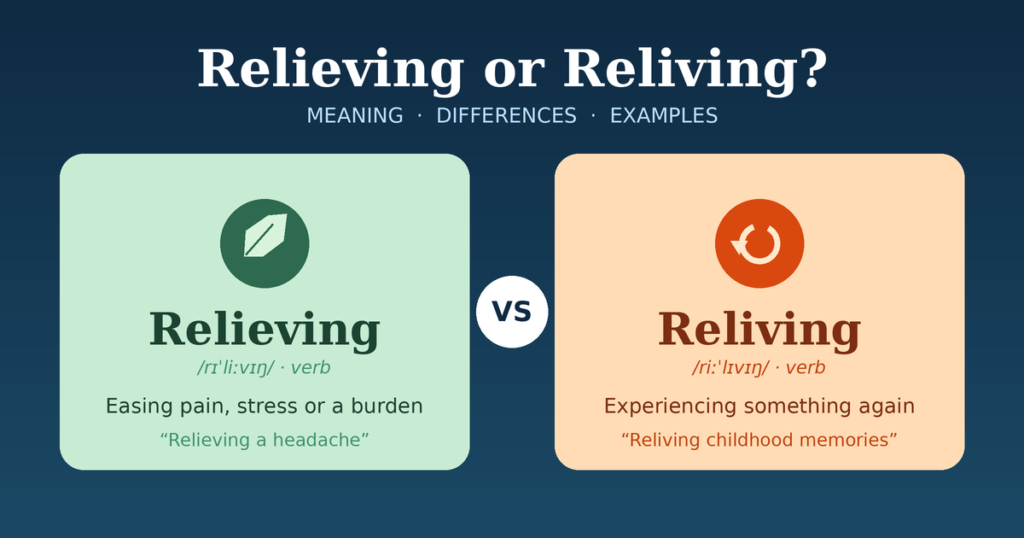
The difference is simple once you see it. Relieving means easing, lightening, or taking away something unpleasant, such as pain, stress, or a duty. Reliving means experiencing something again, usually through memory or imagination.
This guide explains what each word means, how to pronounce it, where it comes from, and how to pick the right one every time. You will find clear definitions, plenty of example sentences, a side-by-side comparison table, memory tricks, and a short practice section to test yourself.
Relieving vs Reliving: The Short Answer
- Relieving (ri-LEEV-ing) is the -ing form of relieve. It means easing pain or worry, lightening a burden, or taking over someone’s duty.
- Reliving (ree-LIV-ing) is the -ing form of relive. It means going through an event, feeling, or memory again.
Here is a quick way to remember the difference: reliving has the word “live” inside it, and you can only relive something you have already lived through. Relieving shares its stem with “relief.”
A matching pair of sentences shows the contrast:
- “The cold compress is relieving the swelling.” (easing it)
- “She spent the evening reliving her wedding day through old photos.” (experiencing it again in memory)
What Does Relieving Mean?
Definition of relieving
Relieving is the present participle and gerund of the verb relieve. To relieve something is to reduce it, lighten it, or remove it, usually when it is uncomfortable, heavy, or stressful. The word also has a workplace and military sense: to relieve a person is to take over their shift or release them from a duty.
So when you see “relieving,” think of making something lighter. Something heavy, painful, or tense becomes easier to carry.
The main meanings of relieving
Dictionaries list several senses of relieve. These are the ones you will meet most often:
- Easing pain or physical discomfort. “The ointment is relieving her itching.”
- Reducing stress, worry, or pressure. “A short walk is relieving some of my anxiety before the exam.”
- Lightening a burden or obligation. “The new policy is relieving the financial strain on small businesses.”
- Taking over from someone on duty. “The night nurse is relieving the day nurse at seven.”
- Freeing someone from a role or responsibility. “The board is relieving him of his duties as manager.”
- Breaking up monotony. “Bright cushions are relieving the plainness of the room.”
- Rescuing or lifting a siege. “Reinforcements are relieving the besieged town.”
- Using the toilet (a polite euphemism). “He was caught relieving himself behind a tree.”
The last one deserves a note. It is common in everyday speech, but it is informal and slightly blunt, so most writers keep it out of formal text.
Example sentences with relieving
- Drinking warm water with honey is relieving my sore throat.
- The rain was relieving the heat after a brutal week.
- Relieving customers of their worries about delivery dates is a big part of good service.
- The coach is relieving the starting pitcher after six innings.
- Knowing the results were clear was relieving in itself.
- Her calm voice kept relieving the tension in the room.
- The government is relieving part of the student debt.
- A few stretches before bed are relieving the stiffness in his back.
Relieving as part of compound adjectives
You will often see “relieving” attached to another word to describe a product or activity. When these come before a noun, they are normally hyphenated:
- pain-relieving cream
- stress-relieving exercises
- tension-relieving massage
- anxiety-relieving techniques
- symptom-relieving medication
If the phrase comes after the noun, the hyphen usually disappears: “This cream is great for relieving pain.” These compounds are a big reason people search for the word, since they appear on product labels and in health articles.
Common words that go with relieving
These partners show up again and again with relieving:
- relieving pain, stress, tension, pressure, anxiety, boredom
- relieving symptoms, discomfort, congestion, itching
- relieving a burden, debt, a workload
- relieving someone of their duties, command, or responsibility
- relieving a shift, a guard, a colleague
Notice the preposition in “relieving someone of something.” It is the standard pattern when a person is freed from a duty or burden.
Synonyms for relieving
In most contexts you can swap relieving for one of these:
- easing
- soothing
- alleviating
- lessening
- reducing
- calming
- lightening
- mitigating
For the duty sense, try “replacing,” “taking over from,” or “substituting for.” If none of these fit your sentence, you probably want the other word.
also read this:Deactivate vs. Inactivate: Meaning and Correct Usage
Where the word comes from
Relieve came into English through Old French from the Latin relevare, which meant “to raise up” or “to lighten.” That Latin verb is built from re- (again, back) and levare (to lift). The same root gives us elevate, lever, and levity. The idea of lifting a weight off someone is still the heart of the word today, and it is also why relief is the matching noun.
What Does Reliving Mean?
Definition of reliving
Reliving is the present participle and gerund of the verb relive. To relive something is to experience it again, most often in your mind. The memory can feel so vivid that it seems to be happening all over again.
The word is built from the prefix re- (again) plus live. That construction makes it easy to understand: you are living something again.
The main meanings of reliving
- Experiencing a memory vividly. “He kept reliving the final goal of that match.”
- Revisiting a past period through stories, photos, or objects. “We spent the afternoon reliving our school days.”
- Replaying an event through media. “Fans are reliving the concert through shaky phone videos.”
- Going through something unpleasant a second time, in thought or in fact. “I have no wish to relive that year.”
- Re-experiencing a distressing event through intrusive memories. “She described reliving the accident every time she heard a siren.”
Example sentences with reliving
- Grandpa loves reliving his days at sea.
- Reading old diaries is like reliving the best summer of my life.
- The documentary had me reliving every moment of the 1998 final.
- They stayed up late reliving their wedding through the photo album.
- I keep reliving that awkward conversation in my head.
- Playing the old game on a retro console had him reliving his childhood weekends.
- She avoids reliving the past and focuses on what comes next.
- Visiting the old campus felt like reliving a dream.
Common words that go with reliving
Reliving almost always takes an object that is a memory, event, or period of time:
- reliving memories, moments, the past
- reliving childhood, school days, the good old days, glory days
- reliving an experience, a trip, a match, a conversation
- reliving a nightmare, a mistake, an accident, a trauma
Synonyms for reliving
- revisiting
- re-experiencing
- recalling
- remembering
- replaying
- reminiscing about
- going back over
There is a small difference in strength. Remembering is light and neutral. Reliving is stronger, because it suggests the emotions return along with the facts. If you say you are “remembering your wedding,” you recall it. If you say you are “reliving your wedding,” you feel it again.
Reliving can be happy, painful, or neutral
The word itself carries no fixed mood. The context decides:
- Positive: reliving the glory days, reliving a great holiday
- Negative: reliving a loss, reliving a humiliating moment
- Neutral: reliving the plot of a book while retelling it
Because it can describe painful memories, you will also see it in discussions of mental health. In psychology, repeated and unwanted re-experiencing of a distressing event is a recognized symptom of post-traumatic stress. If this describes something you or someone close to you is dealing with, a doctor or licensed therapist is the right person to talk to. Everyday “reliving,” like looking through old photos, is a normal and often enjoyable part of life.
Relieving vs Reliving: Side-by-Side Comparison
This table puts the key differences in one place.
| Feature | Relieving | Reliving |
| Base verb | relieve | relive |
| Core meaning | Easing, lightening, or taking over from | Experiencing again |
| Pronunciation | ri-LEEV-ing | ree-LIV-ing |
| Vowel sound in the second syllable | Long “ee” (as in believe) | Short “i” (as in give) |
| Related words | relief, relieved, reliever | relived |
| Usually takes an object like | pain, stress, a burden, a person on duty | a memory, a moment, the past |
| Typical feeling | Comfort, release | Nostalgia, joy, or distress |
| Memory hook | Sounds like relief | Contains the word live |
| Example | “This tea is relieving my headache.” | “I keep reliving that interview.” |
Why People Confuse Relieving and Reliving
Several things make this pair tricky.
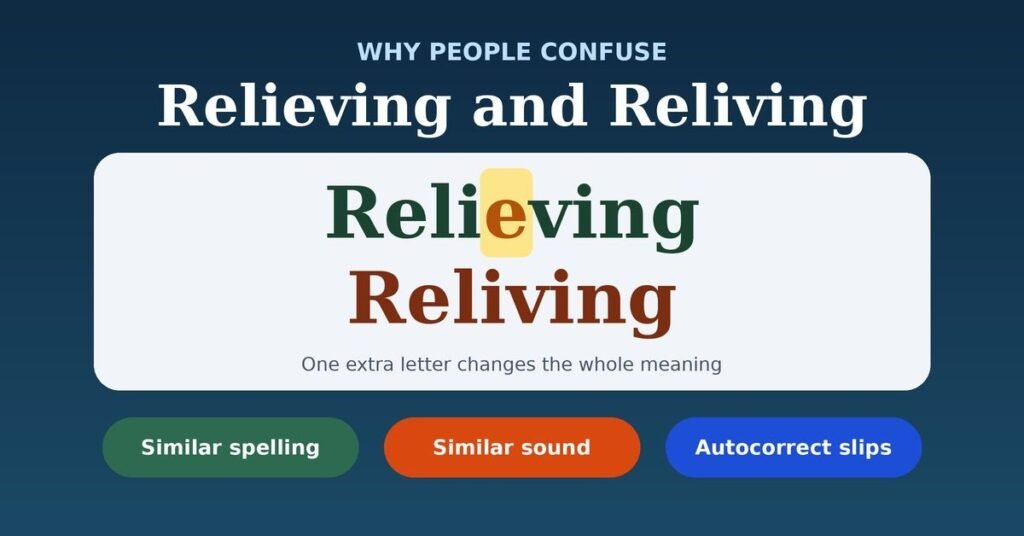
- They differ by one letter. “Relieving” has an extra e, and that tiny difference is easy to miss when typing or proofreading.
- Both are real words. Spellcheck treats them as correct, so the error survives editing.
- Both fit emotional sentences. “I was relieving that moment” and “I was reliving that moment” are both grammatically possible, so the sentence does not look wrong at a glance, even though only one makes sense.
- Fast speech blurs the sounds. In casual conversation the two can sound closer than they really are.
- The related forms collide too. Relieved (feeling comforted) and relived (experienced again) cause the same mix-up in the past tense.
How to Tell Relieving and Reliving Apart: Four Easy Tricks
1. Look for the word “live”
If you can find “live” inside the word, you are looking at reliving. It is “re-live-ing”: living again. Relieving does not contain that word.
2. Use the rhyme test
Relieve rhymes with believe, achieve, and grieve. Relive rhymes with give. Say the sentence aloud. If the verb should sound like “believe,” it is relieve. If it should sound like “give,” it is relive.
3. Try the substitution test
Replace the word in your sentence and see what survives:
- If “easing” or “lightening” works, use relieving.
- If “experiencing again” or “going through again” works, use reliving.
Test it: “The medicine is easing the pain” makes sense, so it is relieving. “She is going through again her school days” makes sense, so it is reliving.
4. Ask what the sentence is about
Ask yourself whether the sentence is about comfort or memory. Comfort points to relieving. Memory points to reliving.
A quick pronunciation guide
- Relieving: /rɪˈliːvɪŋ/, stress on the second syllable, long “ee.” Say “ri-LEEV-ing.”
- Reliving: /riːˈlɪvɪŋ/, stress on the second syllable, short “i.” Say “ree-LIV-ing.”
Both words put the stress on the second syllable. The difference is in the vowel you hear right after the “l.”
Spelling and Verb Forms
Both verbs are regular, and both drop the final e before adding -ing. Here are all the forms side by side.
| Form | Relieve | Relive |
| Base | relieve | relive |
| Third person singular | relieves | relives |
| Past tense | relieved | relived |
| Past participle | relieved | relived |
| Present participle / gerund | relieving | reliving |
| Related noun | relief, reliever | none |
A few spelling points are worth knowing:
- The standard spelling of relive is one word, without a hyphen. You may spot “re-live” occasionally, but most dictionaries and style guides prefer “relive.”
- Relieve follows the “i before e” pattern in its stem, just like believe, retrieve, and grieve.
- There is no noun “reliever” for relive. “Reliever” belongs to relieve (a relief pitcher, for example).
Also read this:Shinning vs Shining: Which Spelling Is Correct?
How Relieving Is Used in Real Situations
Health and medicine
This is where you will meet the word most. It describes anything that eases a symptom:
- “Saline spray is relieving her congestion.”
- “The patch works by relieving muscle pain.”
- “Rest was relieving some of the strain on his knee.”
Stress and emotions
People use it for emotional lightness too:
- “Talking to a friend was relieving a lot of my worry.”
- “Laughing together was relieving the tension after the argument.”
Work and responsibility
In workplaces, the word often means taking over or being released:
- “I am relieving Priya at the front desk at noon.”
- “The captain is relieving the officer of duty.”
- “Hiring two more staff members is relieving the pressure on the team.”
Finance and policy
You will also see it in news writing about economic measures:
- “The program is relieving the burden of high energy costs for families.”
- “Lower interest rates are relieving pressure on borrowers.”
Sports
In baseball, a “relief pitcher” (also called a reliever) comes into the game to replace the starter. When a commentator says the manager is “relieving the pitcher,” the word keeps its original sense of taking over.
Military and emergencies
The verb has a long history here: relieving troops, relieving a guard post, relieving a besieged city. The idea is always the same. Someone arrives to lift the load from those already there.
How Reliving Is Used in Real Situations
Nostalgia and memories
This is the most common use, and it is usually warm:
- “We spent the weekend reliving our college days.”
- “Flipping through the yearbook had her reliving every prank.”
Travel and photos
People relive trips through pictures, souvenirs, and stories:
- “I enjoy reliving our Lahore trip every time I scroll through my camera roll.”
- “He was reliving the sunset over the mountains in his mind.”
Entertainment and games
Rewatching, replaying, and revisiting count as reliving when the experience feels fresh again:
- “Watching the highlights was like reliving the whole tournament.”
- “They’re reliving their teenage years with a retro game night.”
Difficult memories
The word also describes the pull of painful moments:
- “I kept reliving the mistake long after the meeting ended.”
- “She stopped reliving the argument once she wrote down what she wanted to say.”
Storytelling and reunions
Family gatherings and school reunions are classic reliving moments, when people tell the same stories and feel the same laughs return.
Relieving and Reliving in the Same Sentence
Because the words are close, writers sometimes use them together on purpose. These examples show how different they are in practice:
- “Reliving our school days was surprisingly relieving after such a stressful month.”
- “He found that relieving his guilt meant no longer reliving the mistake every night.”
- “The therapist focused on relieving her anxiety without making her relive every detail.”
- “For Ahmed, reliving old football matches was relieving, a gentle break from work.”
In each sentence, one word is about experiencing again and the other is about easing or lightening. Seeing them together makes the contrast hard to forget.
Common Mistakes and How to Fix Them
| Incorrect | Correct | Why |
| She enjoys relieving her childhood memories. | She enjoys reliving her childhood memories. | Memories are experienced again, not eased. |
| This cream is great for reliving muscle pain. | This cream is great for relieving muscle pain. | The cream eases pain. |
| I’m reliving the headache with a tablet. | I’m relieving the headache with a tablet. | Easing a symptom, not experiencing it again. |
| He keeps relieving the accident in his mind. | He keeps reliving the accident in his mind. | Re-experiencing a past event. |
| The nurse is reliving the doctor at midnight. | The nurse is relieving the doctor at midnight. | Taking over a shift. |
| We were reliving to hear the news. | We were relieved to hear the news. | Feeling comforted needs relieved, not reliving. |
A good habit when proofreading is to scan for these two words specifically. Each time you find one, run the substitution test from earlier. It takes a few seconds and catches nearly every mistake.
Relieved vs Relived: The Same Mix-Up in the Past Tense
The confusion does not stop at -ing. The past forms behave the same way.
- Relieved means comforted or freed from worry. It is also the past tense of relieve. “I was relieved when the results came back clear.”
- Relived means experienced again. It is the past tense of relive. “She relived the moment in her dreams.”
A few more examples:
- “He felt relieved after the interview.” (a feeling of comfort)
- “He relived the interview all night.” (replayed it in his mind)
- “They were relieved of their duties.” (released from them)
- “They relived their honeymoon on the anniversary.” (experienced it again)
Note that “relieved” is also a common adjective, as in “a relieved smile,” while “relived” is almost always a verb.
Related Words Worth Knowing
Understanding the family around each word makes both easier to remember.
Words connected to relieving
- Relief (noun): the feeling of comfort when something unpleasant ends. “What a relief!”
- Relieved (adjective): feeling that comfort. “I’m so relieved.”
- Reliever (noun): someone or something that relieves, such as a pain reliever or a relief pitcher.
- Relievable (adjective): able to be eased. This one is rare.
Words connected to reliving
- Relive (verb): the base form.
- Relived (verb, past): experienced again.
- Reliving (verb or gerund): experiencing again, as in “Reliving the past can be bittersweet.”
If you remember that every “relief” word has the ie pair and the live words keep their i alone, you have most of the pattern.
Tips for Writers: Choosing the Right Word Every Time
Here is a short routine you can use whenever one of these words shows up in your writing.
- Read the sentence aloud. Does it sound like “believe” or like “give”?
- Substitute a simpler phrase. “Easing” points to relieving. “Experiencing again” points to reliving.
- Check the object. Pain, stress, burdens, and people on duty go with relieving. Memories, moments, and past periods go with reliving.
- Look at the context. Comfort and release suggest relieving. Memory and repetition suggest reliving.
- Proofread separately. Do one pass only for these words, since spellcheck will not help.
For product descriptions and health content, double-check every “pain-relieving” or “stress-relieving” phrase. A single wrong letter in a label or heading can make a brand look careless.
Practice: Choose the Correct Word
Try these before checking the answers. Each sentence needs either relieving or reliving.
- This gel is great for ______ joint pain.
- They spent Sunday ______ their wedding through old videos.
- The new manager is ______ the outgoing one this afternoon.
- I keep ______ that embarrassing moment from the party.
- A cup of chamomile tea is good for ______ stress.
- Looking at the photographs had him ______ the whole trip.
- Rain was ______ the oppressive heat.
- She is ______ her teenage years by rewatching her favorite shows.
- The government is ______ families of some of the tax burden.
- Watching the replay had the whole team ______ the victory.
Answers
- relieving
- reliving
- relieving
- reliving
- relieving
- reliving
- relieving
- reliving
- relieving
- reliving
Quick Reference Summary
- Relieving = easing, lightening, or taking over from someone.
- Reliving = experiencing something again, often in memory.
- Relieving rhymes with believing and links to relief.
- Reliving contains live.
- Relieved and relived follow the same split in the past tense.
- Pain-relieving and stress-relieving are standard hyphenated compounds before nouns.
Conclusion
Relieving and reliving may look like twins, but they point in opposite directions. Relieving is about lifting something off, whether that is pain, stress, a debt, or a shift at work. Reliving is about going back and feeling something again, whether that is a happy holiday, a school reunion, or a memory you would rather forget.
The quickest checks are the ones you can run in seconds. Look for “live” inside reliving. Say the verb out loud and listen for “believe” or “give.” Swap in “easing” or “experiencing again” and see which one makes sense. With those three habits, you will almost never mix the two up again.
Once you start noticing these words in articles, product labels, and everyday conversation, you will see how often they appear and how clearly each one fits its own job. Use relieving when you mean comfort. Use reliving when you mean memory. Your writing will be clearer, and your readers will notice.