
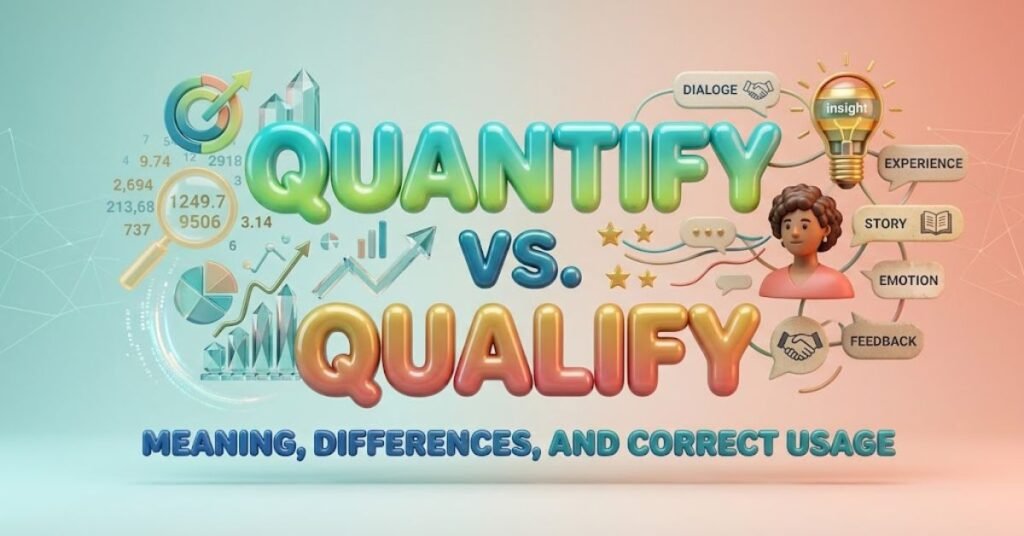

You are reading a report draft and spot the line “We need to qualify the damage.” Does the writer want a number, or does the writer want to soften the claim? Without context, you cannot tell. That is exactly why quantify vs. qualify trips up so many writers, students, and professionals.
The two verbs look alike and sound alike, and both show up in business meetings, research papers, and job applications. But they do very different work.
Quick answer
To quantify is to measure something or express it as a number. To qualify is to describe it, limit it, add conditions to it, or show that you meet a requirement. Quantify answers “how much?” Qualify answers “what kind?” or “under what conditions?”
This guide covers the meaning of each word, the key differences, real example sentences, common mistakes, and simple tricks to choose the right word every time. It draws on standard dictionary definitions and on how research-method guides treat measurable versus descriptive information.
Quantify vs. Qualify at a Glance

Before going deeper, here is the whole idea in a few lines:
- Quantify = turn something into numbers (count it, measure it, put a value on it).
- Qualify = add meaning, limits, or conditions, or meet a standard.
- Quantify links to quantity. Qualify links to quality.
- A quantified statement gives you a figure. A qualified statement gives you context.
| Feature | Quantify | Qualify |
| Core meaning | Express or measure as a number | Describe, limit, or meet a standard |
| Key question | How much? How many? | What kind? Under what conditions? |
| Root idea | Quantity | Quality |
| Output | Figures, percentages, metrics | Conditions, descriptions, eligibility |
| Typical setting | Data, finance, science | Writing, law, hiring, sports |
| Example | “Quantify the cost savings.” | “Qualify your claim with a source.” |
What Does Quantify Mean?
Definition
To quantify means to determine, measure, or express the amount of something. When you quantify a thing, you give it a numerical value so it can be compared, tracked, or analyzed.
The word comes from the Latin quantus, meaning “how great” or “how much.” That root still explains its job today: quantify is always about size, amount, or degree.
Quantify in Everyday Sentences
- “Researchers tried to quantify how much sleep the students lost during exams.”
- “It is hard to quantify the value of good customer service.”
- “The team quantified the risk at roughly 12 percent.”
- “Can you quantify that improvement for the board?”
Notice the pattern. Each sentence either contains a number or asks for one.
Words That Often Pair With Quantify
Writers tend to use quantify with a predictable set of nouns. Recognizing them helps you spot correct usage quickly:
- quantify impact
- quantify risk
- quantify results
- quantify performance
- quantify savings or losses
- quantify uncertainty
- quantify progress
Related words follow the same logic. A quantifiable goal can be measured. Quantification is the act of measuring. A quantity is the amount itself.
When Something Resists Quantifying
Some things are tough to put into numbers: loyalty, creativity, trust, brand reputation. People often say these are “hard to quantify.” That phrase is perfectly correct. It means you cannot easily attach a number to them, not that they have no value.
What Does Qualify Mean?
Here is where confusion starts. Qualify is a flexible verb with several meanings. Most of them have nothing to do with numbers, which is the whole point of this comparison.
The word traces back to the Latin qualis, meaning “of what kind.” That root explains why qualify keeps pointing toward kind, character, and condition.
Meaning 1: To Meet a Requirement
This is probably the most common use. If you qualify for something, you satisfy the conditions to receive it.
- “She qualifies for the scholarship.”
- “You must be 18 to qualify for the program.”
- “His experience qualifies him for the senior role.”
Meaning 2: To Limit or Modify a Statement
Here, to qualify a statement is to soften it, narrow it, or add conditions so it becomes more accurate.
- “I’d qualify that claim: it holds true only for small companies.”
- “He qualified his praise with a few concerns.”
- “The doctor qualified her answer by noting the test was not final.”
This is the sense most often mixed up with quantify, because both involve making a statement more precise. The difference is the method. Quantifying uses numbers. Qualifying uses conditions and wording.
Meaning 3: To Describe or Characterize
Sometimes qualify means to label something by its qualities.
- “Most people would qualify the film as a thriller.”
- “The sales team qualifies a lead as warm or cold.”
Meaning 4: To Advance in a Competition
In sports and contests, qualify means to earn a place in the next stage.
- “Pakistan qualified for the next round.”
- “She qualified for the finals with her best time yet.”
Meaning 5: To Make Someone Eligible or Competent
- “A medical degree qualifies you to practice.”
- “That certificate qualified him as an electrician.”
Related Forms
| Word | Meaning | Example |
| Qualified | Meeting requirements; limited by conditions | “a qualified teacher”; “qualified approval” |
| Qualification | A skill or credential; also a limiting condition | “Her qualifications are strong.” |
| Qualifier | A word or phrase that limits meaning | “Words like often are qualifiers.” |
| Qualifying | Relating to eligibility or a preliminary round | “the qualifying match” |
Quantify vs. Qualify: The Key Differences
The two verbs differ in purpose, method, and result. Think of it this way: quantifying sizes up a thing, while qualifying shapes what you say about it.
1. Purpose
Quantifying aims to measure. Qualifying aims to clarify, limit, or establish eligibility.
2. Method
Quantifying relies on counting, calculating, and data. Qualifying relies on words, conditions, and judgment.
3. Result
A quantified result is a number: “Sales rose 14 percent.” A qualified result is a statement with context: “Sales rose, mainly because of a holiday promotion.”
4. Objectivity
Numbers feel objective and comparable. Qualification carries nuance, which is valuable but more open to interpretation.
Detailed Comparison
| Aspect | Quantify | Qualify |
| Part of speech | Verb | Verb |
| Meaning in short | Measure with numbers | Add conditions or meet criteria |
| Question answered | “How much?” | “In what way? Under what terms?” |
| Used with | Data, costs, risk, impact | Statements, claims, candidates, teams |
| Common nouns | Quantity, quantification | Quality, qualification, qualifier |
| Adjective forms | Quantifiable, quantified | Qualified, qualifying |
| Tone | Precise, analytical | Careful, nuanced |
| Sample sentence | “We quantified the delay at six days.” | “We qualified the delay as minor.” |
Same Topic, Two Different Moves
Take one situation: a restaurant’s slow service.
- Quantify: “Customers waited an average of 28 minutes for their food.”
- Qualify: “Service was slow, though only during the Friday dinner rush.”
The first gives you the size of the problem. The second gives you the circumstances. Neither is better. They answer different questions.
Also Read This:https://trendingarena.com/of-course-or-ofcourse/
Why People Confuse Quantify and Qualify
Several things push writers toward the wrong choice.
They look similar. Both start with qu, both end with -ify, and both have three syllables. In fast reading, the eye can slide right past the difference.
They both make statements more precise. Because each one sharpens meaning, people assume they are interchangeable. They are not. One adds a number; the other adds a condition.
Qualify has many meanings. A word with five senses invites mistakes. Someone who knows “qualify for a job” may not realize the same verb also means “limit a claim.”
Autocorrect and speed. A quick typo can turn one into the other, and spellcheck will not flag it, since both are real words.
Quantify, Qualify, Quantitative, and Qualitative
A related pair causes just as many slip-ups. The adjectives quantitative and qualitative come from the same roots as our two verbs.
| Term | Type | Meaning | Example |
| Quantify | Verb | To measure or express in numbers | “Quantify the results.” |
| Quantitative | Adjective | Based on numbers and measurement | “quantitative survey data” |
| Qualify | Verb | To limit, describe, or meet criteria | “Qualify the statement.” |
| Qualitative | Adjective | Based on qualities, opinions, or experiences | “qualitative interviews” |
Quantitative vs. Qualitative Data
In research, quantitative data is numerical. It answers questions like how many, how often, and how large. Think survey scores, sales figures, test results, and website traffic.
Qualitative data is descriptive. It explores experiences, opinions, and reasons. Think interview transcripts, open-ended survey comments, and field observations.
Notice a small trap: you quantify data to produce quantitative results, but you do not “qualify” interviews to produce qualitative ones. Researchers analyze, code, or interpret qualitative material. The verb “qualify” belongs to a different job.
Why Many Teams Use Both
Numbers tell you what is happening. Words often explain why. A company might see that customer cancellations rose 9 percent (quantitative), then run interviews to learn that a confusing billing page caused it (qualitative). Combining both approaches is commonly called a mixed-methods approach.
How to Use Quantify Correctly
Follow these steps when you reach for the word.
- Check for a measurable target. Can the thing be counted, timed, priced, or scored?
- Name what you measured. “Quantify the risk” works better than a vague “quantify it.”
- Add the number if you have it. A quantified claim without a figure feels unfinished.
- Keep the unit clear. Percent, dollars, hours, or units sold.
Good Examples
- “We quantified customer churn at 4.2 percent per month.”
- “The study quantifies the link between exercise and sleep quality.”
- “Please quantify the budget impact before Friday.”
Weak vs. Strong
| Weak | Stronger |
| “We improved things a lot.” | “We cut average response time from 12 hours to 4.” |
| “The project saved money.” | “The project saved $18,000 in six months.” |
| “Many users liked it.” | “Eighty-one percent of users rated it four stars or higher.” |
How to Use Qualify Correctly
Because qualify has several meanings, check which one you intend.
- Eligibility? Use qualify for plus the thing you are eligible for.
- Limiting a claim? Use qualify plus the statement, often with by or with.
- Describing something? Use qualify as.
- Competition? Use qualify for the next round.
Prepositions Matter
| Pattern | Meaning | Example |
| qualify for | Be eligible | “They qualify for a refund.” |
| qualify as | Count as a type | “That qualifies as a breach.” |
| qualify to (+ verb) | Become entitled to do something | “She qualified to teach.” |
| qualify by/with | Limit a statement | “He qualified it with a warning.” |
Good Examples
- “To qualify for the discount, spend over $50.”
- “I should qualify my earlier remark: I was talking about our U.S. office.”
- “Does a part-time role qualify as work experience?”
Common Qualifier Words
When you qualify a statement, you often reach for words that narrow or soften it:
- generally, usually, often, typically
- in most cases, to some extent, in part
- may, might, could, tends to
- as far as we know, under certain conditions
Used well, these make writing honest. Used constantly, they make writing mushy. Aim for balance.
Quantify vs. Qualify in Real Situations
In Business and Marketing
Managers quantify to prove value: return on investment, conversion rates, cost per lead, churn. Sales teams qualify leads, which means deciding whether a prospect is likely to buy based on budget, authority, need, and timing.
So a single sales meeting can include both:
- “Let’s quantify the pipeline: forty leads, worth about $300,000.”
- “Let’s qualify these leads first. Which ones have an actual budget?”
On a Resume
Hiring managers love numbers. Quantifying your achievements makes them concrete.
| Vague | Quantified |
| “Managed a team.” | “Managed a team of eight support agents.” |
| “Improved sales.” | “Increased regional sales by 22 percent in one year.” |
| “Handled many clients.” | “Handled a portfolio of 35 active clients.” |
Meanwhile, qualifying appears in a different place: your qualifications, the skills and credentials that make you eligible for the role.
In Academic and Scientific Writing
Scientists quantify results with statistics. They also qualify conclusions to avoid overreach. A sentence like “The treatment reduced symptoms in 60 percent of participants” quantifies. A follow-up like “though the sample was small, and results may not apply to older adults” qualifies.
Good research writing does both. Numbers provide evidence, and careful qualification protects honesty.
In Everyday Conversation
- “How much did the trip cost?” invites you to quantify.
- “It was fun, but only because the weather held up” qualifies your opinion.
In Law and Contracts
Legal writing leans heavily on qualification: conditions, exceptions, and limits. A phrase such as “subject to the terms below” qualifies a promise. Specific amounts and dates, meanwhile, quantify obligations.

In Sports and Competitions
Here only qualify appears: teams qualify for tournaments, athletes qualify for finals. You would never say a team “quantified” for the playoffs.
Common Mistakes and How to Fix Them
| Mistake | Why it is wrong | Correction |
| “We need to qualify the sales growth.” (meaning measure it) | Qualify does not mean measure | “We need to quantify the sales growth.” |
| “He quantified for the final round.” | Quantify cannot mean become eligible | “He qualified for the final round.” |
| “Please quantify your answer with a source.” (meaning add a condition) | Adding a source or caveat is qualifying | “Please qualify your answer with a source.” |
| “Qualifying the results” when you mean adding numbers | Wrong verb for numeric work | “Quantifying the results” |
| “She is quantified for the job.” | Quantified relates to numbers | “She is qualified for the job.” |
The Tricky Case: “Quantify the Impact” vs. “Qualify the Impact”
Both phrases are grammatical. They simply say different things.
- Quantify the impact: put a number on it. “The outage cost us $40,000.”
- Qualify the impact: describe or limit it. “The outage mostly affected mobile users.”
Ask yourself what the reader needs: a figure or a clarification.
Overusing Either Word
Both verbs can turn stiff in casual writing. If “quantify” feels heavy, try measure, count, put a number on. If “qualify” sounds formal, try add a caveat, narrow, or soften. Plain words often read better.
Easy Ways to Remember the Difference
The Root Trick
- Quantify → quantity → numbers
- Qualify → quality → description and conditions
The Two-Question Test
Before choosing, ask:
- Am I measuring, or am I explaining? Measuring means quantify. Explaining or limiting means qualify.
- Is there a number involved? If yes, quantify. If no, consider qualify.
The Swap Test
Replace the verb with a plain alternative:
- If measure fits, use quantify.
- If limit, describe, or be eligible fits, use qualify.
“We need to measure the damage” works, so the verb is quantify. “We need to limit that statement” works, so the verb is qualify.
The Read-Aloud Check
Say the sentence out loud. If it sounds like counting, quantify. If it sounds like adding a “but” or “as long as,” qualify.
Quantify and Qualify Together: A Worked Example
The strongest writing often uses both verbs. Consider a short project update.
Before (vague): “The new onboarding flow helped. People seemed happier, and sign-ups went up.”
After (quantified and qualified): “The new onboarding flow raised sign-ups by 17 percent over four weeks. That gain appeared mainly among mobile users, and four weeks is too short to confirm it will last.”
What changed?
- The number “17 percent over four weeks” quantifies the result.
- The phrases “mainly among mobile users” and “too short to confirm” qualify the claim.
The reader now knows how big the effect is and how far to trust it. That combination is what makes a statement credible, and it is a good habit for anyone writing reports, proposals, or articles.

Quick Practice: Quantify or Qualify?
Pick the right verb for each sentence, then check the answers below.
- We need to ______ the carbon emissions of each factory.
- Only students with a 3.5 GPA ______ for the honors program.
- I would ______ that statement: it only applies in rural areas.
- Analysts tried to ______ the effect of the price change on demand.
- Does a weekend workshop ______ as formal training?
- The company can ______ its savings at nearly $2 million.
Answers:
- quantify (measuring emissions)
- qualify (meeting a requirement)
- qualify (limiting a claim)
- quantify (measuring an effect)
- qualify (counting as a type)
- quantify (expressing savings as a figure)
If you got five or six right, you have a solid grip on the difference.
Practical Tips for Writers and Professionals
- Quantify when you want proof. Wherever a claim can be backed by a figure, add one.
- Qualify when you want accuracy. If a statement is not universally true, say where it holds.
- Do not hide behind qualifiers. Too many “might” and “perhaps” phrases weaken your message.
- Do not fake precision. Quantifying something that cannot be measured reliably can mislead. Saying “customer happiness rose 37.4 percent” from three casual chats looks scientific but is not.
- Match the verb to the question. If the question is “how big?” quantify. If it is “how, when, or for whom?” qualify.
- Proofread for swaps. Search your draft for both verbs and confirm each one does the job you intended.
Conclusion
The difference between quantify and qualify comes down to one simple idea. Quantify gives you a number, while qualify gives you a condition, a description, or a claim to eligibility. Quantify links to quantity and answers “how much?” Qualify links to quality and answers “what kind?” or “under what circumstances?” Use quantify for data, results, and measurable impact. Use qualify for limiting claims, describing things, meeting requirements, or advancing in a contest.
When you are unsure, ask whether you are measuring or explaining, and swap in a plain word like measure or limit to test your choice. A few seconds of care protects your credibility, whether you are writing a resume, a research paper, or an email to your manager. Use both verbs well, and your writing becomes both precise and trustworthy.