
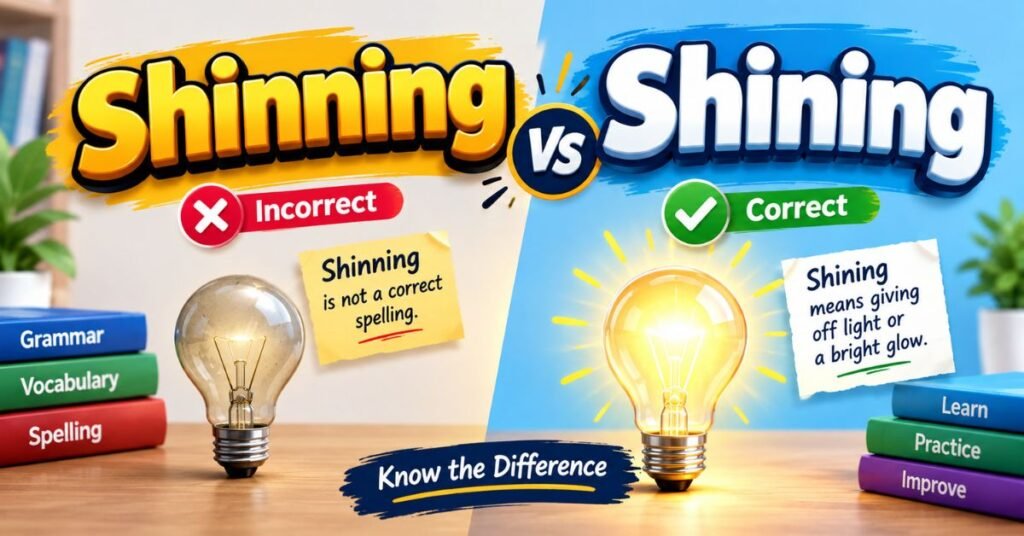

You are typing a sentence about the sun, a star, or a proud moment, and you pause. Is it “the sun is shinning” or “the sun is shining”? The two spellings look almost identical, and spellcheck does not always rescue you.
The short version: “shining” is the correct spelling for light, brightness, and polish. “Shinning” is a real word, but it means something completely different. This guide explains the difference, the grammar rule behind it, and how to get it right every time.
Quick Answer
Shining is the correct spelling when you mean giving off light, glowing, being bright, or standing out. It is the present participle of the verb shine.
Shinning is the present participle of a different verb, shin, which means to climb something by gripping it with your hands and legs. It has nothing to do with light.
| Spelling | Correct for light? | What it means | Example |
| Shining | Yes | Giving off light, glowing, excelling | The sun is shining. |
| Shinning | No | Climbing up using hands and legs | He was shinning up the pole. |
If your sentence is about brightness, shine, or sparkle, use shining. If it is about climbing, shinning might be right, but that is rare.
Deep Explanation with Real Context
Most spelling errors happen because a word looks “almost right.” Shining vs shinning is a classic case. Both are real English forms, so a spellchecker may accept either one without complaint.
The confusion comes from sound as much as sight. When you say the word aloud, you hear a short “ih” sound before the “ning.” That sound makes many writers think a double n is needed. In reality, the vowel in shine is long, and that changes the spelling rules completely.
Here is a quick way to think about it:
- Shine has a long i sound (as in “kite”). The silent e creates that sound.
- Shin has a short i sound (as in “sit”). There is no silent e.
When you add -ing, each word follows its own pattern. Shine drops the e and becomes shining. Shin doubles its final consonant and becomes shinning. Same ending, different rules, different meanings.
Why this matters in real writing
A single wrong letter can change the meaning of a sentence. “The stars were shinning above us” suggests, to a careful reader, that stars were climbing something. In a school essay, a business email, a cover letter, or a blog post, that slip makes the writing look careless. Getting it right takes a few seconds and protects your credibility.
Shining vs Shiny, Shinny, and Shone
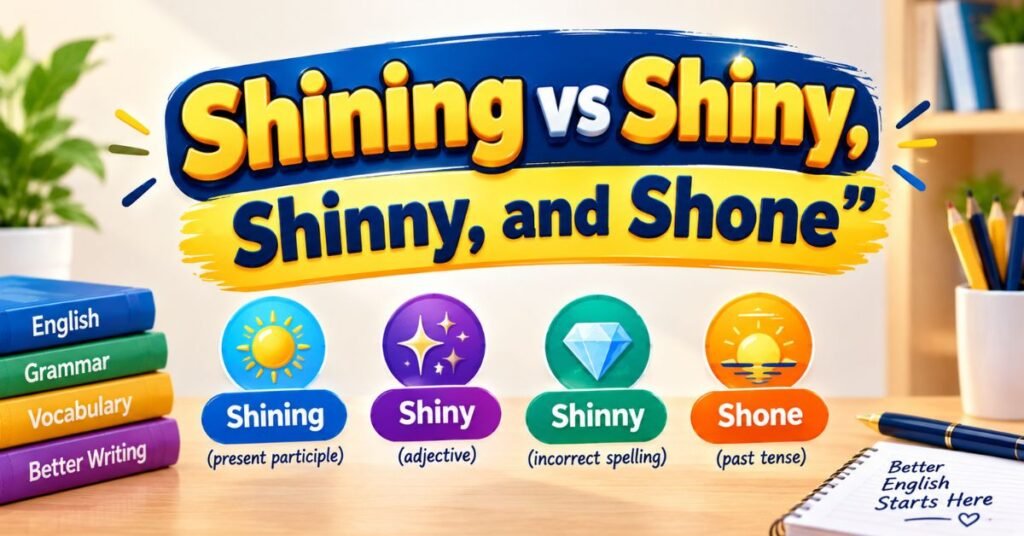
Several related words cause trouble alongside shining. Here is how they fit together.
| Word | Part of speech | Meaning | Example |
| Shine | Verb / noun | To give off light; a glow or polish | The lamp will shine all night. |
| Shining | Verb form / adjective | Currently giving light; outstanding | A shining example of teamwork. |
| Shone | Past tense | Gave off light (no object) | The moon shone over the lake. |
| Shined | Past tense | Polished (with an object) | She shined her shoes. |
| Shiny | Adjective | Bright and reflective | A shiny new coin. |
| Shinny | Verb / noun | To climb; also informal street hockey | The boys shinny up the tree. |
| Shinning | Verb form | Climbing with hands and legs | He is shinning up the rope. |
Shone or shined?
Both are correct past forms of shine, but they are used differently:
- Use shone when the subject gives off light on its own: “The sun shone all afternoon.”
- Use shined when someone polishes something: “He shined the trophy before the ceremony.”
Many American writers also use shined for light, but shone remains the standard choice in formal writing.
Shiny vs shining
Shiny describes how a surface looks: bright, smooth, and reflective. Shining describes light being given off, or something that stands out as excellent.
- A shiny car has a polished, reflective finish.
- A shining light is actively glowing.
- A shining performance is outstanding.
What Does Shinning Mean and Why It Is Misleading
Shinning comes from the verb shin. In this sense, to shin means to climb a pole, rope, or tree by gripping it with your arms and legs. You will most often see it in the phrase “shinning up” something.
Examples:
- The sailor was shinning up the mast.
- Two kids were shinning up the old oak tree.
The word is also tied to shin, the front of the lower leg, which is why the climbing sense exists in the first place.
So why is shinning misleading? Because it looks like a natural spelling of shining and it is a legitimate word. Your spellchecker will usually let it through. That is the trap. The tool sees a real word and assumes you meant it.
The result is a sentence like this:
The morning sun was shinning through the window.
It reads smoothly, but it is wrong. The sun is not climbing the window. It is shining through it.
Shinning vs Shining Grammar and Meaning Breakdown
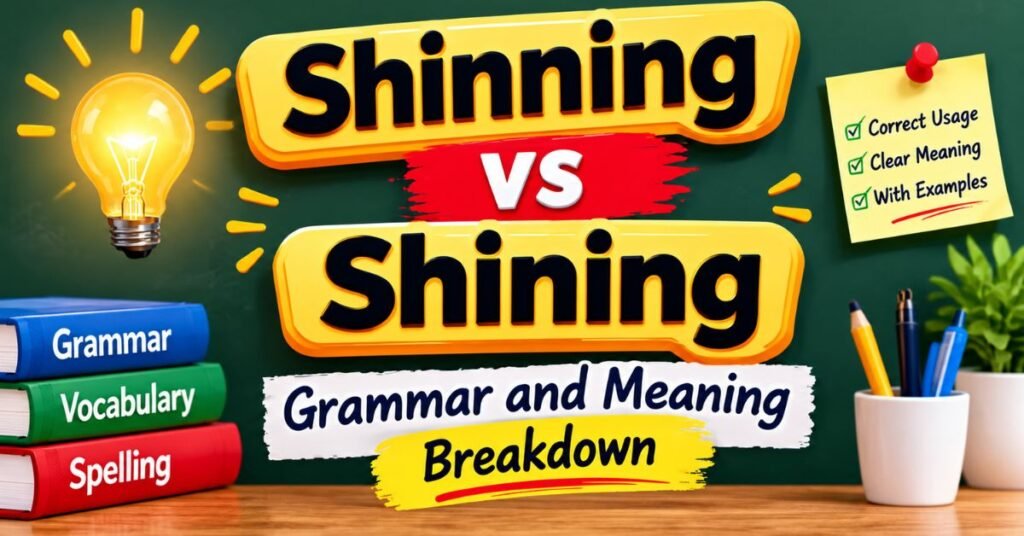
Let us compare the two words side by side so the difference is easy to remember.
| Feature | Shining | Shinning |
| Base verb | shine | shin |
| Vowel sound | Long i (shyne) | Short i (shin) |
| Spelling change | Drop the silent e | Double the final n |
| Core meaning | Light, glow, excellence | Climbing |
| Frequency | Very common | Rare |
| Used as adjective? | Yes (“a shining example”) | Not typically |
A simple memory trick
Ask yourself one question: “Is anything giving off light or standing out?”
- If yes, you want shining.
- If the answer is “someone is climbing,” you want shinning.
You can also use this: the word shine has a silent e that “disappears” when -ing arrives. The word shin has no e to lose, so it keeps its letters and adds an extra n.
How to Spell Shining Correctly and Why It Matters
Spelling shining correctly takes only two steps:
- Start with the base verb: shine.
- Remove the final silent e and add -ing: shin + ing = shining.
That is it. No doubled letter is needed.
Common mistakes to avoid
- Writing shinning for light (the most common error).
- Writing shinning in headings, captions, or social media posts where nobody proofreads.
- Assuming a word is correct because spellcheck does not flag it.
Why correct spelling matters
Readers form quick judgments. A wrong spelling in a resume, an application, or a website can lower trust, even if the rest of the writing is excellent. Search engines also match queries to correctly spelled content, so accurate spelling helps readers find what they need.
A good habit is to proofread any -ing word that comes from a verb ending in silent e. Those are the words most likely to cause trouble.
Shining in a Sentence Advanced Usage and Context
Shining works in more situations than most people realize. It can be a verb form, an adjective, or part of a longer phrase.
As a present participle (action in progress)
- The sun is shining on the hills.
- A flashlight was shining into the dark corridor.
- She kept shining the brass until it glowed.
As an adjective (describing a noun)
- The company set a shining example for others.
- He wore a shining suit of armor in the play.
- The children had shining faces after the performance.
In figurative language
- Her talent was shining through, even in a small role.
- The team’s shining moment came in the final minute.
In formal and professional writing
- The report highlights several shining examples of good practice.
- The new design is a shining achievement for the engineering team.
Notice that in every case, the idea is light, brightness, or excellence. That is your signal to use the one-n spelling.
Shinning in a Sentence Why It Leads to Errors
When shinning is used correctly, it sits in a very narrow context: climbing.
Correct uses of shinning
- The scout was shinning up the flagpole.
- He spent the afternoon shinning up the rope in the gym.
Incorrect uses of shinning
These sentences all contain the same mistake:
- The stars are shinning brightly tonight. ❌
- Her new shoes were shinning in the light. ❌
- He is a shinning example of hard work. ❌
The corrected versions:
- The stars are shining brightly tonight. ✅
- Her new shoes were shining in the light. ✅
- He is a shining example of hard work. ✅
Why the error is so common
There are three main reasons:
- It is a real word. Spellcheck tools may not flag it.
- Doubling rules feel natural. Many verbs double their last letter before -ing (running, sitting, winning), so writers assume the same applies here.
- Fast typing. An extra n is easy to add without noticing.
Shining vs Shinning in Different Sentences
Seeing both words in context is the fastest way to lock in the difference. Read each pair and notice how the meaning changes.
| Sentence | Correct word | Why |
| The lighthouse is ___ across the bay. | shining | It gives off light. |
| The monkey was ___ up the pole. | shinning | It is climbing. |
| Her smile was ___ with pride. | shining | Brightness and emotion. |
| He is ___ up the drainpipe to reach the roof. | shinning | Climbing by gripping. |
| The lamp is ___ on the desk. | shining | Light being given off. |
| The trophy looked ___ after the polish. | shining (or shiny) | Bright and reflective. |
Quick comparison in full sentences
- “The lantern is shining.” — The lantern gives off light.
- “The boy is shinning.” — The boy is climbing something, and a reader will wonder what.
If a sentence about shinning leaves a reader asking, “Climbing what?”, the writer probably meant shining.
Sun Shining or Sun Shinning Grammar Clarity
The phrase “sun shining” is correct. “Sun shinning” is not.
The sun gives off light and warmth, so the verb is shine, and its -ing form is shining.
Correct examples
- The sun is shining today.
- We walked along the beach with the sun shining on the water.
- The sun was shining through the trees.
Incorrect examples
- The sun is shinning today. ❌
- With the sun shinning, we went outside. ❌
A note on sentence structure
You will often see “sun shining” in two different roles:
- As part of a main clause: “The sun is shining.”
- As an absolute phrase: “The sun shining, we set off early.” Here the phrase adds background to the main action.
In both cases, the spelling stays the same. Only the grammar around it changes.
Shining Star Meaning and Real Life Usage
A shining star is a person or thing that stands out because of excellence, talent, or promise. The phrase borrows from the sky: stars are visible because they give off light, so a “shining star” is easy to notice.
Meanings of “shining star”
- Literal: A star in the night sky giving off light.
- Figurative: Someone who performs exceptionally well, or who inspires others.
Everyday examples
- She was the shining star of the school play.
- The new hire quickly became a shining star on the sales team.
- Their small town is the shining star of the region’s food scene.
Writing tip
Because “shining star” is a familiar phrase, use it with care in professional writing. It can sound a bit generic if repeated. If you need variety, see the synonyms section below.
And note that the spelling does not change in titles. A well-known horror title, for example, is The Shining, with one n.
Shining Bright Meaning and Emotional Context
Shining bright describes strong, visible light. It is also a popular way to describe confidence, joy, hope, or success.
Literal meaning
- The stars were shining bright over the desert.
- A porch light kept shining bright all night.
Emotional and figurative meaning
- Her eyes were shining bright with excitement.
- He kept shining bright even after a tough year.
- The couple’s love was shining bright on their wedding day.
Bright or brightly?
Formal grammar prefers the adverb brightly in “shining brightly.” The shorter bright is common in speech, songs, and casual writing, and many dictionaries accept it as an adverb. Your choice depends on tone:
| Phrase | Best for |
| Shining brightly | Formal writing, essays, reports |
| Shining bright | Casual writing, poetry, captions |
Either way, the shining spelling stays the same.
Shine Grammar Rules and Verb Structure

To use shining with confidence, it helps to understand how the verb shine works.
Principal parts of the verb
| Form | Word |
| Base form | shine |
| Third person singular | shines |
| Present participle | shining |
| Simple past | shone (or shined) |
| Past participle | shone (or shined) |
Transitive and intransitive use
Shine can work in two ways:
- Intransitive (no object): The sun shines. Past: The sun shone.
- Transitive (takes an object): He shines his shoes. Past: He shined his shoes.
This split explains why you see both shone and shined.
Shine as a noun
Shine is also a noun meaning brightness or polish.
- The floor has a beautiful shine.
- Take the shine off the pan by scrubbing it.
Idioms with shine
- Shine through: to be clearly visible. (“Her kindness shines through.”)
- Take a shine to: to like someone quickly. (“The dog took a shine to him.”)
- Shine a light on: to draw attention to something. (“The report shines a light on the issue.”)
The Grammar Rule Behind “Shine → Shining”
The spelling difference comes down to a rule that applies to hundreds of English verbs.
Rule 1: Drop the silent e
When a verb ends in a silent e, drop the e before adding -ing.
| Base verb | + ing |
| shine | shining |
| make | making |
| write | writing |
| hope | hoping |
| bake | baking |
Rule 2: Double the final consonant
When a short, one-syllable verb ends in a single vowel followed by a single consonant, double the consonant before -ing.
| Base verb | + ing |
| shin | shinning |
| run | running |
| sit | sitting |
| hop | hopping |
| win | winning |
The pairs that prove the rule
Look at how these pairs work. The silent e changes both the sound and the spelling:
| With silent e (long vowel) | Without e (short vowel) |
| shine → shining | shin → shinning |
| hope → hoping | hop → hopping |
| pine → pining | pin → pinning |
| wine → wining | win → winning |
Once you see shine belongs on the left side, the correct spelling is clear: shining.
Why Shining and Shinning Confusion Happens
Understanding why people slip makes it easier to avoid the error.
1. Two rules compete
English has both the “drop the e” rule and the “double the consonant” rule. Writers who half-remember one may apply the wrong one.
2. Pronunciation does not show the difference clearly
In fast speech, the stress and vowel in shining and shinning can sound close, so the ear does not help much.
3. Autocorrect and spellcheck gaps
Because shinning is a valid word, tools may let it pass. They check whether a word exists, not whether it fits the meaning.
4. Visual similarity
The two words differ by a single letter. Readers and writers often see what they expect to see, which makes the error easy to miss while proofreading.
5. Habit from other words
Because so many common words double their final letter (running, winning, sitting), a double n feels familiar.
How to catch the mistake
- Read the sentence aloud and ask what the word means.
- Replace the word with “glowing” or “giving off light.” If it fits, use shining.
- Search your document for “shinn” before publishing.
Shining Synonyms and Writing Improvement
Using the same word again and again can flatten your writing. Here are alternatives to shining, grouped by meaning.
Synonyms for light and brightness
- Gleaming
- Glowing
- Glittering
- Sparkling
- Radiant
- Luminous
- Beaming
- Dazzling
Synonyms for excellence
- Outstanding
- Brilliant
- Exceptional
- Stellar
- Remarkable
- Illustrious
Choosing the right synonym
| Word | Best used for | Example |
| Gleaming | Polished, reflective surfaces | A gleaming kitchen counter |
| Glowing | Soft, steady light or warm feeling | A glowing review |
| Sparkling | Small, quick flashes of light | Sparkling water in the sun |
| Radiant | Strong light or visible joy | A radiant smile |
| Stellar | Excellent performance | A stellar season |
| Beaming | Wide, happy expression | A beaming parent |
Improve your sentences
Weak: “The sun was shining and the lake was shining.” Better: “The sun was shining, and the lake gleamed beneath it.”
Using one shining and one synonym keeps the sentence fresh without losing clarity.
Practice Session Shinning vs Shining
Also Read This:Submission vs Submittion: Which Spelling Is Correct?
Test yourself. Choose the correct word for each sentence: shining or shinning. Cover the answer key below until you finish.
- The moon was ______ over the quiet village.
- The firefighter was ______ up the pole to reach the cat.
- She is a ______ example of leadership.
- Their eyes were ______ with excitement.
- The boy kept ______ up the rope in gym class.
- A bright flashlight was ______ in my face.
- The trophy was ______ on the top shelf.
- We watched the sun ______ over the ocean. (Choose the correct -ing form.)
- He is ______ his shoes before the interview.
- The sailor was ______ up the mast during the storm.
Bonus: Fix the sentence
Rewrite each sentence correctly.
- The stars are shinning tonight.
- She had a shinning smile.
- It was a shinning moment for the whole team.
Answer Key
- shining: the moon gives off light.
- shinning: the firefighter is climbing.
- shining: “shining example” means an excellent example.
- shining: eyes glowing with emotion.
- shinning: climbing a rope.
- shining: a flashlight gives off light.
- shining: the trophy is bright and polished (shiny would also work).
- shining: “watch the sun shining” gives off light.
- shining: polishing shoes (a transitive use of shine).
- shinning: climbing the mast.
Bonus answers
- The stars are shining tonight.
- She had a shining smile.
- It was a shining moment for the whole team.
How did you do?
- 9–10 correct: You have this down.
- 6–8 correct: Review the grammar rule section once more.
- 5 or fewer: Go back to the quick answer and the memory trick. A little practice will fix it.
FAQs
Is it shinning or shining? Shining is correct for light and brightness.
Is shinning a real word? Yes, but it means climbing, not shining.
Why does shining have one n? The silent e drops before -ing, so no extra n is added.
Is it “sun shining” or “sun shinning”? “Sun shining” is correct.
What is the past tense of shine? It is shone (or shined when polishing).
Conclusion
Shining is the correct spelling for light, brightness, and excellence. Shinning is a different word, taken from the verb shin, and it means climbing. The difference comes from a simple rule: shine ends in a silent e, so the e drops before -ing, while shin doubles its final n.
Whenever you are unsure, ask yourself whether something is giving off light or standing out. If it is, write shining, and your sentences about the sun, the stars, or a proud moment will always be spelled correctly.



Pingback: Deactivate vs. Inactivate: Meaning and Correct Usage