

You are rushing to finish a report. Your editor asks, “What’s the dateline?” You freeze for a second. Did she mean the date it is due? Or something else entirely?
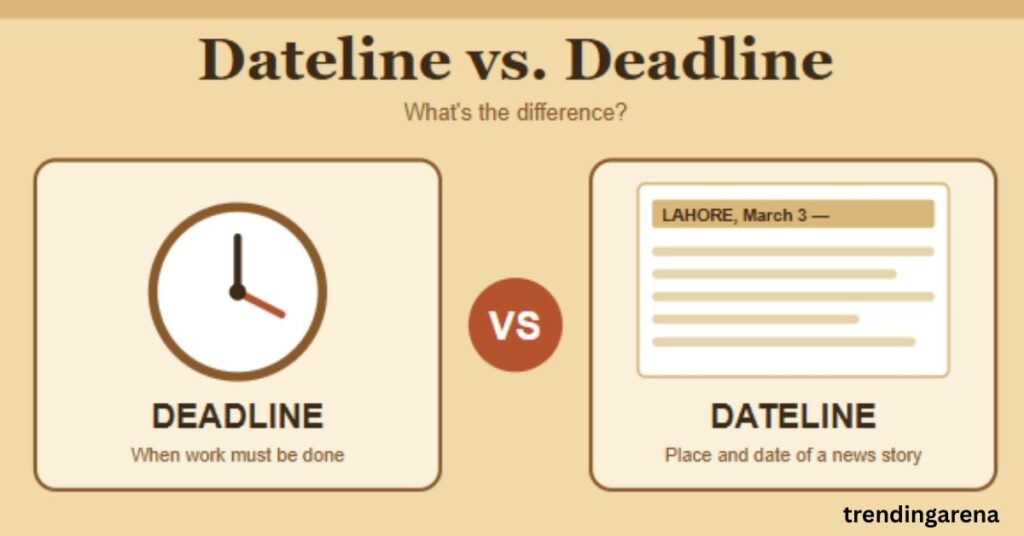
This mix-up is more common than you would think. “Dateline” and “deadline” look alike, sound alike, and both involve time. Yet they do very different jobs. One tells readers where and when a news story was filed. The other tells you when your work must be done.
In this guide, you will learn what each word means, where each one comes from, how to use both correctly, and which mistakes to avoid. You will also see real examples, a comparison table, and a few practical tips you can use in your own writing today.
Quick Answer
A deadline is the date or time by which something must be finished. A dateline is the line at the start of a news story that names the place (and often the date) where the story was written or filed.
Here is the difference at a glance:
| Feature | Deadline | Dateline |
| Part of speech | Noun (also used as a modifier, as in “deadline pressure”) | Noun (sometimes used as a verb in journalism) |
| Core meaning | A time limit for finishing a task | A line of text giving the place and often the date of a news story |
| Where you see it | Work, school, projects, contracts, sports trades | Newspapers, wire reports, magazines, news websites |
| Example | “The deadline for the essay is Friday.” | “LAHORE, Pakistan, March 3 —” |
| Can you miss it? | Yes | No |
| Related idea | Due date, cutoff, time limit | Byline, location tag, news header |
The easy memory trick: you meet a deadline, but you read a dateline. If you can miss it, extend it, or beat it, you want the word “deadline.”
What Does “Dateline” Mean?
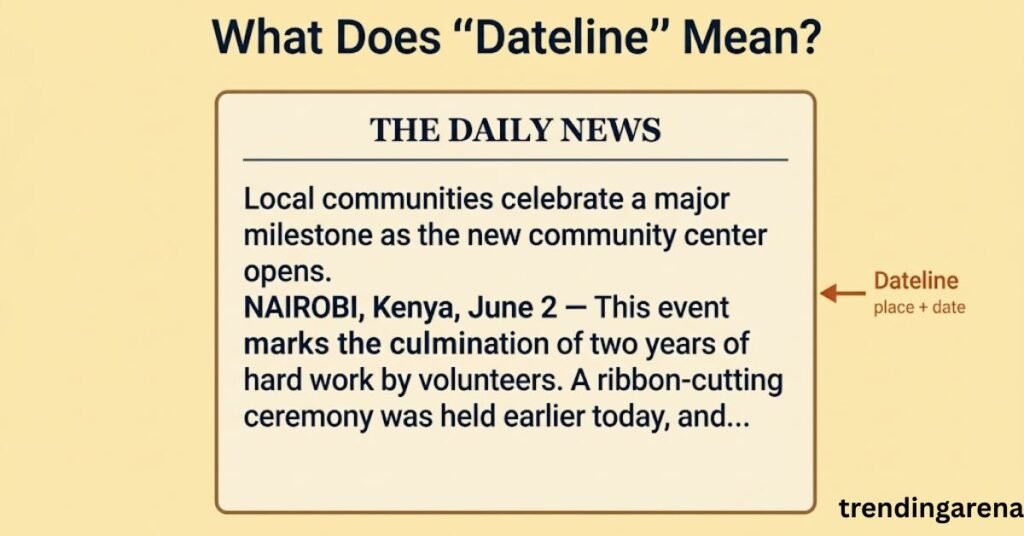
A dateline is a short line of text placed at the top of a news article. It usually gives the city where the reporter filed the story. Many datelines also include the date.
For example, a story about a political summit might open like this:
NAIROBI, Kenya, June 2, 2010 — Leaders from across the region met on Wednesday to discuss…
That first part in bold is the dateline. It helps readers understand where the events took place and when the report was written.
Where the word comes from
The word is a simple compound of “date” and “line.” Early newspapers printed a line showing the date and place of origin. Today, the practice continues in wire services and major news outlets. In older print news, a dateline carried more weight, because readers had no other way to tell how fresh a report was or how far it had traveled.
Other meanings of dateline
The word has a few extra uses worth knowing:
- As a verb: In journalism, to “dateline” a story means to attach a dateline to it. An editor might say, “Let’s dateline this piece from Geneva, since that’s where the talks happened.”
- As a TV title: Dateline NBC is a well-known American news program. This show has made the word familiar to millions of people who have never worked in a newsroom. It is also the main reason many people confuse the term with “deadline.”
- As a geography term: “Dateline” sometimes appears as a short form of the International Date Line, which we will cover below.
What a dateline usually includes
- The city or location, often written in capital letters
- The state or country, depending on the style guide
- The date, in many (but not all) outlets
- A dash or similar separator before the story begins
Style guides differ. Some outlets drop the date and keep only the place. Others include both. If you write for a publication, check its house style first.
Understanding “Deadline”
A deadline is the final point in time by which a task must be completed. Miss it, and there may be consequences: a late fee, a lost opportunity, a lower grade, or an annoyed client.
The word is everywhere. You will find it in offices, classrooms, courtrooms, and newsrooms.
Everyday examples
- “The deadline for submitting your application is April 19.”
- “She worked on her presentation right up until the deadline.”
- “We asked for a longer deadline, but the client said no.”
- “The team is working under a tight deadline this week.”
A surprising history
Here is a fact that surprises most people. The word “deadline” has a dark origin. According to Merriam-Webster, its first sense was a line drawn within or around a prison that a prisoner could not cross without risking being shot. The first known use dates to 1864.
Over time, journalists and printers borrowed the term. It came to mean a cutoff for submitting copy before a paper went to press. From there, it spread into ordinary business and school life. Today, most people never think about that grim starting point.
Related words and synonyms
If you want to avoid repeating “deadline,” try these alternatives:
- Due date
- Cutoff
- Time limit
- Final date
- Closing date
- Target date (softer, less strict)
A small note on nuance: “due date” and “deadline” often mean the same thing, but “deadline” tends to feel firmer. A “target date” suggests some wiggle room. A “hard deadline” means no exceptions.
Dateline vs. Deadline: Key Differences Explained
Now that you know each word, the differences become clear. Let’s break them down.
1. They answer different questions
- Deadline answers: “By when must this be done?”
- Dateline answers: “Where and when was this story written?”
2. They belong to different worlds
A deadline can appear in any field. A dateline lives almost entirely in news writing and publishing. If you are not a journalist, editor, or student of media, you may rarely need it.
3. You can act on a deadline, but not on a dateline
You can meet, miss, extend, push, or beat a deadline. You cannot “miss a dateline.” The verbs that sit next to each word tell you which one you need.
| Verbs that fit “deadline” | Verbs that fit “dateline” |
| meet, miss, beat, extend, set, push back | include, add, update, write, attach |
| “We met the deadline.” | “The editor added a dateline.” |
| “They missed the deadline.” | “The dateline reads Paris.” |
4. They differ in how often people use them
“Deadline” is a common everyday word. “Dateline” is a specialist term. This is why people sometimes assume the more familiar word is the right one, or mix them up when they hear them spoken.
Side-by-side sentence examples
Correct use of deadline:
- “The grant deadline is next Monday.”
- “I’ll send the draft before the deadline.”
- “Everyone felt the pressure as the deadline approached.”
Correct use of dateline:
- “The dateline on the article said Geneva.”
- “The reporter forgot to include a dateline.”
- “A dateline helps readers see where a story began.”
Incorrect use (and the fix):
- ❌ “I missed the dateline for my assignment.”
- ✅ “I missed the deadline for my assignment.”
Is “Dateline” Formal or Informal?
“Dateline” is neither strictly formal nor informal. It is a technical, professional term. Its tone is neutral, and it sits comfortably in journalism, publishing, and media studies.
Think of it like “byline” or “headline.” Nobody calls those words formal or casual. They are simply the correct names for parts of a news story.
Where does it fit?
- Formal writing: Fine in textbooks, style guides, and newsroom manuals.
- Casual conversation: Most people will not use it unless they are talking about the TV show or working in media.
- Professional settings: Perfectly natural among reporters and editors.
If you use “dateline” when you mean “deadline” in a formal setting, readers may see it as an error, and it can hurt your credibility.
Is “Deadline” Formal or Informal?
“Deadline” is neutral and flexible. You can use it in a legal contract or in a text to a friend, and it will sound right in both.
| Setting | Example |
| Formal | “The deadline for filing the appeal is thirty days from the date of the ruling.” |
| Business | “Please confirm the delivery deadline by Thursday.” |
| Casual | “My deadline is tomorrow, so I can’t hang out tonight.” |
| Academic | “Late submissions after the deadline will lose marks.” |
Because it works almost everywhere, “deadline” rarely needs a replacement. You may choose “due date” in a more polite email or “cutoff” in a technical setting, but “deadline” is almost never the wrong choice when you mean a time limit.
The International Date Line Connection
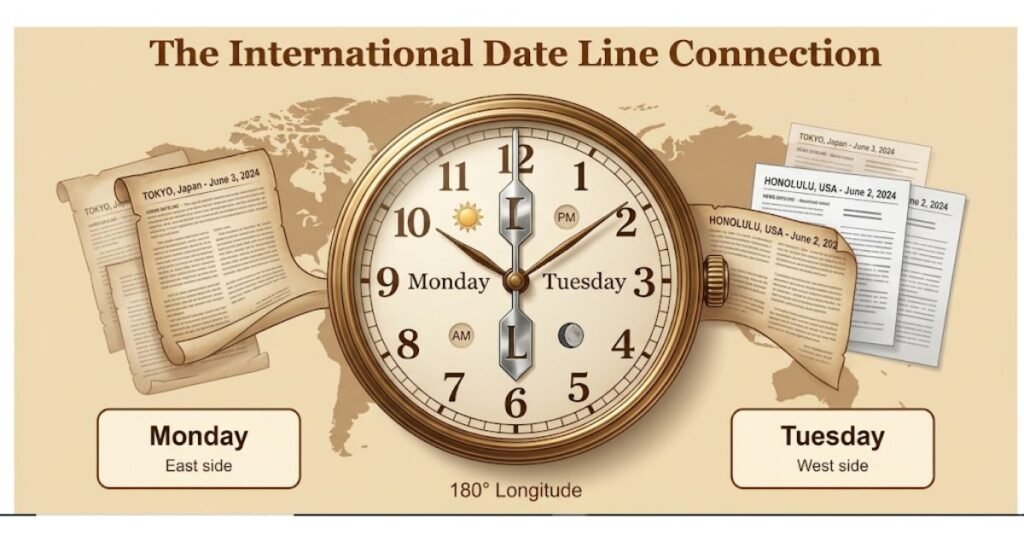
Here is another source of confusion. Some people see “date line” and think of the International Date Line (IDL).
The International Date Line is an imaginary line that runs roughly along the 180th meridian in the Pacific Ocean. It marks the point where one calendar day ends and the next begins. When you cross it heading west, you move forward a day. When you cross it heading east, you move back a day.
It is not a perfectly straight line. It bends and shifts around certain islands and countries so that neighbors can share the same calendar day.
How does this relate to “dateline”?
The link is mostly in the wording. Both terms contain “date” and “line,” but they refer to different things:
| Term | Meaning |
| Dateline (news) | Text at the start of a news story showing place and often date |
| International Date Line | A geographic line in the Pacific where the calendar date changes |
| Deadline | The time limit for finishing something |
You may occasionally see “dateline” used loosely to refer to the International Date Line, but the more common and clearer phrase is “International Date Line.” In news writing, the date written in a dateline can be affected by time zones. A reporter in Asia may file a story that is dated a day ahead of the same event for a reader in the Americas. This is one reason why careful newsrooms pay attention to the date and place together.
Can We Use “Deadline” in Questions?
Yes, absolutely. “Deadline” works naturally in questions, and it is one of the most common ways it appears in daily life.
Common question patterns
- “What is the deadline for the project?”
- “When is the deadline?”
- “Can we extend the deadline?”
- “Is the deadline firm or flexible?”
- “Who set this deadline?”
- “How close are we to the deadline?”
These questions are clear, polite, and professional. They work in email, in meetings, and in chat messages.
Using “dateline” in questions
You can use “dateline” in a question too, but only in the right context:
- “Does the story need a dateline?”
- “Which city should we use for the dateline?”
- “Should the dateline include the date?”
If your question is about when work is due, always choose “deadline.” Using “dateline” there would confuse the reader.
Tips for asking about deadlines
- Be specific. Ask for the exact date and time, including the time zone.
- Ask about flexibility. “Is there any room to adjust the deadline?” shows respect and clarity.
- Confirm in writing. After a call, send a short note repeating the deadline you agreed on.
Common Confusions and Mistakes
Even strong writers trip over these two words. Let’s look at the most frequent errors and how to fix them.
Mistake 1: Using “dateline” when you mean “deadline”
This is the most common slip. It often happens because of the TV show or because the words look so alike.
- ❌ “The dateline for submissions is Friday.”
- ✅ “The deadline for submissions is Friday.”
Mistake 2: Using “deadline” for the news header
Less common, but it happens in the other direction.
- ❌ “The article’s deadline read Chicago, May 4.”
- ✅ “The article’s dateline read Chicago, May 4.”
Mistake 3: Writing “dead line” or “date line” as two words
In standard modern English, both words are written as one. Some older sources and a few specialized uses separate them, but for everyday writing, stick with a single word.
Mistake 4: Mixing up “deadline” and “timeline”
A timeline is a sequence of events or milestones over time. A deadline is one fixed point at the end. A project can have a timeline with several milestones, and one final deadline.
| Term | What it is | Example |
| Deadline | A single cutoff point | “Submit by June 30.” |
| Timeline | A schedule of steps | “Research in May, draft in June, edit in July.” |
| Due date | Often the same as deadline, slightly softer | “The invoice due date is the 15th.” |
| Dateline | Place and date tag on a news story | “ISLAMABAD, Oct. 5 —” |
Mistake 5: Confusing the TV show with the term
Dateline is a title of a television news program. When it is capitalized and italicized, it refers to the show. When it is lowercase, it usually refers to the news header. Context makes this clear, but be careful in written work.
Quick self-check
Before you publish, ask yourself:
- Am I talking about a time limit? Use deadline.
- Am I talking about the location and date label on a news story? Use dateline.
- Am I talking about a sequence of steps? Use timeline.
The Psychology Behind Deadlines
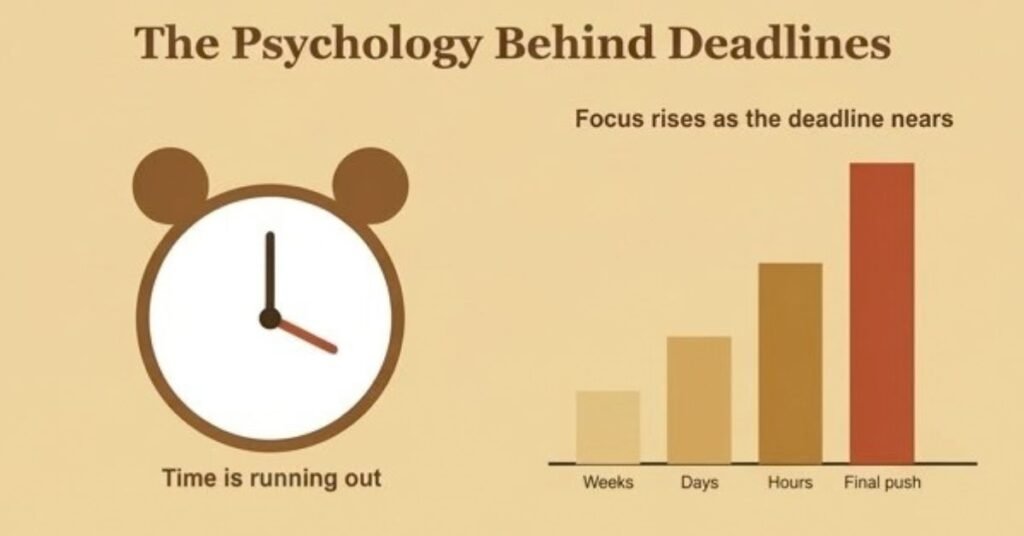
Why do deadlines have such a strong grip on us? A little psychology explains it.
Deadlines create focus
A clear end point gives your brain a target. Without one, tasks tend to drift. This is why people often get more done in the final hours before something is due than in the weeks before.
Parkinson’s Law
British writer C. Northcote Parkinson famously observed that work expands to fill the time available for its completion. If you give yourself a month to write a report, it may take a month. If you give yourself a week, you may finish in a week. Tighter deadlines can make you more efficient, though only up to a point.
The planning fallacy
Psychologists Daniel Kahneman and Amos Tversky described the planning fallacy: people tend to underestimate how long tasks will take, even when they have run into delays before. This is why many deadlines feel tighter than expected. Building a buffer into your schedule is one simple fix.
Stress and pressure
A little pressure can sharpen attention. Too much can lead to anxiety, rushed work, and burnout. Researchers and workplace experts often point out that the best deadlines are realistic, clearly communicated, and linked to a clear purpose.
Procrastination
Many people delay starting work until pressure builds. This habit can feel productive in the short term, but it often lowers quality and raises stress. Splitting a large task into smaller deadlines is one of the most reliable ways to avoid it.
Healthy ways to handle deadline pressure
- Break big goals into smaller milestones.
- Set your own earlier deadline, a few days before the real one.
- Work in short, focused blocks, then take a break.
- Tell someone your deadline so you feel accountable.
- Ask early for an extension if you truly need one.
Practical Writing Tips
Also read this:
Commit vs Comit: Correct Spelling, Meaning and Usage
Use these simple habits to get both words right every time.
Tips for using “deadline” correctly
- Pair it with the right verbs. Meet, miss, extend, set, beat, and push back all work well.
- Use the right preposition. “On deadline” and “under deadline” mean working while a time limit presses. “By the deadline” means no later than that point.
- Add the time, not just the date. “Friday at 5 p.m. PKT” is clearer than “Friday.”
- Avoid vague phrases. “ASAP” is not a deadline. A real date and time is.
- Match the tone to your reader. In a formal email, you might write, “Kindly note that the submission deadline is 30 November.”
Tips for using “dateline” correctly
- Place it at the start of the story. A dateline sits before the first sentence of the article.
- Use the location where the story was filed or where the main event occurred, following your outlet’s style.
- Check your style guide. Some publications include the date, some don’t, and some limit datelines to certain types of stories.
- Keep it short. A dateline is a label, not a sentence.
- Update it if the story changes. If a reporter moves location or a story is revised after publication, make sure the dateline still reflects the facts.
A simple memory trick
- Deadline: think of a hard stop. Past it, your task is “dead.”
- Dateline: think of a date and place label on a story.
Practice sentences
Fill in the blank with deadline or dateline:
- The ______ on the front-page story said “Beijing.”
- She asked for a longer ______ because the project was bigger than expected.
- Our editor reminded us to add a ______ to every wire story.
- The grant ______ passed last night.
Answers: 1. dateline, 2. deadline, 3. dateline, 4. deadline.
Proofreading checklist
Before you hit send or publish:
- [ ] Did I use “deadline” for every time limit?
- [ ] Did I use “dateline” only for the news header or TV show?
- [ ] Did I spell both as single words?
- [ ] Did I include a time and time zone with each deadline?
- [ ] Did I read the sentence aloud to check that it sounds right?
Conclusion
“Dateline” and “deadline” look alike but mean different things. A deadline is the time limit for finishing a task, while a dateline is the place-and-date line at the top of a news story.
Remember the rule: if you can meet, miss, or extend it, use “deadline.” If you read it at the start of an article, use “dataline”.