

You are typing a caption, a text, or a product description. You get to the word and stop. Is it girlie or girly?
Both look right. Both show up all over TikTok, Instagram, and Reddit. And a quick search gives you a pile of pages that all say slightly different things.
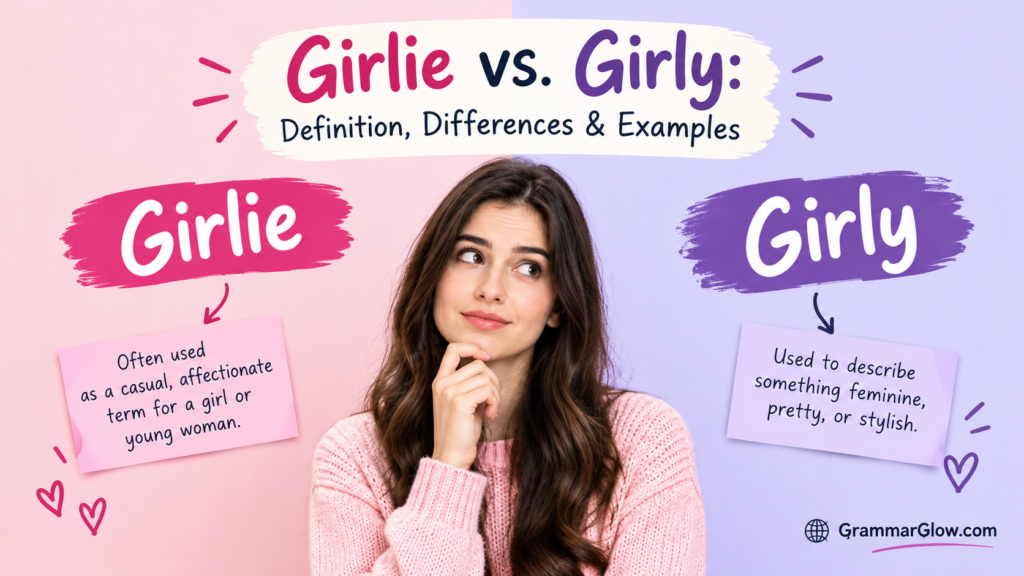
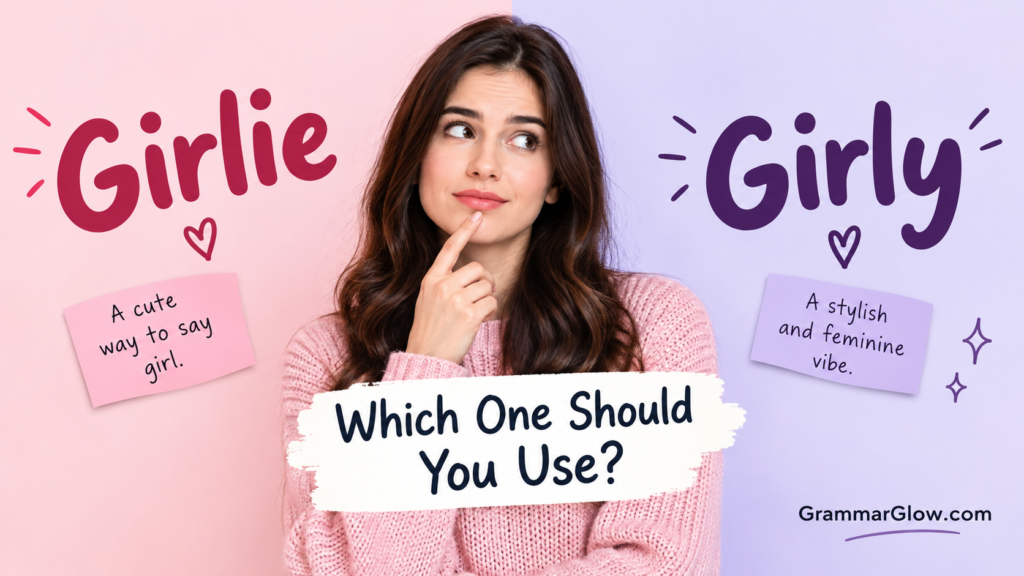
Here is the short answer. Girly is the safer, standard spelling for describing things. Girlie is the informal, playful form, mostly used as a friendly name for a person. Both are real words. They just do different jobs.
This guide breaks down the meaning, the grammar, the slang, the plural forms, and the common mistakes. You will also get a simple method for picking the right word every time. By the end, you will not need to second-guess yourself again.
Girlie or Girly: Which One Should You Use?
Start with the rule of thumb most writers can live by:
- Use girly when you describe a thing, a style, or a quality. Think “a girly dress” or “a girly bedroom.”
- Use girlie when you talk to a person or about a person in a casual, friendly way. Think “hey girlie” or “gym girlie.”
That is the whole idea in two lines. The rest of this article explains why, and where the rule bends.
Dictionaries treat the two as close relatives. Most list girly as the main entry and girlie as a variant spelling. That is why girly feels safer in essays, reports, product pages, and anything a stranger will read.
Girlie is not wrong, though. It has its own life as slang, and it carries a warmer, more personal tone. Writers who care about voice often choose it on purpose.
Quick comparison table
| Feature | Girly | Girlie |
| Main role | Adjective (describing things) | Informal noun or nickname (addressing people) |
| Tone | Neutral to playful | Friendly, affectionate, casual |
| Best for | Formal and general writing | Texts, captions, comments, branding |
| Typical example | “a girly aesthetic” | “thanks, girlie” |
| Safe in professional writing? | Yes | Rarely |
| Plural form | Not used as a plural noun | Girlies |
Keep this table in mind. We will build on it as we go.
Girlie vs. Girly: Definition, Differences & Examples
What girly means
Girly is an adjective. It describes something that is typical of girls, young women, or traditional femininity. It can also describe a person who enjoys things society often labels feminine.
Examples:
- She picked a girly pink notebook for school.
- The cafe has a girly, pastel look.
- He joked about his girly laugh.
- Her handwriting was round, loopy, and girly.
In most of these sentences, the word points at a quality or a style. It is a description, not a nickname.
What girlie means
Girlie has a few senses, and tone matters with each one.
- Internet slang for a woman or feminine person. This is the “hey girlie” sense. It is affectionate and friendly.
- A casual word for a young girl. This is older and less common today.
- An adjective meaning girl-like or feminine. It overlaps with girly, but it feels more marked and less neutral.
- A dated adjective tied to adult entertainment. You see this in phrases like “girlie magazine” or “girlie show.” It is old-fashioned and can sound sleazy.
That last sense explains why some careful editors avoid girlie in serious writing. The word carries baggage that girly does not.
The practical difference
The simplest way to see the gap is to compare sentences that swap one for the other.
| Sentence | Better choice | Why |
| She loves girly outfits. | girly | Describes a style |
| Hey girlie, how was your day? | girlie | Friendly address |
| The room has a girly aesthetic. | girly | Describes a look |
| Gym girlie era starts Monday. | girlie | Social media identity |
| A girly voice carried through the hall. | girly | Describes a quality |
| Thanks, girlie! | girlie | Nickname for a friend |
Notice the pattern. Descriptions go with girly. Nicknames and identities go with girlie.
Girlie vs. Girly: Same Meaning or Totally Different?
The honest answer: close in meaning, different in tone and job.
Both words come from “girl.” Both point toward femininity. In many older sentences, you can swap them and nobody blinks. So they are not “totally different.”
But the modern internet has pulled them apart.
- Girly stayed an everyday descriptor.
- Girlie grew into a social label, a pet name, and a vibe.
Think of it like “cozy” and “cosy.” That pair is a pure spelling variant. Girlie and girly are more than that, because the internet gave one of them an extra personality.
Why the split happened
Slang tends to pick one spelling and cling to it. Online, the “-ie” ending makes a word feel softer and more intimate. Compare “foodie,” “goodie,” “cutie,” and “bestie.” Each adds warmth. Girlie follows the same path.
Meanwhile, “-y” endings are the normal way English forms adjectives: “dirty,” “bossy,” “sporty.” Girly fits that pattern, which is why it feels like the grammatical default.
So the split is not random. It follows two familiar habits in English word formation.
Girlie vs. Girly: A Quick Guide to Correct English Usage
Here is a fast reference you can scan in a few seconds.
Choose girly when you:
- write for school, work, news, or a brand with a neutral voice
- describe clothing, decor, colors, or personal style
- are unsure and want the safest option
- write for a mixed or global audience
Choose girlie when you:
- text or comment to a friend
- use a social media label such as “book girlie”
- write in a deliberately playful or branded voice
- quote someone who speaks that way
A simple three-question check
- Am I describing a thing or addressing a person? Thing means girly. Person in a casual setting means girlie.
- Is the setting formal? If yes, go with girly.
- Do I want warmth and personality more than polish? If yes, girlie may fit.
If you answer “not sure” to all three, pick girly. It almost never causes trouble.
Girlie or Girly Slang: How the Internet Uses Them
Slang lives and dies by social platforms, and this pair is a good example.
Girlie as an affectionate label
On TikTok, Instagram, and X, girlie works as a warm way to address a woman, a friend, or a group. It signals closeness. It also stretches into identity labels, such as:
- gym girlie – someone who loves lifting, workouts, or gym outfits
- book girlie – a big reader, often with a cozy-reading aesthetic
- pilates girlie – a fan of studio classes and wellness routines
- coffee girlie – a person whose personality runs on espresso
- tired girlie – a joking label for a rough week
These tags usually celebrate a hobby or mood. They are light and self-aware, and people often use them about themselves.
Girly in digital culture
Girly has not gone anywhere. It still thrives in phrases like “girly aesthetic,” “girly outfit,” and “girly makeup.” The word describes a look. Fashion posts, home decor boards, and beauty tutorials lean on it heavily.
The tone question
Girlie is warm when friends use it. It can feel patronizing when a stranger, a boss, or an authority figure uses it. Context decides everything.
Imagine two situations:
- A close friend texts, “You got this, girlie.” That feels supportive.
- A manager says, “Nice work, girlie.” That feels dismissive, even insulting.
Same word. Different relationship. Different effect.
So here is a good habit: only use girlie where the relationship already supports a casual nickname.
Also Read This Submission vs Submittion: Which Spelling Is Correct?
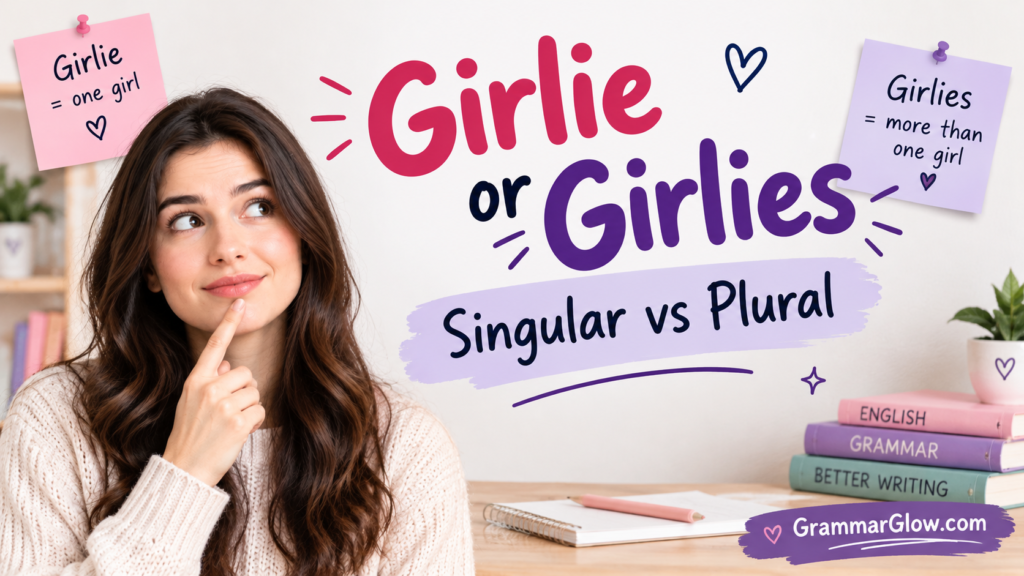
Girlie or Girlies – Singular vs Plural
Number trips people up here, so let us slow down.
The singular and plural of girlie
Girlie is the singular noun. Its plural is girlies.
- Singular: “Hey girlie, you look great.”
- Plural: “Girlies, we are meeting at seven.”
The plural follows the normal rule for words ending in a consonant plus “-ie”: drop nothing, just add “-s.” Compare “cookie → cookies” and “bestie → besties.”
What about girlys?
“Girlys” is not standard. Words ending in consonant plus “-y” usually change to “-ies” in the plural (“city → cities”). If you ever need a plural noun, “girlies” is the form people recognize.
Girly as a plural?
Girly is mainly an adjective, so it does not take a plural in normal use. You would say “girly outfits,” not “girlies outfits.” If someone says “the girlies,” they mean the noun form: girlie, plural girlies.
Quick number reference
| Form | Correct? | Example |
| girlie | Yes | “She is such a girlie.” |
| girlies | Yes | “The girlies are here.” |
| girly | Yes (adjective) | “A girly style.” |
| girlys | No | Avoid |
| girlys’ / girlies’ | Possessive forms; use only when needed | “The girlies’ trip” |
Hey Girlie – Is It Correct?
Yes, “hey girlie” is correct as casual, informal speech. It is a friendly greeting, similar to “hey girl” or “hey bestie.”
Some points to keep in mind:
- It works best in texts, DMs, comments, and spoken chat.
- It signals warmth and familiarity.
- It does not belong in formal emails, cover letters, or business messages.
- The punctuation is simple: “Hey, girlie!” with a comma after “hey” is the cleaner way to write it.
Examples that work
- “Hey, girlie! Are we still on for lunch?”
- “Hey girlie, I saved you a seat.”
- “Miss you, girlie.”
Examples to avoid
- “Dear girlie, thank you for your application.” (too casual for the setting)
- “Hey girly, how are you?” (works in speech, but girlie is the usual spelling for this address)
If you want to sound warm but stay professional, skip the nickname and use the person’s name.
Thanks Girly or Girlie – Which Sounds Better?
This one comes up in texts and captions all the time. Here is the honest breakdown.
“Thanks, girlie” is the more common written form for a friendly sign-off. The “-ie” ending matches how people use it as a nickname.
“Thanks, girly” appears too, and in speech the two sound identical. But in writing, many people read “girly” as an adjective that is missing its noun.
Which should you pick?
| Situation | Better pick |
| Texting a friend | Thanks, girlie |
| Replying to a comment on social media | Thanks, girlie |
| Writing a formal thank-you note | Skip the nickname |
| Customer service reply | Skip the nickname |
A small tip: put a comma before the nickname. “Thanks, girlie” reads as a direct address. “Thanks girlie” without the comma is common online and fine in casual spaces, but the comma is the cleaner choice.
Gym Girlie or Gym Girly – What’s Correct?
The popular label is gym girlie. It is a noun phrase that names an identity, so the “-ie” form fits.
Why gym girlie wins
“Gym girlie” works like “gym rat” or “gym bro.” You are naming a type of person, not describing a quality of an object. That is the key test: person label = girlie.
When gym girly can appear
You might see “gym girly” used as an adjective phrase in something like “a gym girly outfit.” Here, “girly” describes the outfit. That use can be right, but many writers would still tidy it into “a girly gym outfit” for clarity.
Same logic for other labels
- Book girlie (person) vs. a girly book cover (description)
- Coffee girlie (person) vs. a girly coffee mug (description)
- Pilates girlie (person) vs. a girly pilates set (description)
Once you spot the pattern, every example becomes easy.
Girly or Girlie Reddit Usage
Reddit gives a useful window into how real people write, since threads mix casual chat with grammar questions.
Based on how these words commonly show up in comment sections:
- Girlie appears in friendly replies, jokes, and community banter, often between users who already share a hobby or fandom.
- Girly appears in descriptive posts, such as fashion, decor, gaming, and product discussions.
- Language-focused communities often debate tone. Some users say girlie feels patronizing in the wrong setting. Others say it is simply affectionate.
What this tells you
Real-world usage backs up the same pattern we have been tracking:
- Casual address leans girlie.
- Descriptions lean girly.
- Tone and relationship matter more than spelling.
Treat community chatter as a guide to voice, not to grammar. For formal writing, rely on dictionaries and style guides instead of comment threads.
Three habits you will notice in online threads
Once you read enough posts, a few small habits stand out.
- Lowercase is common. People write “hey girlie” without capitals because the tone is relaxed. That is fine in a comment box, but not in an essay.
- Emoji do the tone work. A heart or sparkle next to “girlie” often tells the reader the word is meant warmly.
- Self-labeling is popular. Users call themselves “tired girlie” or “spreadsheet girlie” to joke about their own lives. Using the word about yourself usually feels safer than using it about someone else.
These habits show that girlie is as much about mood as meaning. Girly, on the other hand, rarely needs that extra signal, because it simply describes.
A practical takeaway for writers
If you write for a blog, a brand, or a newsletter, read your audience first. A community that already says “girlie” in every comment will welcome it in your copy. A broader or more formal audience may not. When you cannot tell, girly keeps you out of trouble, and you can always add a friendly nickname later once you know the room.
British vs American English Usage
Many spelling pairs split along the Atlantic. Think “color/colour” or “organize/organise.” Girlie and girly are not one of those pairs.
Where they land
- American English: Girly is the usual choice for description. Girlie appears as slang and in fixed phrases.
- British English: Girly is also standard for description. Girlie shows up in informal speech and writing.
In other words, the choice depends on tone and function, not on your country.
| Feature | American English | British English |
| Standard descriptive word | girly | girly |
| Informal nickname | girlie | girlie |
| Regional spelling rule? | No | No |
A note on older senses
Some dictionaries and usage references preserve older or more marked meanings under girlie, such as the “girlie magazine” sense. If you write for an audience that might read the word in that older way, girly is the safer pick.
Common Mistakes with Girlie or Girly
Even confident writers slip here. These are the errors that come up most.
Mistake 1: Using girlie to describe objects in formal writing
- Weaker: “The brand launched a girlie notebook line.”
- Better: “The brand launched a girly notebook line.”
Mistake 2: Using girly as a nickname in text
- Okay but less common: “Hey girly!”
- More common: “Hey, girlie!”
Mistake 3: Writing “girlys” as a plural
- Wrong: “The girlys are here.”
- Right: “The girlies are here.”
Mistake 4: Using girlie in professional communication
A cover letter, a business email, or a client proposal is the wrong place for a nickname. Stay with names and neutral descriptions.
Mistake 5: Forgetting tone with strangers or superiors
Even a correct spelling can land badly. If you do not know how someone will react, leave the nickname out.
Mistake 6: Mixing both spellings in one piece
Pick one per use case. If you write “a girly style” in one line and “a girlie style” in the next, readers notice. Consistency looks more polished.
Mistake 7: Overusing the word
Slang loses charm when it appears in every sentence. Use it where it adds voice, then move on.
Fast fix table
| Mistake | Fix |
| girlie for descriptions in formal text | switch to girly |
| girlys as plural | use girlies |
| nickname in a business email | use the person’s name |
| mixed spellings in one article | choose one per context |
How to Choose the Right Word Every Time
Here is a clear process you can follow in about ten seconds.
- Ask what the word is doing. Is it describing something, or naming or addressing someone?
- If describing, use girly. That covers fashion, decor, color, style, voice, and aesthetic.
- If addressing or labeling a person casually, use girlie. That covers “hey girlie,” “gym girlie,” and similar tags.
- Check the setting. If it is formal or professional, lean toward girly or avoid the nickname entirely.
- Check the relationship. Only use girlie where friendly closeness already exists.
- Check the plural. If you need one, write girlies.
- Stay consistent. Use the same spelling for the same job throughout a piece.
A quick memory trick
Girly = describes. Girlie = addresses.
Say it twice, and it sticks.
Want one safe default?
If you ever feel stuck, go with girly. It is the standard form, and it works in nearly every setting. Reserve girlie for the places where you want a warm, casual voice.
Final word-by-word summary
| Word | Best use | Avoid when |
| girly | Describing style, objects, qualities | You are addressing a friend by nickname |
| girlie | Casual nickname or social label | Writing formally or addressing strangers |
| girlies | Plural of girlie | Used as an adjective |
| girlys | Nowhere | Always |
FAQs
Is it girlie or girly?
Both are real words. Girly is the standard spelling for describing things, and girlie is the informal form, mostly used as a friendly nickname.
Is girlie a real word?
Yes. Dictionaries list it as informal or slang, and it has several senses, including a casual term for a girl or woman.
Which is more common, girly or girlie?
Girly is the more common spelling in everyday and published writing. Girlie is common in social media captions and comments.
What is the plural of girlie?
The plural is girlies. “Girlys” is not standard English.
Can I use girlie in professional writing?
It is best avoided. Use girly for descriptions, or skip the nickname and use the person’s name.
Is “hey girlie” correct?
Yes, in casual speech and texts. Write it as “Hey, girlie!” and keep it for friends.
Does the spelling differ in British and American English?
No. Both regions treat girly as the standard descriptive word and girlie as informal.
Conclusion
Girlie and girly look almost identical, but they do different work.
Girly is the standard, neutral adjective. It describes styles, objects, and qualities, and it fits comfortably in everyday and professional writing.
Girlie is the informal, affectionate form. It shines in texts, captions, and community chatter, where it works as a nickname or a playful identity label. It also has an older, more marked side, which is a good reason to handle it with care.
The plural is girlies, and “girlys” is not standard. The choice does not change between American and British English. What changes is tone, setting, and relationship.
So the next time you hesitate, run the simple check: Am I describing, or am I addressing? Describe with girly. Address with girlie. When in doubt, choose girly.
That small habit will keep your writing clear, friendly, and well matched to the moment.



Pingback: Transferred vs Transfered: Which Is Correct?Transferred vs Transfered: Which Is Correct? -... - TrendingArena.com