
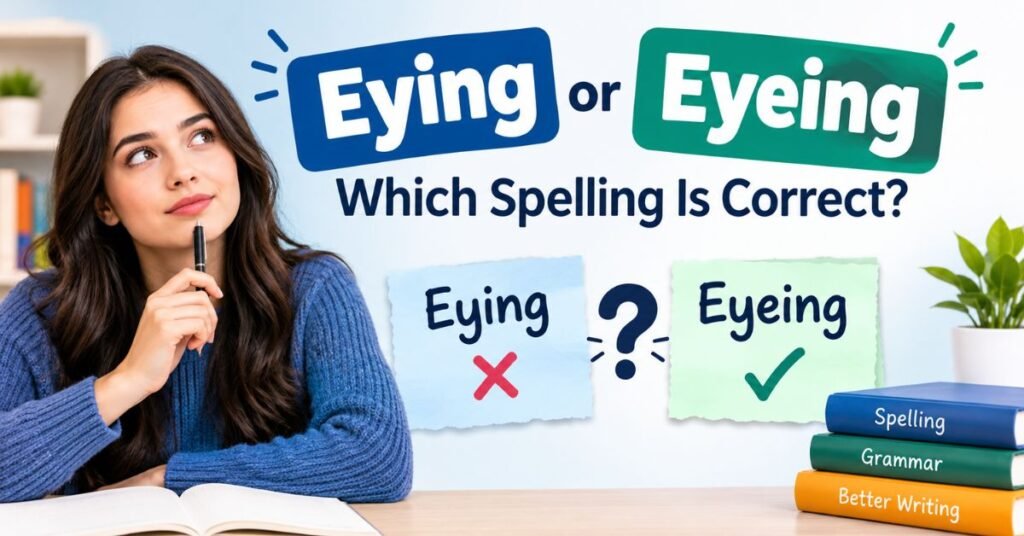

If you have ever written the phrase “She was ___ the new car,” you may have paused and wondered whether the correct spelling is eying or eyeing. The confusion is understandable. English often drops a final e before adding -ing, as in make → making and write → writing. So, at first glance, eying seems like the obvious choice.
The good news is that both “eying” and “eyeing” are recognized spellings. However, they are not equally common. Eyeing is the more familiar form and is generally the best choice for ordinary, formal, academic, professional, and online writing. Major dictionaries recognize both forms, with Cambridge specifically identifying eying as a US variant of eyeing. Oxford also lists both forms as possible -ing forms of the verb eye.
So, if you are wondering which spelling to use, the simplest answer is:
Use “eyeing” in most situations. “Eying” is also correct, but it is a less familiar variant.
Understanding why both forms exist, what eyeing means, and how to use it naturally can help you avoid uncertainty whenever this unusual spelling appears.
Eying vs. Eyeing: The Quick Answer
Both eying and eyeing are forms of the verb eye, meaning to look at someone or something carefully, attentively, suspiciously, or with interest.
| Spelling | Correct? | Meaning | Recommended use |
| Eyeing | Yes | Looking at something or someone with attention or interest | Best general choice |
| Eying | Yes | Same meaning as eyeing | Acceptable variant |
| Eye | Yes | Base verb | To look at carefully |
| Eyed | Yes | Past tense/past participle | Looked at carefully |
For example:
- She was eyeing the last piece of cake.
- She was eying the last piece of cake.
Both sentences are grammatically valid and have the same basic meaning.
Still, eyeing is usually the safer spelling when you want the form most readers will immediately recognize. Cambridge gives eyeing as the main entry and notes “US also eying,” while Oxford lists both eyeing and eying among the verb’s -ing forms.
What Does Eyeing Mean?
Eyeing is the present participle of the verb eye.
As a verb, eye means to look at someone or something carefully. The action often involves more than simply seeing something. It can suggest attention, interest, curiosity, suspicion, desire, or careful consideration.
For example:
She was eyeing the chocolate cake.
This does not merely mean that she saw the cake. It suggests that she was looking at it with interest, perhaps because she wanted a piece.
Another example is:
The manager is eyeing several candidates for the position.
Here, eyeing means considering or watching the candidates with particular interest.
Dictionaries give similar meanings. Cambridge defines eye as looking at someone or something with interest, while Oxford explains that to eye someone or something is to look at it carefully, especially when you want something or suspect something may be wrong.
Common meanings of eyeing
Depending on context, eyeing can express:
- Looking at something carefully
- Watching someone closely
- Showing interest in something
- Considering something as an option
- Looking at something suspiciously
- Watching something because you want it
- Examining someone or something attentively
For example:
The cat was eyeing the bird.
The cat is watching the bird closely, probably because it is interested in it.
She was eyeing the designer handbag.
She was looking at the handbag with interest, possibly because she wanted to buy it.
The detective was eyeing the suspect.
The detective was watching the suspect carefully, perhaps because of suspicion.
Why Is It Eyeing Instead of Eying?
This is where the spelling becomes interesting.
Many English verbs that end in a silent e lose that e before -ing:
- make → making
- take → taking
- write → writing
- hope → hoping
- use → using
Because eye ends in e, it is natural to assume that:
eye + ing = eying
That form does exist. But English has retained eyeing as another accepted spelling.
The result is an unusual situation in which both forms are recognized:
eye → eyeing
eye → eying
Oxford lists both eyeing and eying as -ing forms of eye. Cambridge likewise recognizes eying, identifying it as a US alternative to eyeing.
The important point is that the ordinary spelling rule for dropping a final e does not force you to write eying. English spelling contains many historical and lexical exceptions, and eyeing has become an established form.
Is Eyeing or Eying More Common?
Eyeing is generally the more familiar spelling.
This is one of the most useful practical distinctions between the two forms. Although dictionaries recognize eying, readers are more likely to encounter eyeing in everyday writing.
Collins lists the verb forms as “eyes, eyeing or eying, eyed”, confirming that both spellings are accepted. Oxford does the same by listing both -ing forms.
That means you do not need to treat eying as a spelling error. However, if you are choosing a form for a general audience, eyeing is usually the clearest default.
This is particularly useful in:
- School assignments
- Business writing
- Articles and blog posts
- Reports
- Professional communication
- Academic writing
- Website content
- General-purpose publishing
Using eyeing also makes the relationship with the base word eye immediately visible.
Is Eying Wrong?
No. Eying is not simply a misspelling.
This distinction matters because you may see people correcting eying to eyeing as though only one form were legitimate. Major dictionaries do not support such a strict conclusion.
Cambridge lists eyeing as the present participle and identifies eying as a US alternative. Collins lists both forms in the verb’s word forms, and Oxford lists both eyeing and eying as possible -ing forms.
Therefore:
Eying is an accepted spelling, but eyeing is usually the better default choice.
Calling eying “incorrect” would be too strong.
The more useful advice is to distinguish between correctness and common usage. A word can be grammatically and lexically valid without being the form most writers choose.
Eyeing and Eying Have the Same Meaning
There is no important difference in meaning between eyeing and eying.
Both come from the verb eye, and both describe the same action.
Compare:
The customer was eyeing the expensive watch.
and:
The customer was eying the expensive watch.
The spelling changes, but the meaning does not.
In both sentences, the customer is looking at the watch with interest.
The same applies in other contexts:
The company is eyeing a new market.
The company is eying a new market.
Both mean that the company is considering or showing interest in entering a new market.
This is why the choice between the two spellings is primarily a matter of spelling preference and usage, rather than meaning or grammar.
Examples of Eyeing in Everyday Sentences
The easiest way to understand eyeing is to see how it works in context.
Looking at food with interest
Daniel was eyeing the last slice of pizza.
Here, eyeing suggests that Daniel wants the pizza or is strongly interested in it.
Watching someone carefully
The security guard was eyeing the man near the entrance.
The guard is watching the man closely, possibly because his behavior seems unusual.
Showing interest in a purchase
Mia has been eyeing that laptop for months.
In this sentence, eyeing means considering or wanting the laptop.
Considering a career opportunity
She is eyeing a promotion next year.
The meaning is figurative. She is interested in or aiming for a promotion.
Considering a location
The company is eyeing several cities for its next office.
The company is evaluating or considering those cities.
Watching an opponent
The two players were eyeing each other before the match began.
They were watching each other carefully.
Looking suspiciously
The detective kept eyeing the locked door.
The detective was paying close attention to it, perhaps because something seemed suspicious.
These examples show why eyeing can mean more than simply “looking.” The surrounding context often tells you why someone is looking.
Eyeing vs. Seeing vs. Looking vs. Watching
One common source of confusion is assuming that eyeing is simply another word for seeing. It is not.
These verbs have related meanings, but they describe different actions.
| Word | Basic meaning | Example |
| Seeing | Perceiving something with your eyes | I saw a bird outside. |
| Looking | Directing your eyes toward something | She is looking at the painting. |
| Watching | Observing something over a period of time | We were watching the game. |
| Eyeing | Looking closely or with particular interest | He was eyeing the new motorcycle. |
| Staring | Looking for a long time, often intensely | She was staring at the screen. |
| Gazing | Looking steadily, often with admiration or thought | They were gazing at the stars. |
Consider the difference:
I saw a new phone.
This simply tells us that you noticed the phone.
I was looking at a new phone.
This tells us where your attention was directed.
I was watching the phone.
This sounds unusual unless something about the phone is changing or being observed.
I was eyeing a new phone.
This suggests interest in the phone, perhaps because you are thinking about buying it.
The word eyeing therefore carries a sense of deliberate attention.
Eyeing Can Describe Interest in an Opportunity
One especially important use of eyeing is figurative.
You do not have to be literally looking at something with your eyes. You can also eye an opportunity, position, goal, market, or achievement.
For example:
The young athlete is eyeing a place on the national team.
The athlete is not literally staring at a place. Instead, the athlete is hoping for or actively considering that opportunity.
Similarly:
The company is eyeing international expansion.
This means the company is considering or targeting international expansion.
Other examples include:
- The team is eyeing the championship.
- The company is eyeing a larger market.
- She is eyeing a leadership position.
- Investors are eyeing new opportunities.
- The restaurant is eyeing a second location.
- He is eyeing a career in technology.
This figurative use is common in business, sports, journalism, and general writing.
Eyeing in Different Grammatical Structures
Because eyeing is the -ing form of eye, it can appear in several grammatical structures.
Present continuous
She is eyeing the new apartment.
The action is happening now or around the present time.
Past continuous
He was eyeing the expensive watch.
The action was in progress at a particular time in the past.
Present perfect continuous
They have been eyeing that property for months.
The interest or action began in the past and has continued.
After another verb
She kept eyeing the door.
Here, eyeing follows kept and describes the continuing action.
As a gerund
The -ing form can also function as a noun-like expression:
Eyeing the dessert made it difficult to concentrate.
Here, eyeing the dessert acts as the subject of the sentence.
Another example:
Eyeing every possible opportunity can make decision-making difficult.
The grammatical function changes according to the sentence, but the spelling remains the same.
Is Eyeing Used in American and British English?
Yes. Eyeing is used in both American and British English.
It is inaccurate to assume that eyeing belongs exclusively to one variety of English.
Cambridge’s English dictionary lists eyeing and notes “US also eying.” This indicates that eying is recognized particularly as an American variant, while eyeing is the main form presented by the dictionary.
Oxford’s Advanced Learner’s Dictionary also lists both spellings without restricting eyeing to one English variety.
Collins likewise lists eyeing or eying among the verb forms.
So, rather than thinking:
British = one spelling
American = another spelling
it is more accurate to understand the situation as:
Eyeing = widely used standard form
Eying = recognized variant, especially identified by Cambridge as US
Regional preferences can influence which form a reader encounters, but neither spelling needs to be treated as a completely different word.
Why Does Eying Look More Logical?
The spelling eying often feels more logical because English has a familiar pattern involving verbs that end in silent e.
For example:
- hope → hoping
- love → loving
- move → moving
- write → writing
- close → closing
In these cases, the final e disappears before -ing.
If you apply that pattern mechanically to eye, you get:
eye → eying
That explains why many people instinctively write eying.
The problem is that English spelling is not entirely mechanical. Individual words can preserve spellings for historical, lexical, or readability reasons.
With eye, retaining the e produces:
eye → eyeing
This spelling clearly shows the connection to eye, and it is a well-established form in modern English.
Oxford’s dictionary evidence confirms that both forms are legitimate rather than treating eying as a spelling mistake.
Also Read This : Upmost vs. Utmost: Which Word Should You Use?
Common Mistakes with Eyeing and Eying
The most frequent mistake is not necessarily spelling the word incorrectly. It is misunderstanding the status of the two forms.
Mistake 1: Assuming Eying Is Always Wrong
Some writers believe that eying must be incorrect because eyeing looks more familiar.
That is not accurate. Dictionaries recognize eying as an alternative form.
Mistake 2: Assuming Both Forms Have Different Meanings
They do not.
Eyeing and eying represent the same verb form and have the same basic meaning.
Mistake 3: Treating Eyeing as Meaning Only “Seeing”
Eyeing usually implies purposeful or noticeable attention. It often carries a sense of interest, suspicion, desire, or evaluation.
Mistake 4: Assuming Eying Is a British Spelling
The evidence does not support that simple rule. Cambridge specifically labels eying as a US alternative, while eyeing is its main English entry.
Mistake 5: Overusing Eyeing When Watching Is More Natural
Not every act of looking is eyeing.
For example:
The children were watching the movie.
is much more natural than:
The children were eyeing the movie.
Eyeing is best when the person is looking at something carefully, attentively, suspiciously, or with interest.
When Should You Use Eyeing?
For most writers, eyeing is the easiest and safest choice.
Use eyeing when you want to:
- Write for a broad audience
- Follow the most familiar spelling
- Make the connection to eye obvious
- Write professional or academic content
- Avoid distracting readers with an unusual variant
- Produce clear general-purpose English
Examples:
The investor is eyeing the technology sector.
She was eyeing the dress in the shop window.
The dog was eyeing the food on the table.
He has been eyeing that position for months.
The company is eyeing several new markets.
The spelling is immediately recognizable and unlikely to distract the reader.
When Can You Use Eying?
You can use eying when the context or editorial preference calls for it.
Because dictionaries recognize it, there is no need to automatically “correct” it simply because eyeing is more familiar.
For example:
The company is eying expansion into Asia.
This sentence is grammatically sound.
However, if you are writing for a general audience and have no particular reason to choose the shorter variant, eyeing is usually the better default.
The choice can also depend on the publication, house style, regional preference, or consistency within a piece of writing.
The most important rule is to be consistent. If you choose eying, do not switch randomly between eying and eyeing in the same document.
Eyeing or Eying in Formal Writing
For formal writing, eyeing is generally the preferable choice because it is highly familiar and transparent.
Consider a business report:
The company is eyeing expansion into three new markets.
This looks natural and professional.
You could also write:
The company is eying expansion into three new markets.
The second sentence is not grammatically wrong, but some readers may find the spelling less familiar.
For professional communication, clarity is usually more important than choosing the shortest possible spelling. That makes eyeing a sensible default.
Eyeing in Business and News Writing
The verb eye is particularly common when discussing goals, plans, opportunities, and targets.
For example:
The retailer is eyeing international growth.
Investors are eyeing the company’s next earnings report.
The team is eyeing another championship.
The government is eyeing changes to the current policy.
In these examples, eyeing does not necessarily mean literally looking at something. Instead, it means considering, targeting, pursuing, or showing interest in something.
This figurative use is well established. Collins, for example, defines eye as looking at something carefully or warily and includes examples of eyeing goals and opportunities.
Eyeing vs. Eyed
Another useful distinction is between eyeing and eyed.
Eyeing describes an ongoing action:
She is eyeing the new car.
Eyed is the past tense or past participle:
She eyed the new car suspiciously.
Compare:
| Form | Function | Example |
| Eye | Base verb | I eye the situation carefully. |
| Eyes | Third-person singular present | She eyes the situation carefully. |
| Eyeing | Present participle / gerund | She is eyeing the situation carefully. |
| Eyed | Past tense / past participle | She eyed the situation carefully. |
Both Cambridge and Oxford identify eyed as the past form while recognizing eyeing and eying as the -ing forms.
This makes the basic verb pattern easy to remember:
eye → eyes → eyed → eyeing / eying
Eyeing or Eying: Which One Should You Choose?
If you are still unsure, use this practical rule:
Choose “eyeing” unless you have a specific reason to use “eying.”
Why?
- Eyeing is highly recognizable.
- It is listed as the main form in major learner dictionaries.
- It works naturally in American and British English.
- It clearly preserves the connection to the word “eye.”
- It is suitable for formal, informal, academic, business, and online writing.
At the same time, remember that eying is not automatically wrong.
A useful way to think about the pair is:
Eyeing = preferred general choice
Eying = accepted alternative
This distinction gives you a practical answer without incorrectly labeling a dictionary-recognized form as an error.
A Simple Memory Trick
If you frequently hesitate between eying and eyeing, use this simple memory trick:
Keep the word “eye” visible in “eyeing.”
Think:
eye + ing = eyeing
Although this is not a universal spelling rule for English verbs, it is a useful way to remember the preferred form.
You can also connect it with the pronunciation:
eye-ing
The spelling eyeing makes the two parts visually obvious.
For example:
She is eyeing the cake.
The word eye remains clearly visible inside eyeing.
More Examples: Eyeing in Different Contexts
Here are additional examples showing how naturally eyeing can be used.
Shopping
I was eyeing a pair of shoes in the window.
The speaker was interested in the shoes.
Food
The children were eyeing the birthday cake.
They were looking at the cake with interest, probably because they wanted to eat it.
Sports
The team is eyeing another championship.
The team hopes to achieve or compete for another championship.
Business
The company is eyeing expansion into new markets.
The company is considering or targeting expansion.
Suspicion
The detective was eyeing the suspect carefully.
The detective was watching the suspect with suspicion or close attention.
Career
She is eyeing a senior management position.
She is interested in or aiming for that position.
Travel
We are eyeing several destinations for our next vacation.
We are considering several destinations.
Property
They have been eyeing that house for months.
They have been interested in or considering buying the house.
These examples demonstrate an important feature of eyeing: the word can describe both literal observation and figurative interest or intention.
A Practical Comparison
The following summary can help you choose quickly:
| Question | Eyeing | Eying |
| Is it a recognized word form? | Yes | Yes |
| Comes from the verb “eye”? | Yes | Yes |
| Means looking with attention or interest? | Yes | Yes |
| Can describe figurative interest? | Yes | Yes |
| Used in modern English? | Yes | Yes |
| More familiar to most readers? | Generally yes | Generally less familiar |
| Listed by major dictionaries? | Yes | Yes |
| Best default for general writing? | Yes | Usually not the first choice |
The important takeaway is that the difference is mainly spelling preference and usage frequency, not meaning.
Final Verdict: Eying or Eyeing?
So, is it eying or eyeing?
Both are correct, but “eyeing” is the best general choice.
Eyeing and eying are both accepted forms of the present participle of eye. The verb eye means to look at someone or something carefully, often with interest, suspicion, desire, or attention. Cambridge lists eyeing as the main form and identifies eying as a US alternative, while Oxford and Collins also recognize both spellings.
If you are writing a sentence for school, work, a website, an article, or everyday communication, eyeing is usually the safest and most familiar spelling.
For example:
She was eyeing the last piece of cake.
That is the form most readers will immediately recognize.
However, if you encounter eying, there is no need to assume it is an obvious spelling mistake. It is a legitimate variant with the same meaning



Pingback: Congratulations On or For: Which One Is Correct?