
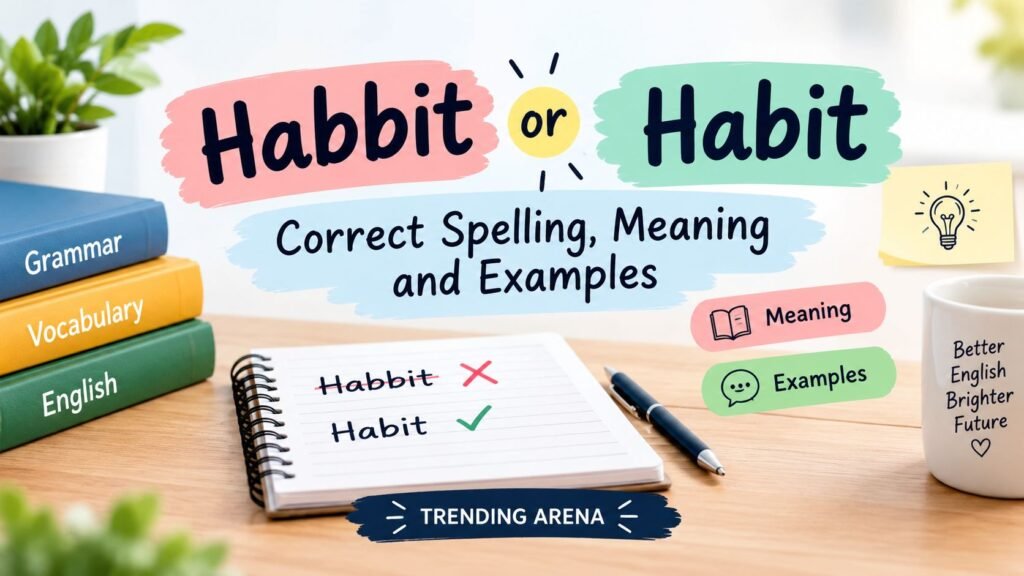

You are typing a sentence, you reach the word for something you do every day, and you freeze. Is it habit or habbit? Two b’s or one?
You are not alone. People search for this exact question all the time, and the confusion is easy to understand. English is full of words with a short vowel followed by a doubled consonant, so a double b feels natural. This guide clears it up for good.
Here is the short version. Habit is the correct spelling. Habbit is a misspelling and is never correct in standard English. The rest of this article explains why, shows you how to remember it, and covers meaning, origin, plural form, pronunciation, look-alike words and real example sentences.
Also Read This: Roster vs Roaster: Meaning, Usage, and Key Differences
Quick Answer

“Habit” (one b) is the only correct spelling. It means a regular behavior or practice, often one that happens automatically. “Habbit” does not appear as a standard English word in any major dictionary.
| Spelling | Correct? | Notes |
| habit | Yes | Standard in American, British, Canadian and Australian English |
| habbit | No | Common typo, often caused by confusion with rabbit |
| habits | Yes | Regular plural |
| habbits | No | Misspelled plural |
| habitual | Yes | Adjective form |
| habbitual | No | Misspelled adjective |
One-line memory trick: You have a habit. Both words share the letters h-a-b, and habit grows out of the Latin verb for “to have.” No second b is needed.
The Meaning of Habit
A habit is something you do regularly, often without thinking about it. The word most often refers to a usual way of behaving, or a tendency someone has settled into. Merriam-Webster gives “good eating habits” as a typical example.
Psychologists describe it a little more precisely. A habit may begin because you want to reach a goal. Over time, the goal matters less and the behavior becomes more automatic. Brushing your teeth is a good example. You no longer decide to do it each night. It just happens.
Main Definitions of Habit
The word has several related senses. Here are the ones you will meet most often.
- A regular behavior or routine. “Her morning walk is a daily habit.”
- A recurring tendency or pattern. “He has a habit of arriving late.”
- An addiction or dependence. “He finally kicked the habit.”
- Clothing worn for a specific role or activity. “The nun wore a black habit.” “She wore a riding habit.”
- A settled way of thinking. “A habit of mind that questions everything.”
The clothing sense surprises many learners. It is actually the older meaning in English. Today it survives mainly in phrases such as nun’s habit, monk’s habit and riding habit.
Is Habit a Noun or a Verb?
Habit is mostly a noun. It can also work as a verb, but that use is rare and old-fashioned. The form habited means “dressed in a particular way,” as in “a figure habited in grey.” You will almost never need it in everyday writing.
Habbit or Habit – Synonyms & Usage
Before we go deeper into spelling, it helps to know where each word you might choose fits. A habit is not always the best word. Sometimes a close synonym says it better.
| Word | Best used when | Example |
| Habit | Something you do regularly, often automatically | “Checking your phone first thing is a habit.” |
| Routine | A fixed sequence you follow on purpose | “My evening routine takes twenty minutes.” |
| Custom | A tradition shared by a group | “It is a local custom to remove shoes.” |
| Practice | A deliberate, repeated activity | “Daily practice improved her guitar playing.” |
| Tendency | A leaning, not always acted upon | “He has a tendency to overthink.” |
| Pattern | A repeated shape of behavior over time | “I noticed a pattern in my spending.” |
| Ritual | A repeated act with symbolic weight | “Coffee on the porch is her morning ritual.” |
| Trait | A fixed part of someone’s character | “Patience is her strongest trait.” |
Habit vs. Routine
People mix these up, so here is a clean test. A routine is something you plan and choose to do. A habit is something you do without needing to decide. A morning routine can contain several habits. Making the bed, if you do it without thinking, is a habit inside the routine.
The Origin of Habbit or Habit
The history of this word explains why the spelling has one b.
Habit entered English during the Middle Ages through Anglo-French. Its ultimate source is the Latin word habitus, which meant condition, character, state or appearance, and even dress. Habitus comes from the Latin verb habere, “to have” or “to hold.”
Wiktionary notes that the English word replaced an earlier Middle English form, abit, which came from Old French. Both versions trace back to the same Latin source.
How the Meaning Travelled
The story of meaning is odd. In Latin, habitus first meant a state or condition. It then shifted toward how a person carries and conducts themselves. After that it came to mean clothing. English took the word in nearly the reverse order. The clothing sense arrived first, and the “acquired way of behaving” sense developed later. Merriam-Webster points out that this kind of order is an accident of history, not a logical path.
Why There Is Only One B
Here is the spelling lesson hidden inside the history. English borrowed habit from Latin and French, and the Latin spelling has a single b: habitus. The English word kept that single b.
Compare that with native English words such as rabbit, hobbit or cabbage. They follow different spelling histories. Memorizing the Latin root habere gives you a reliable anchor.
Related Words From the Same Root
If you know the family, you will never doubt the spelling again. Every one of these keeps a single b.
- habitual (done by habit)
- habituate (to make accustomed)
- habituation (the process of becoming used to something)
- inhabit (to live in a place)
- inhabitant (a resident)
- habitable (fit to live in)
- cohabit (to live together)
- rehabilitate (to restore to a good condition)
- habitat (the natural home of a plant or animal)
Notice the pattern. None of them has a double b. If you can spell inhabitant, you can spell habit.
British English vs American English Spelling

Many spelling debates exist because American and British writers do things differently. Think of color and colour, or center and centre. People sometimes wonder whether habbit could be a regional variant.
It is not.
| Region | Correct spelling | Variant spelling? |
| United States | habit | None |
| United Kingdom | habit | None |
| Canada | habit | None |
| Australia | habit | None |
| India and Pakistan | habit | None |
There is one spelling worldwide. You do not need to adjust it for your audience, whether you write for a US blog, a UK school or an international business email.
Habit in the Oxford Dictionary
Major dictionaries agree on the spelling. Oxford, Merriam-Webster, Cambridge and Collins each list habit with one b, and none lists habbit as a variant. You can verify this yourself in under a minute by searching any of them.
Dictionaries also help with the full range of meanings. Entries for habit usually cover:
- a settled or regular tendency or practice
- an automatic reaction or pattern
- a specific item of dress for a religious order
- clothing for a particular activity such as riding
- a drug or substance dependence (informal)
When you are unsure about any word, a dictionary entry gives you the spelling, the part of speech, example sentences and often the origin all at once.
Common Phrases With Habit
Habit appears in many everyday expressions. Learning them also helps you remember the spelling because you meet the word in context.
| Phrase | Meaning | Example |
| Kick the habit | Quit a harmful behavior | “He kicked the habit last spring.” |
| Force of habit | Doing something automatically out of long repetition | “I reached for the light switch out of force of habit.” |
| Creature of habit | A person who likes fixed routines | “My dad is a creature of habit.” |
| Old habits die hard | Long-standing behaviors are difficult to change | “I tried to stop snacking at night, but old habits die hard.” |
| Get into the habit of | Start doing something regularly | “Get into the habit of saving ten percent.” |
| Break the habit | Stop a repeated behavior | “It took months to break the habit.” |
| Out of habit | Without thinking | “She locked the door out of habit.” |
| Habit of mind | A settled way of thinking | “Curiosity is a good habit of mind.” |
| Bad habit | A harmful or unhelpful repeated behavior | “Biting your nails is a bad habit.” |
| Good habit | A helpful repeated behavior | “Reading before bed is a good habit.” |
Which Prepositions Go With Habit?
- Habit of + noun or -ing verb: “a habit of lateness,” “a habit of checking email”
- In the habit of: “She is in the habit of walking at dawn.”
- Into the habit of: “He got into the habit of writing daily.”
- Out of the habit of: “I fell out of the habit of exercising.”
Pronunciation and Spelling
The pronunciation is straightforward. Say it as HAB-it.
- Syllables: hab-it (two syllables)
- Stress: on the first syllable
- Sound of the “a”: the short vowel, as in cat
- Sound of the “i”: a weak, quick vowel, close to the one in bit
Because the stress falls on the first syllable and the vowel is short, learners sometimes assume the next consonant must be doubled. That instinct comes from real English patterns. Words like rabbit and hobbit do double the consonant. But habit does not, and the Latin history is the reason.
A Quick Spelling Helper
Say it slowly in three beats: ha – bi – t. Then write it. You will notice only one b fits between the “a” and the “i.”
Synonyms for Habit
When you want to avoid repeating the same word in an essay or article, try these. Each has a slightly different shade of meaning.
Everyday synonyms
- routine
- practice
- custom
- pattern
- tendency
- way
More formal synonyms
- wont (old-fashioned, as in “as was his wont”)
- proclivity
- propensity
- disposition
- inclination
Informal synonyms
- thing (“It’s her thing.”)
- quirk
- tic
- knack (for a skill, not a repeated behavior)
Choose the synonym that fits the situation. A quirk is a little odd and charming. A propensity is a leaning. A habit is simply something you do again and again.
Examples of Incorrect Usage
Here are the errors people most often write. Each correction is shown so you can see the fix.
| Incorrect | Correct |
| She has a bad habbit of interrupting. | She has a bad habit of interrupting. |
| Good habbits take time to build. | Good habits take time to build. |
| It is a habbitual problem. | It is a habitual problem. |
| Protect the animal’s habbitat. | Protect the animal’s habitat. |
| He inhabbits the old house. | He inhabits the old house. |
| The habbit tracker helped me stay consistent. | The habit tracker helped me stay consistent. |
If you see any of the left-hand forms in your writing, replace the double b with a single b. Spell-checkers usually flag them, but not always. A misspelling that happens to resemble a name or brand can slip past a quick proofread.
Plural Form of Habit
The plural is simple. Add s.
- singular: habit
- plural: habits
No spelling change is needed. There is no doubled letter, no dropped letter and no irregular ending.
Possessive Forms
- Singular possessive: the habit’s origin
- Plural possessive: the habits’ effects
A Note on Habitus
You may spot a related word, habitus, in sociology and philosophy. It refers to the deeply ingrained dispositions and ways of acting shaped by a person’s background. It comes from the same Latin source. Its plural is debated. Wiktionary lists habiti, habitus and habituses, and notes that the strict Latin plural is habitūs. Unless you write academic sociology, you can ignore this and stick with habits.
Correct Usage of Habit
Knowing the spelling is half the job. Using the word well is the other half.
Use Habit for Repeated Behavior
The word works best when the behavior repeats and often happens on autopilot.
- “She has a habit of humming while she cooks.”
- “Drinking water first thing in the morning became a habit.”
Do Not Use Habit for One-Time Actions
A one-off event is not a habit.
- Incorrect: “Yesterday I had a habit of going to the market.”
- Better: “Yesterday I went to the market.”
Pair It With the Right Verbs
| Verb | Example |
| form / build / develop | “It takes time to build a habit.” |
| break / kick / quit | “She quit the habit of skipping breakfast.” |
| have | “He has a habit of tapping his pen.” |
| pick up | “I picked up the habit from my brother.” |
| fall into | “They fell into the habit of Friday dinners.” |
| stick to | “Stick to the habit for a few weeks.” |
How Long Does It Take to Form a Habit?
You will often hear that a habit takes 21 days. That number is a popular myth. A well-known 2009 study by Phillippa Lally and colleagues at University College London followed volunteers who picked a new behavior. On average, it took about 66 days for the behavior to feel automatic, and the range was very wide, from under three weeks to well over eight months. Simple behaviors tended to settle faster than complicated ones.
The takeaway is practical. Give yourself time, and do not give up because a habit has not clicked after three weeks.
Habit vs Habitat
These two look alike, which causes mix-ups. They share a Latin root, but their meanings are different.
Key Differences
| Feature | Habit | Habitat |
| Part of speech | Noun (rarely a verb) | Noun |
| Core meaning | A repeated behavior or tendency | The natural home of an animal or plant |
| Syllables | 2 (HAB-it) | 3 (HAB-i-tat) |
| Spelling | h-a-b-i-t | h-a-b-i-t-a-t |
| Example | “Early rising is a good habit.” | “The forest is the owl’s habitat.” |
Easy Way to Tell Them Apart
- If you are talking about what someone does, use habit.
- If you are talking about where something lives, use habitat.
Both words, along with inhabit, come from the Latin idea of “having” or “holding,” so living somewhere and doing something regularly both connect back to the same root.
Habit Examples in Sentences
Seeing the word in real sentences is the fastest way to lock in the spelling. Read these aloud.
Everyday Examples
- “Drinking tea in the afternoon is her favorite habit.”
- “He has a habit of leaving his keys on the kitchen counter.”
- “Checking your phone before bed is a hard habit to break.”
- “My grandmother has a habit of humming old songs.”
- “Walking after dinner is a healthy habit.”
Work and Study Examples
- “Strong study habits matter more than last-minute cramming.”
- “She built the habit of writing a to-do list every morning.”
- “Good note-taking habits help students remember lectures.”
- “Reviewing your budget weekly is a smart financial habit.”
- “Teams with good communication habits solve problems faster.”
Health and Wellness Examples
- “Regular sleep is one of the most important health habits.”
- “He gave up smoking and finally kicked the habit.”
- “Small daily habits add up over time.”
- “She tracks her habits in a notebook.”
- “A habit of stretching reduced his back pain.”
Examples With the Clothing Meaning
- “The nun wore a simple grey habit.”
- “The rider changed into her riding habit before the lesson.”
- “The monks, in their dark habits, entered the chapel quietly.”
Examples With Common Phrases
- “I turned left out of habit, even though I meant to go straight.”
- “He is a creature of habit and always orders the same meal.”
- “Old habits die hard, especially late-night snacking.”
How to Pronounce Habit
Pronunciation is the same across major English varieties.
- Respelling: HAB-it
- Approximate IPA: /ˈhæbɪt/
- Rhymes with: rabbit, in sound only (the spelling differs)
- Common mistake: adding a long “a” so it sounds like hay-bit
Steps to Say It Correctly
- Start with a clear “h” sound.
- Open your mouth for the short “a,” as in cat.
- Close your lips quickly for the “b.”
- Finish with a light, short “it.”
- Stress the first syllable, not the second.
Notice that habit and rabbit sound almost identical. That is the heart of the confusion. They rhyme in sound, but their spelling stories are different.
Common Mistakes With Habbit or Habit
Here are the problems that trip people up most often, along with practical fixes.
Mistake 1: Doubling the B
This is the central error. People write habbit because rabbit has two b’s and sounds the same.
Fix: Link habit to the verb have. You have a habit. One b.
Mistake 2: Confusing Habit With Habitat
Writers sometimes use habitat when they mean habit, especially when typing fast.
Fix: Ask whether the sentence is about behavior or about a home.
Mistake 3: Spelling the Adjective Wrong
The adjective is habitual, not habbitual and not habitial.
Fix: Say it in syllables: ha-BIT-u-al. Each syllable maps cleanly to the letters.
Mistake 4: Using Habit for One-Time Events
A habit needs repetition.
Fix: If it happened once, use action, event or simply the verb.
Mistake 5: Trusting Autocorrect Too Much
Autocorrect is helpful, but it can fail. If a brand name, username or unusual spelling is involved, the misspelling can stay in the text.
Fix: Do one slow proofread of any word that you know you often get wrong.
Quick Memory Tricks
- Have a habit. The same letters start both words.
- One b, one habit. Picture a single habit you want to build.
- Habit lives with inhabit. If you can spell inhabit, you can spell habit.
- Rabbits hop, habits don’t. Only the rabbit gets two b’s.
Google Trends and Usage Data
Search behavior around this topic tells its own story. People type the misspelled form into search engines because they are testing which spelling is right. That pattern is common for words where sound and spelling do not match neatly.
I have not included specific search volumes here because those figures change constantly and I do not want to give you numbers I cannot verify. You can check the live picture yourself:
- Open Google Trends.
- Enter “habit” and “habbit” as two comparison terms.
- Choose your region and time range.
- Look at the gap between the two lines.
What you will almost certainly see is that habit dominates, while habbit shows up as a small share of searches, often from people double-checking.
What the Data Pattern Means for Writers
- Readers frequently check this spelling, so a clear answer is valuable.
- Searchers want a fast verdict first, then supporting detail.
- Related searches usually include habit meaning, habit tracker, habit examples and habit synonyms.
One more thing worth noting: Habit is also a brand name, as in the Habit Burger Grill restaurant chain. That is a proper noun and a deliberate brand choice. It does not make habbit a valid spelling.
Why Habits Matter Beyond Spelling
Since you are here, a quick word on the thing itself. Habits shape much of daily life. Researchers who study behavior often describe a loop with three parts: a cue, a routine and a reward. The cue triggers the behavior, the routine is the behavior itself, and the reward is what makes your brain want to repeat it.
Simple Ways to Build a Good Habit
- Start tiny. Pick a version of the habit so small it feels almost silly.
- Attach it to something you already do. For example, stretch right after brushing your teeth.
- Make it obvious. Place your running shoes by the door.
- Track it. A paper calendar with an X for each day works well.
- Be patient. Remember the range in the Lally study. Some habits take weeks, others take months.
Conclusion
The answer to “habbit or habit” is simple. Habit, with one b, is correct. Habbit is a misspelling, probably inspired by words like rabbit that sound similar but have a different history.
To lock it in, remember these points:
- Habit comes from the Latin habitus, tied to the verb habere, “to have.”
- You have a habit, and neither word needs an extra letter.
- The plural is habits, the adjective is habitual, and related words like inhabit and habitat keep a single b too.
- One spelling is used in American, British and every other major variety of English.
- Do not mix up habit (a repeated behavior) with habitat (a home for plants and animals).