
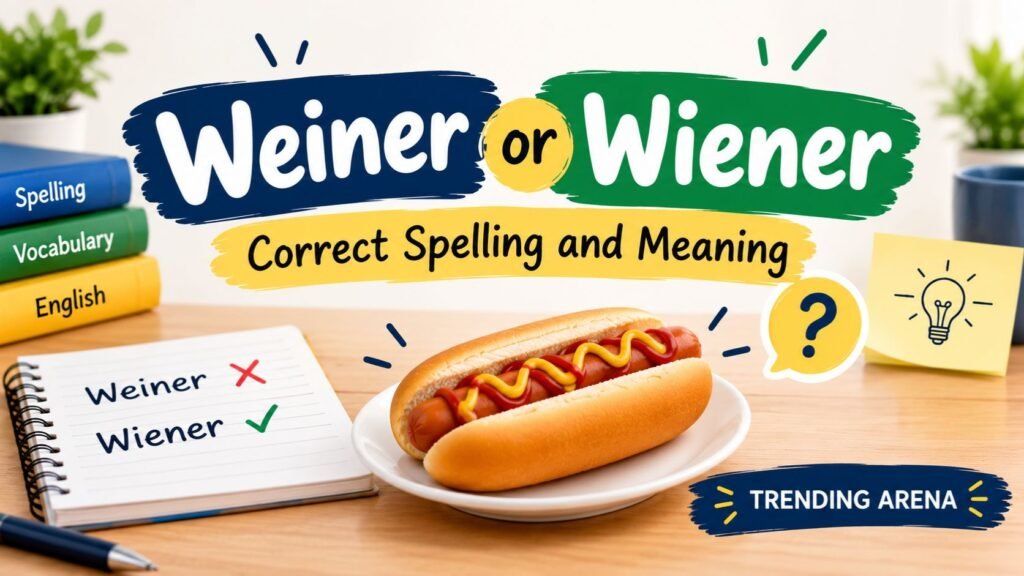

You are typing a menu, a caption, or a school assignment, and you stop. Is it “weiner” or “wiener”? The two spellings look almost the same, and both show up everywhere online.
Here is the good news: there is a clear answer, and it comes down to one city in Europe. This guide walks you through the correct spelling, the history behind it, how to say it, and the few cases where “Weiner” is actually right. You will also get examples, a comparison table, and simple tricks to remember the difference for good.

Quick Answer
“Wiener” is the standard, correct spelling for the sausage, the hot dog, the dog breed nickname, and the word for a person or thing from Vienna.
“Weiner” is a less common variant of the sausage word, and it is also a real surname with its own history.
Here is the short version:
- Wiener (i before e): hot dog, Vienna sausage, wiener schnitzel, wiener dog
- Weiner (e before i): mainly a family name, and a frequent misspelling of the food word
- Safe choice: if you are writing about food, use “wiener”
Merriam-Webster lists “wiener” as the main entry and treats “weiner” as a less common variant. Another major American dictionary, the American Heritage Dictionary, has been noted by language commentators as having no separate entry for “weiner.” So if you want to be correct in formal writing, “wiener” is the one to pick.
Also Read This: https://trendingarena.com/roster-vs-roaster/
The Origin of Weiner or Wiener
To understand the spelling, you have to start in Austria.
Vienna and the Word “Wien”
The German name for the city of Vienna is Wien. It is pronounced roughly like “veen.” Add the ending “-er,” and you get Wiener, which means “from Vienna” or “Viennese.” That is the heart of the whole matter. The sausage is named after the city, and the city’s name contains “ie.”
German does this all the time. A person from Frankfurt is a Frankfurter. A person from Hamburg is a Hamburger. Both of those became food words in English, just like “wiener” did.
From Wienerwurst to Wiener
The longer German name is Wienerwurst, which combines “Wiener” with “Wurst,” the German word for sausage. You may also see Wiener Würstchen, meaning “little Viennese sausage.”
According to Merriam-Webster, the English word “wiener” is a shortened form of “wienerwurst.” The dictionary dates the first known use of “wiener” to 1880, and “wienerwurst” to 1882. German immigrants brought their sausage traditions to the United States in the nineteenth century, and the short form stuck.
Why People Write “Weiner”
If the spelling is so clear, why does “weiner” appear so often? There are three main reasons.
- English vowel habits. Many English speakers learned the rhyme about the first vowel doing the talking. In “ie,” that would suggest the “i” sound, so people expect “ei” to sound like a long “e” instead. Spelling follows the sound they say, not the German source.
- Pronunciation drift. English speakers say “WEE-ner” for the sausage. In English, the letters “ei” often make that “ee” sound (think of “receive” and “seize”), so “weiner” feels natural.
- The surname. “Weiner” is a genuine family name. Seeing it in news stories, credits, and signs makes the spelling familiar, even when it is wrong for food.
Paul Brians, a Washington State University professor who runs a well-known list of common English errors, puts “weiner” in the wrong column for the sausage. He explains that Americans are not used to the European way of reading “ie” as “ee,” so the misspelling is common.
Which Spelling Should You Use?
The right choice depends on what you are writing about. Use this simple guide.
Use “Wiener” When You Mean
- A hot dog or frankfurter
- Vienna sausage
- A dish named after Vienna, such as wiener schnitzel
- The nickname for a dachshund
- A person or thing from Vienna (usually capitalized and often in German phrases)
- The mathematician Norbert Wiener, or ideas named after him
Use “Weiner” When You Mean
- A person whose family name is spelled that way
- A business or brand that uses a family name spelled “Weiner”
- A quote or title where the spelling is part of the original text
A Simple Memory Trick
Think of Wien, the German name of Vienna. The word “Wien” already has the letters “ie” in the right order. Add “er,” and you get Wiener. If you can remember the city, you can remember the spelling.
Another quick trick: the i comes first in Vienna, and the i comes first in Wiener.
Quick Decision Checklist
Ask yourself these questions in order:
- Am I writing about food or a dog? Use wiener.
- Am I writing about the city of Vienna or something from it? Use Wiener.
- Am I writing someone’s actual name? Check how that person spells it, and copy it exactly.
- Am I unsure? Use wiener. It is the safe, standard choice.
Common Mistakes with Weiner or Wiener
Even careful writers slip up here. These are the mistakes you will see most often.
Mistake 1: Weiner Schnitzel
The famous breaded cutlet is Wiener Schnitzel, meaning “Viennese cutlet.” Writing “Weiner Schnitzel” is a common error on menus and recipe blogs. The word “Wiener” here is a German adjective, so it also gets a capital letter in German style.
Mistake 2: Weiner Dog
The popular nickname for a dachshund is usually written wiener dog. You will see “weiner dog” in social media posts, but the standard dictionary form uses “ie.” The breed’s formal name is dachshund, a German word often explained as “badger dog,” because the breed was developed to hunt badgers.
Spellings of the nickname also vary in punctuation. Some people write it as two words, some hyphenate it, and some run it together. Two words is the most common and the easiest to defend.
Mistake 3: Mixing Up Names
Famous people share these spellings, which adds to the confusion. Norbert Wiener, the American mathematician who helped found cybernetics, is spelled with “ie.” Public figures with the “ei” spelling are different families entirely. When you write a person’s name, always check the spelling instead of assuming.
Mistake 4: Confusing It with “Whiner”
Because “Weiner” in German sounds like the English word “whiner,” people sometimes mix them up in writing. They are unrelated words. A whiner is someone who complains. A wiener is a sausage, or a person from Vienna.
Mistake 5: Over-Correcting Surnames
Some writers learn that “wiener” is right and then “fix” every instance of “Weiner” they see. Do not do this. If it is a person’s name, the original spelling is correct for that person.
Mistake 6: Other Odd Spellings
Look out for these as well:
- Weener and wener (attempts to spell the sound)
- Wienner (an extra “n”)
- Wiener used with a lowercase “w” when it is part of a proper German name
Pronunciation and Spelling
Pronunciation explains most of the spelling trouble, so it is worth a closer look.
How Germans Say It
In German, letters follow different rules from English.
- W sounds like an English V.
- ie sounds like a long e, as in “see.”
- ei sounds like the English word eye.
So German Wiener sounds like “VEE-ner.” German Weiner sounds like “VY-ner.”
This is why the two spellings are not interchangeable in German. They really are different words with different sounds.
How English Speakers Say It
In English, the sausage is almost always pronounced WEE-ner. The “W” becomes an English “W,” and the “ie” keeps its long “e” sound. This anglicized version is standard and fully accepted. The Merriam-Webster pronunciation guide for the word shows the “WEE-ner” sound.
The surname Weiner is trickier. According to the Wikipedia entry on the name, many English-speaking families say it as WY-ner, which is close to the German sound. Many others say WEE-ner, partly because of confusion with the “Wiener” surname and partly because English often reads “ei” as “ee.” Neither is wrong. The best approach is to ask a person how they say their own name.
Pronunciation Table
| Spelling | German sound | Common English sound | Rhymes with |
|---|---|---|---|
| Wiener | VEE-ner | WEE-ner | cleaner |
| Weiner (surname) | VY-ner | WY-ner or WEE-ner | diner or cleaner |
| Wien (city) | VEEN | VEEN | seen |
| Whiner (complainer) | not a German word | WY-ner | diner |
A Note on Spelling by Ear
If you spell by sound, you will often get the wrong result. The English “ee” sound can come from “ie,” “ei,” “ea,” or “ee.” That is why spelling by ear fails here, and why the memory trick about the city of Vienna is so useful.

American vs British English Differences
The spelling “wiener” does not change between American and British English. What changes is how often people use the word and what they call the food.
In American English
Americans use wiener as a casual word for a hot dog, especially in the Midwest and in phrases like “wiener roast,” which means a cookout where people roast hot dogs over a fire. Merriam-Webster even uses that phrase in its examples. You will also hear it in food names, like Rhode Island’s “hot wiener,” a local style of hot dog that has its own regional identity.
In British English
British speakers are more likely to say hot dog, frankfurter, or simply sausage. The word “wiener” is understood, but it usually appears in specific terms such as Wiener Schnitzel, in the names of Viennese things, or in surnames. Some British speakers also hear it as distinctly American.
Slang Differences
In both varieties, “wiener” has slang meanings that can sound humorous or rude. Merriam-Webster notes a slang sense for a body part and an informal sense for a weak or awkward person. Because of this, writers often avoid the word in formal or professional text unless they mean the food.
Quick Comparison
| Feature | American English | British English |
|---|---|---|
| Standard spelling | wiener | wiener |
| Common word for the food | hot dog, wiener | hot dog, frankfurter |
| “Wiener roast” | Familiar | Rare |
| Wiener Schnitzel | Familiar | Familiar |
| Variant “weiner” | Listed as a less common variant | Not standard |
Correct Word Formation
Understanding how the word is built makes the spelling stick.
Breaking Down the Word
Wiener = Wien + er
- Wien is the German name for Vienna.
- -er is a common German ending that can mean “a person from” or “of that place.”
So Wiener literally means “Viennese” or “one from Vienna.” The same pattern gives us:
- Berliner (a person from Berlin, and a type of pastry)
- Hamburger (from Hamburg)
- Frankfurter (from Frankfurt)
Once you see the pattern, “wiener” feels like part of a family of place-based food words.
Plural and Possessive Forms
- Singular: wiener
- Plural: wieners (some dictionaries also list “weiners” as a variant)
- Possessive singular: wiener’s
- Possessive plural: wieners’
Example: “The wiener’s bun was soft,” and “The wieners’ toppings were set out on the table.”
Compound Words and Phrases
| Term | Meaning |
|---|---|
| Wienerwurst | The German name for the sausage |
| Wiener Würstchen | Small Viennese sausage |
| Wiener Schnitzel | Breaded cutlet from Vienna |
| Wiener roast | An outdoor cookout for hot dogs |
| Wiener dog | Nickname for a dachshund |
| Wiener Melange | A Viennese coffee drink |
Capital Letters
Here is a rule worth remembering:
- Use a lowercase “w” when you mean the food: “I ate two wieners.”
- Use a capital “W” in proper names and German dish names: “Wiener Schnitzel,” “Wiener Philharmoniker,” or “Norbert Wiener.”
Dictionary-Style Word Details
Here is a clear, dictionary-style summary of the word.
Word: wiener (also spelled weiner, less commonly)
Part of speech: noun
Pronunciation: WEE-ner
Origin: short for the German Wienerwurst, meaning “Vienna sausage,” from Wiener, “of Vienna”
First recorded use: 1880 (according to Merriam-Webster)
Main Meanings
- Food sense: a frankfurter or hot dog. This is the primary and most common meaning.
- Slang sense: a vulgar term for a part of the male body.
- Informal sense: a weak, awkward, or ineffectual person.
Related Words and Synonyms
- Hot dog
- Frankfurter
- Frank
- Vienna sausage
- Sausage
- Dog (casual slang)
Related Proper Nouns
- Wiener Schnitzel: the famous breaded veal or pork cutlet
- Norbert Wiener: the mathematician who coined the term cybernetics for the study of control and communication
- Wiener filter and Wiener process: terms in engineering, signal processing, and probability named after him
About the Surname Weiner
The surname Weiner comes from more than one source, which is why it is a little complicated. Genealogy sources describe these origins:
- German origin: a form of “Wagner,” meaning a cartwright or wagon-maker
- Altered form of Wiener: a version of the Viennese name with the vowels switched
- Yiddish origin: from Vayner, meaning a wine merchant or keeper of a wine shop, related to the German word Wein, “wine”
Records from 23andMe’s surname project show that Weiner ranked around 2,238th among U.S. surnames in 2000 and 2,546th in 2010. It also reports that most people with this name have Ashkenazi Jewish ancestry. The surname Wiener is a separate name meaning “from Vienna,” though over time the two have been swapped in both directions.
Weiner or Wiener in Everyday Examples
Examples help the rule feel real. Here are sentences showing each form in action.
Food Examples (Use “Wiener”)
- “We roasted wieners and marshmallows over the campfire.”
- “She ordered a wiener with mustard and sauerkraut.”
- “The restaurant is known for its Wiener Schnitzel and potato salad.”
- “He packed a pack of wieners for the picnic.”
- “Our neighbor’s wiener dog loves to chase squirrels.”
Name Examples (Spell as the Person Does)
- “Dr. Norbert Wiener developed the foundations of cybernetics.”
- “The Weiner family has run the bakery for three generations.”
- “I sat next to Ms. Weiner at the conference.”
Incorrect and Correct Pairs
| Incorrect | Correct |
|---|---|
| Weiner schnitzel | Wiener Schnitzel |
| Weiner dog | Wiener dog |
| Let’s roast some weiners | Let’s roast some wieners |
| The weiner roast starts at six | The wiener roast starts at six |
| Norbert Weiner | Norbert Wiener |
Examples in Different Settings
On a menu: “Classic Wiener Schnitzel, served with lemon and parsley potatoes.”
In a school essay: “The word wiener comes from Wien, the German name for Vienna.”
On a food blog: “These grilled wieners are ready in ten minutes.”
In a business email: Avoid the word unless you are discussing food, because the slang meanings can be distracting.
A Writer’s Tip
If your text appears in print, on a website, or on a menu, a spelling slip stands out. A simple spell check may not flag “weiner,” because it is a real word and a real surname. Always read food words with care before you publish.
Weiner or Wiener: Google Trends and Usage Data
People search for this topic for a few predictable reasons. Looking at the shape of that interest helps explain why the confusion persists.
What Drives the Searches
- Seasonal food interest. Searches linked to hot dogs tend to rise in warm months, around barbecues, summer holidays, and sports events.
- Brand and pop-culture moments. Famous vehicles, contests, and shows that use the word send people to check the spelling.
- School and writing tasks. Students and writers look up spelling questions all year.
- News about named individuals. When a person with the surname appears in the news, people look up the name and the word together.
What Usage Patterns Show
Language commentators have noticed that “wiener” appears more often than “weiner” in printed and online food writing, though “weiner” is far from rare. Its frequency is one reason it shows up in dictionaries as a recorded variant.
Merriam-Webster takes a descriptive approach. Listing a variant tells you the form exists in real writing. It does not mean every editor would approve of it. That difference is why formal style guides and teachers still prefer “wiener.”
How to Check the Trend Yourself
You do not have to take anyone’s word for it. Here is a simple way to check current interest.
- Open Google Trends.
- Type “wiener” and “weiner” as two comparison terms.
- Set the region to your country and the time range to five years.
- Look at the lines for seasonal peaks.
- Try adding “wiener dog” and “wiener schnitzel” for extra detail.
Because search behavior changes, a live check will always be more accurate than any number printed in an article.
Additional Clarifications About Weiner or Wiener
A few finer points often come up after the main question is answered.
Is “Weiner” Ever Acceptable for the Food?
Merriam-Webster records it as a less common variant, so it is not a nonsense word. Still, “wiener” is the form most teachers, editors, and style guides will expect. If you are writing for school, work, a publication, or a menu, stick with “wiener.”
Does “Weiner” Mean Anything in German?
As a common noun, no. It exists as a surname, with the origins listed above. German speakers would not read “Weiner” as the word for the sausage or for a person from Vienna.
Why Is the Word Used as Slang?
Words for sausages often pick up humorous meanings because of how they look and sound. “Wiener” is no exception. Dictionaries record these slang senses as informal or vulgar. In professional writing, it is wise to keep the word tied to its food meaning.
Is “Wiener” the Same as “Frankfurter”?
Close, but not identical in origin. “Frankfurter” points to the city of Frankfurt, and “wiener” points to Vienna. In everyday American English, people often use them interchangeably for hot dogs. In German, the names refer to distinct regional sausages.
Should I Capitalize “Wiener Dog”?
No. In the food and dog senses, use lowercase: “wiener dog.” Capital letters are for proper names, such as “Wiener Schnitzel.”
What About Brand Names?
Companies sometimes choose their own spellings for marketing. A brand’s official spelling should be copied exactly when you name it, even if it differs from standard usage. Check the brand’s own website to be sure.
Does the Spelling Differ in Other Languages?
Yes. In German, Wiener is the correct spelling for “Viennese,” and German writers would see “Weiner” as a different word. Some languages borrow the term with their own spelling rules. In English, the “ie” form stays standard.
A Note for Editors and Teachers
When correcting this error, explain the reason instead of only marking it wrong. A short note like “Wiener comes from Wien, the German name for Vienna” teaches the rule and helps the student keep it for next time.
Comparison Table: Weiner or Wiener Variations
This table pulls the main points together so you can scan them quickly.
| Feature | Wiener | Weiner |
|---|---|---|
| Standard spelling for food | Yes | No (variant only) |
| Dictionary status | Main entry | Less common variant |
| Origin | German, from Wien (Vienna) | Surname (German or Yiddish) |
| Meaning in German | Viennese, of Vienna | No common-noun meaning |
| German pronunciation | VEE-ner | VY-ner |
| Typical English pronunciation | WEE-ner | WY-ner or WEE-ner |
| Used for hot dogs | Yes | Often seen, but nonstandard |
| Used for dachshund nickname | Yes (wiener dog) | Often seen, but nonstandard |
| Used in Wiener Schnitzel | Yes | No |
| Used as a surname | Yes (separate name) | Yes |
| Best for formal writing | Yes | Only as a person’s name |
Related Terms at a Glance
| Term | Spelling | Notes |
|---|---|---|
| Sausage from Vienna | Wiener / Wienerwurst | Standard |
| Cutlet from Vienna | Wiener Schnitzel | Capitalized in German style |
| Dachshund nickname | Wiener dog | Lowercase |
| Cookout term | Wiener roast | Mostly American |
| Mathematician | Norbert Wiener | Proper name |
| Family name | Weiner | Spell as the person does |
| Complainer | Whiner | Unrelated word |
Conclusion
So, weiner or wiener? For the sausage, the hot dog, the dog nickname, and anything from Vienna, the answer is wiener. The word comes from Wien, the German name of Vienna, and the “ie” in the city’s name is the reason for the “ie” in the word.
“Weiner” is not made up, but it belongs mostly to family names. It also appears as a less common variant in dictionaries and as a frequent slip in everyday writing. If you are not sure, choose “wiener” and you will almost always be right.