
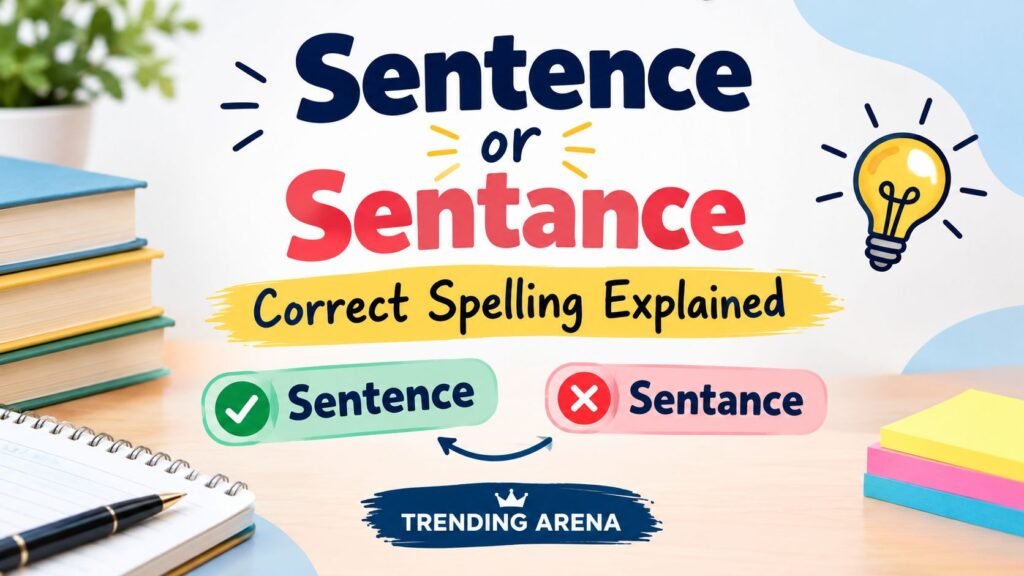

You are typing fast, and you stop. Does that middle vowel look right? Sentence or sentance? The two forms differ by a single letter, which is exactly why the doubt feels so real.
Here is the short version. Sentence is the only correct spelling. Sentance is a misspelling, not a regional variant and not a second accepted form. Dictionaries list one word, and editors fix the other without a second thought.
This guide explains why the mistake happens, what the word actually means, how the spelling holds up in British and American English, and how to lock in the right version for good. You will also find plain examples, a comparison table, and a few memory tricks that work.
Quick Answer
The correct spelling is sentence, with an “e” in both the middle and the final syllable. Sentance is a common misspelling and should not appear in schoolwork, emails, reports, or published writing.
The fastest way to remember it:
- sent + ence = sentence
- Every vowel in the word is an e. There is no “a” anywhere.
- The word is spelled s-e-n-t-e-n-c-e.
A quick check you can run in your head:
| If you wrote… | Verdict | Fix |
|---|---|---|
| sentence | Correct | Keep it |
| sentance | Incorrect | Change to sentence |
| sentances | Incorrect | Change to sentences |
| sentanced | Incorrect | Change to sentenced |
| sentancing | Incorrect | Change to sentencing |
One rule covers all of them. Whenever the word shows up, in any form, the vowels stay as e.
The Origin of Sentence or Sentance
Knowing where a word comes from often makes its spelling feel less random. Sentence has a long and fairly tidy history.
The English word came from Old French sentence, which in turn came from the Latin sententia. In Latin, that word carried the sense of an opinion, a judgment, or a way of thinking. It is linked to the verb sentire, which means to feel or to perceive. You can still see that family resemblance in English words such as sensation, sentiment, and consent.
Over the centuries the meaning stretched. A “sentence” was first an opinion or a formal decision. Later it also came to mean a complete unit of written or spoken language. Both uses survived, which is why the same word now describes a line of text and a court’s punishment.
So where does sentance come from? Nowhere, historically. It has no Latin parent, no French ancestor, and no medieval spelling to point to. It is a modern slip, and the cause is easy to spot.
- The second syllable is unstressed, so the vowel is weak. In everyday speech it sounds like a soft “uh” (linguists call this a schwa).
- English has hundreds of words ending in -ance, such as distance, importance, and performance. Your brain pattern-matches.
- Writers who spell by ear, especially fast typists and English learners, pick the ending that feels familiar.
That last point matters. English spelling often keeps old forms that pronunciation has since blurred. The sound tells you very little about the letters, so the spelling has to be learned as a whole.
Also read this: Alright Meaning in Text: Definition, Usage, and Real-Life Chat Examples
Meaning Of Sentence
Sentence carries two main meanings, and both use exactly the same spelling.
Sentence in grammar
In grammar, a sentence is a group of words that expresses a complete thought. It usually has a subject (who or what the sentence is about) and a predicate (what the subject does or is). It starts with a capital letter and ends with a period, question mark, or exclamation mark.
Some examples:
- The train arrived late.
- Did you finish the report?
- Close the door.
- What a view!
Each one stands on its own. You do not need extra information to understand it. That independence is the test of a complete sentence.
Sentences are also grouped by purpose:
- Declarative: makes a statement.
- Interrogative: asks a question.
- Imperative: gives a command or instruction.
- Exclamatory: shows strong feeling.
Sentence in law
In legal English, a sentence is the punishment a court hands down after a conviction. You see it in phrases such as prison sentence, suspended sentence, life sentence, and reduced sentence.
For example: “The judge announced the sentence on Friday.”
Sentence as a verb
The word also works as a verb in legal contexts. To sentence someone means to formally impose that punishment.
- The judge will sentence the defendant next week.
- The court sentenced him to three years.
- The sentencing hearing lasted two hours.
Notice that the “e” stays in sentenced and sentencing. The misspellings sentanced and sentancing simply carry the original mistake forward.
British English vs American English Spelling
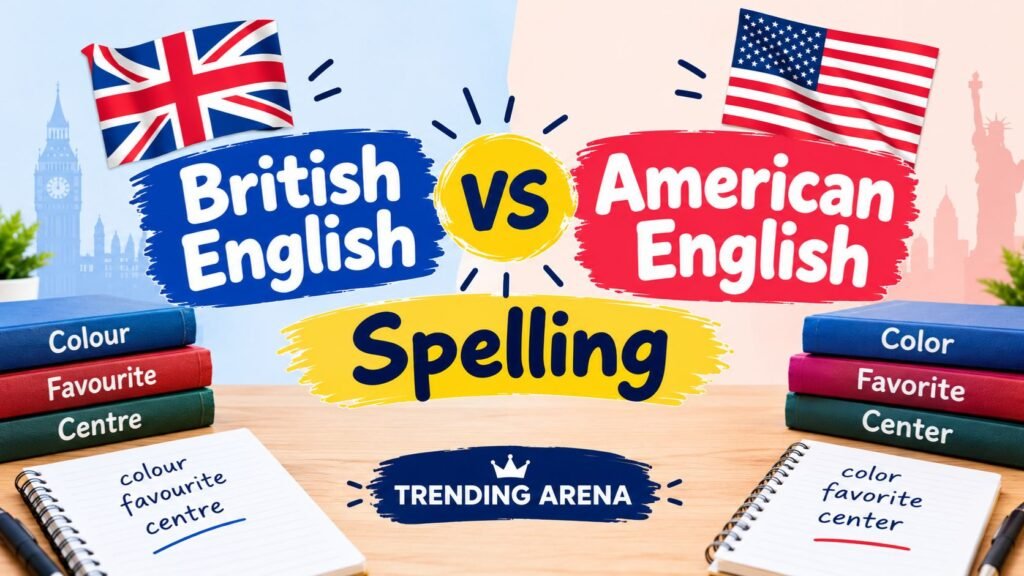
Many spelling questions in English split along the Atlantic. Color and colour, center and centre, organize and organise. People often assume sentance might be one of these pairs.
It is not.
| Variety | Correct spelling | Is “sentance” accepted? |
|---|---|---|
| American English | sentence | No |
| British English | sentence | No |
| Canadian English | sentence | No |
| Australian English | sentence | No |
There is no UK-versus-US difference for this word. A British schoolteacher and an American editor will both circle sentance in red.
This is useful to know because search queries like “sentence or sentance UK” are common. Writers wonder whether the misspelling is secretly the British form. It is not. If you are unsure which national standard to follow, the answer is the same everywhere, so you can stop worrying about it.
Which Spelling Should You Use?
Use sentence. Every time, in every context.
That sounds blunt, but the question really does have one answer. Here is how it plays out across common situations:
| Situation | Use | Why |
|---|---|---|
| School essay or exam | sentence | Standard spelling; marked wrong otherwise |
| Work email or report | sentence | Typos weaken credibility |
| Text message or social post | sentence | Autocorrect may not save you |
| Legal or news writing | sentence | Same spelling for the court meaning |
| Grammar lesson | sentence | It names the grammatical unit |
There is one narrow exception worth mentioning for completeness. Sentance does exist as a rare surname, and a company or person could use that spelling as a proper name. If you are writing about someone called Sentance, keep their name as it is. For ordinary writing, that exception never applies.
If you are ever stuck, reread the word slowly and look for the pattern: sent at the start, ence at the end. If you spot an “a,” swap it for an “e.”
Regional Usage
Beyond the UK and US, the picture stays consistent. English learners in India, Pakistan, Nigeria, the Philippines, and elsewhere all meet the same standard spelling in textbooks, dictionaries, and exams. Regional vocabulary can differ, and some word forms do vary, but this particular word does not.
A few practical points about regional usage:
- Education systems. Curricula in English-speaking countries teach sentence as the standard form from early grammar lessons onward.
- Legal systems. Courts and legal publishers use sentence for the punishment, in judgments, statutes, and news reports.
- Publishing. Style guides do not list sentance as an option, so editors correct it automatically.
The spoken forms may differ slightly. Some accents give the final syllable a clearer vowel, while others reduce it to almost nothing. That variation in sound is one reason the written form feels uncertain. But accent never changes the letters on the page.
If you work with multilingual writers or teach English as a second language, it helps to point out this gap directly. Say it out loud, then show the letters. The two do not always match, and that is normal for English.
Sentence Or Sentance Key Differences
The real difference between the two forms is not meaning. It is status. One is a word. The other is an error.
| Feature | Sentence | Sentance |
|---|---|---|
| Standard English word | Yes | No |
| Listed in major dictionaries | Yes | No |
| Part of speech | Noun and verb | None |
| Meaning | A complete thought; a court punishment | Usually an attempted spelling of sentence |
| Plural | sentences | Not applicable |
| Past tense (legal verb) | sentenced | Not applicable |
| Acceptable in formal writing | Yes | No |
| Acceptable in casual writing | Yes | No |
Three things stand out here.
- They are not two words. People sometimes search “sentence vs sentance” as though comparing two meanings. There is only one meaning to compare.
- Formality does not rescue the error. A relaxed text message still looks careless with sentance in it.
- Spell checkers usually catch it, but not always. Relying on software alone is risky, especially when you are typing quickly or working on a device with weak autocorrect.
Common Mistakes with Sentence
Most errors with this word are small and predictable. Knowing the pattern makes them easy to avoid.
1. Writing “sentance”
The classic mistake. It usually comes from sound, not from ignorance.
- Incorrect: Please write one sentance about your weekend.
- Correct: Please write one sentence about your weekend.
2. Writing “sentances”
The plural carries the same slip.
- Incorrect: The paragraph has six sentances.
- Correct: The paragraph has six sentences.
3. Writing “sentanced” or “sentancing”
Legal writing is full of these.
- Incorrect: He was sentanced to two years.
- Correct: He was sentenced to two years.
4. Dropping or doubling letters
Other near misses also appear: sentense, sentince, and scentence. None is correct. Every vowel in the word is an e, and there is only one “c.”
5. Adding an extra “e” before -ing
The verb sentence loses its final “e” before -ing.
- Incorrect: The judge is sentenceing the defendant.
- Correct: The judge is sentencing the defendant.
6. Trusting spell check completely
Software helps, but it can miss errors in unusual contexts, in names, or when autocorrect guesses a different word. A quick manual read before you send or publish catches what tools skip.
A simple proofreading routine
- Search the document for “sentan.” It finds sentance, sentances, sentanced, and sentancing in one pass.
- Read the finished piece aloud, slowly.
- Check any legal passages twice, since they use the word often.
How To Spell Sentences
The plural is straightforward: take the singular and add an s.
sentence + s = sentences
The final “e” stays. You do not change it or swap it for an “a.”
Here is the whole word family in one place:
| Form | Spelling | Example |
|---|---|---|
| Singular noun | sentence | This sentence is clear. |
| Plural noun | sentences | The page has five sentences. |
| Base verb | sentence | The judge will sentence him. |
| Third person | sentences | She sentences offenders. |
| Past tense | sentenced | He was sentenced yesterday. |
| Present participle | sentencing | The sentencing begins at noon. |
| Related adjective | sentential | The study looks at sentential structure. |
Memory tricks that actually work
Spelling advice is only useful if it sticks. These are simple, and they work because each one gives your memory a concrete hook.
- Split it. Break the word into sent and ence. Say “I sent a sentence.” The word sent is hiding inside.
- Spot the three e’s. Write it as sEntEncE. If you see an “a,” something is wrong.
- Link it to sense. A sentence should make sense. Both end in an “e” sound and share a Latin root with the idea of feeling and meaning.
- Say it the long way. Pronounce it as “sen-TEN-ce” once in your head. Exaggerating the vowels often shows you where the letters belong.
Pick one and use it. Repeating the word in meaningful sentences works better than copying it ten times in a row.
Sentance vs Sentence Fragment
The phrase “sentance vs sentence fragment” turns up in searches, and it mixes two separate ideas. One is a spelling problem. The other is a grammar problem. Keeping them apart saves a lot of confusion.
- Sentance is a misspelling of sentence. Fix it by changing one letter.
- A sentence fragment is a group of words that looks like a sentence but is missing something essential: a subject, a verb, or a complete thought.
Here is a fragment:
Because the rain was heavy.
The reader waits for the rest. What happened because of the rain? A complete version might be:
Because the rain was heavy, the match was cancelled.
Fragment, clause, or phrase?
A few related terms get mixed up with fragments, so here is a short guide.
| Term | What it is | Example |
|---|---|---|
| Sentence | Complete thought, can stand alone | The match was cancelled. |
| Independent clause | Subject and verb, can stand alone | The match was cancelled |
| Dependent clause | Subject and verb, cannot stand alone | Because the rain was heavy |
| Phrase | Related words, no full subject-verb pair | After the long journey |
| Fragment | Incomplete group presented as a sentence | Running through the park. |
Run-on sentences
The opposite problem also exists. A run-on sentence joins independent clauses without proper punctuation or a connecting word.
- Run-on: The movie ended we went home.
- Fixed: The movie ended, and we went home.
- Also fixed: The movie ended. We went home.
Fragments are not always wrong. Writers use them on purpose in advertising, dialogue, and creative work for punch. “No excuses.” works fine. In formal writing, though, complete sentences are the safer choice.
The takeaway: spelling errors and grammar errors often travel together. A student might write a fragment and misspell the word in the same line. Fix the spelling first, then check the structure.
Sentence or Sentance in Everyday Examples
Seeing the word in real situations helps the correct form feel natural. The examples below show sentence across common settings.
At school
- Write one sentence using the new vocabulary word.
- Underline the subject in each sentence.
- Your topic sentence should introduce the main idea.
At work
- Please shorten the opening sentence of the proposal.
- The final sentence needs a clearer call to action.
- Keep each sentence concise so the steps are easy to follow.
In law and news
- The judge announced the sentence in open court.
- She received a suspended sentence and a fine.
- The court sentenced him after the hearing.
In everyday conversation
- Can you say that in one sentence?
- I lost track halfway through your last sentence.
- That is a strange sentence, but it is grammatically correct.
Side-by-side corrections
| Incorrect | Correct |
|---|---|
| He wrote a long sentance. | He wrote a long sentence. |
| The judge issued a sentance. | The judge issued a sentence. |
| I need to fix this sentance. | I need to fix this sentence. |
| Both sentances are too long. | Both sentences are too long. |
| She was sentanced yesterday. | She was sentenced yesterday. |
Notice how the correct versions look instantly cleaner. That visual contrast is a quiet way your brain learns spelling. The more often you see the right form in context, the more the wrong one starts to look off.
Google Trends & Usage Data
Search behavior tells an interesting story about this word. People type “sentence or sentance,” “sentence vs sentance,” and “is sentance a word” into search engines because they hit a moment of doubt while writing. That pattern is typical for spelling confusions: the query itself is evidence of uncertainty, not evidence that the misspelling is valid.
I will not quote exact search-volume numbers here, because they change over time and I have not verified current figures for this article. If you want hard numbers, you can check them yourself:
- Open Google Trends.
- Compare the terms “sentence or sentance” and “sentence vs sentance.”
- Set the region to the United States, then the United Kingdom, and compare.
- Look at related queries to see what people ask next.
What you can say with confidence is more general:
- Misspelling searches reflect doubt. People search the wrong form precisely because they suspect it is wrong.
- Frequency online does not equal correctness. A misspelling can appear many times on the internet and still be an error. Search engines index mistakes alongside correct writing.
- Edited writing tells the truth. In books, newspapers, academic journals, and legal documents, the standard form dominates overwhelmingly. The error mostly lives in unedited text, comments, and quick messages.
For a reliable final check, look the word up in a trusted dictionary. Major dictionaries list sentence and treat the other form as a mistake. That, rather than raw web frequency, is what defines standard spelling.
Tone, Context, and Formality
Some word choices shift with tone. You might pick begin over commence in a casual email, or purchase over buy in a contract. Spelling does not work that way here. Sentence is neutral. It sits comfortably in a legal judgment and a text to a friend.
That means there is no “informal” version of the spelling to fall back on. Compare these:
| Context | Right choice | Note |
|---|---|---|
| Formal academic paper | sentence | Expected without question |
| Business proposal | sentence | A typo can cost trust |
| Casual chat | sentence | Still the only correct form |
| Social media caption | sentence | Short does not mean sloppy |
| Legal document | sentence | Same spelling, different meaning |
Why small errors cost more than you think
A single misspelling rarely ruins a document. But readers notice. In a résumé, a cover letter, a client email, or an exam answer, a basic slip can quietly change how your whole message is judged. It is not fair, but it is real. People tend to read spelling errors as signs of rushed work.
This is where good habits pay off:
- Reread important messages before sending.
- Keep a short list of words you tend to misspell.
- Use spell check as a safety net, not as the only check.
Clearer writing, not just correct spelling
Spelling is one layer of quality. The sentence itself matters too. If you want your writing to land well:
- Keep sentences focused on one main idea.
- Vary length. Mix short, medium, and longer sentences.
- Cut filler words that add nothing.
- Read the piece aloud to catch awkward rhythm.
Short sentences are not always better, and long ones are not always worse. The goal is simple: make each sentence easy to follow for the person reading it.
Comparison Table
Here is a compact summary you can bookmark or screenshot.
| Point | Sentence | Sentance |
|---|---|---|
| Correct spelling | ✅ Yes | ❌ No |
| Dictionary entry | ✅ Yes | ❌ No |
| Grammar meaning | A complete thought | None |
| Legal meaning | A court punishment | None |
| Works as a verb | ✅ Yes (sentence, sentenced, sentencing) | ❌ No |
| Plural | sentences | Not applicable |
| British English | ✅ Correct | ❌ Incorrect |
| American English | ✅ Correct | ❌ Incorrect |
| Formal writing | ✅ Appropriate | ❌ Never |
| Casual writing | ✅ Appropriate | ❌ Still wrong |
| Origin | Latin sententia via Old French | No historical origin |
| Memory aid | sent + ence | Remember: no “a” |
If you only take one thing from this table, take the last row. There is no “a” in sentence.
Conclusion
The answer to “sentence or sentance” is simple: sentence. The other form is a misspelling, nothing more. It is not a British variant, not a casual alternative, and not a separate word with its own meaning.
The mix-up makes sense once you see where it comes from. The second syllable is weak in speech, and English has plenty of -ance words that make the “a” feel plausible. But the word’s roots in Latin sententia and Old French sentence point to one spelling only, and every modern form follows it: sentences, sentenced, sentencing.
To keep it right from now on:
- Remember sent + ence.
- Check the plural and verb forms for the same vowels.
- Run a quick search for “sentan” when proofreading.
- Treat spell check as backup, not a replacement for a careful reread.