

You are typing a message to your team. You want to say the new shift list is ready. Your fingers hover over the keyboard. Is it “roster” or “roaster”? One letter separates them, yet the two words belong to completely different worlds. One lives in offices, locker rooms, and hospital wards. The other lives in kitchens, coffee shops, and comedy clubs.
This guide clears up the roster vs. roaster question once and for all. You will learn what each word means, where each one came from, how to pronounce them, and how to pick the right one every time. You will also find real examples, a side-by-side table, and a few memory tricks that actually stick.
Roster vs. Roaster: Quick Answer
If you only have ten seconds, here is the short version.
Meaning
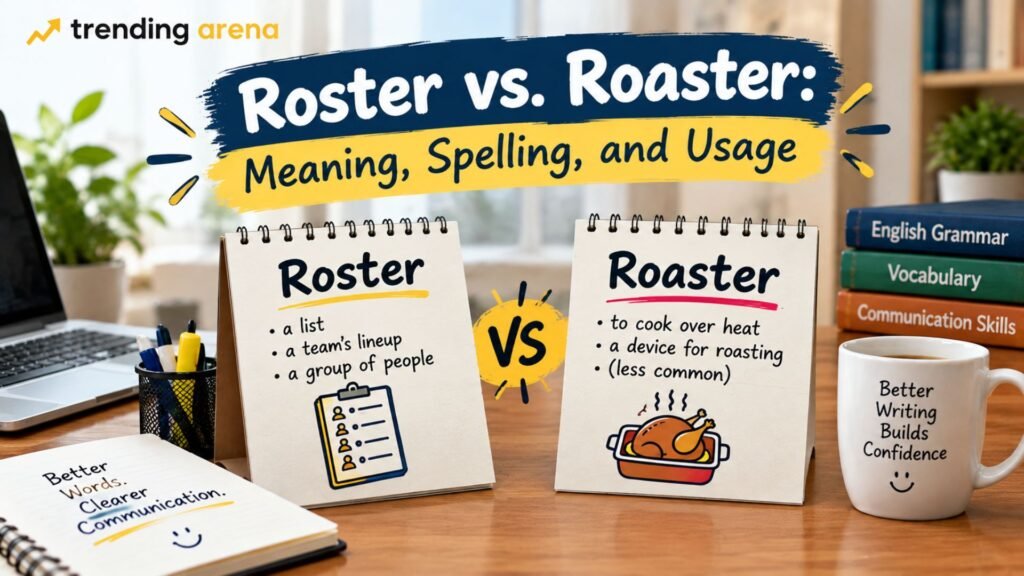
- Roster is a list of names. It shows who is on a team, who is working a shift, or who belongs to a group.
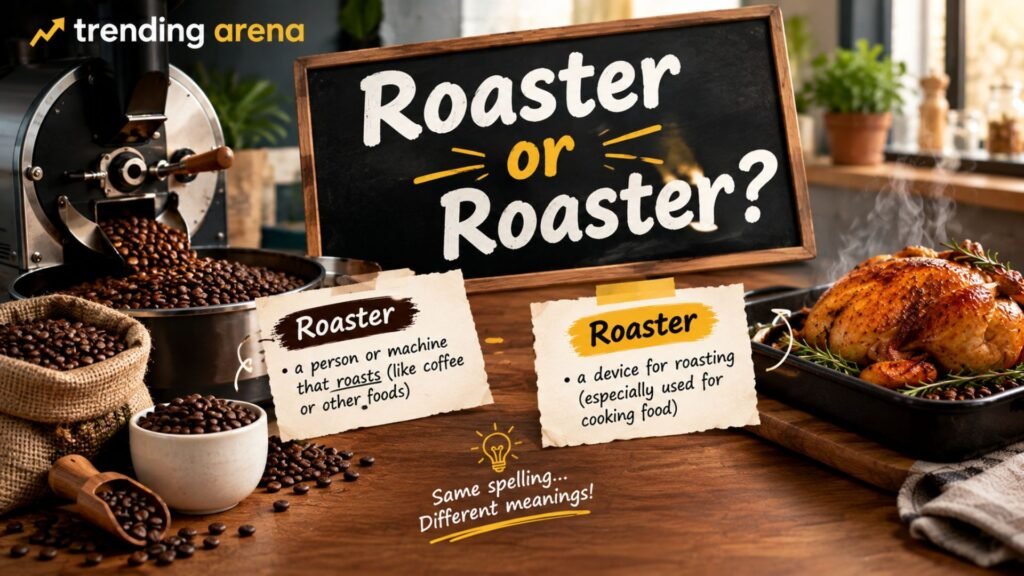
- Roaster is something or someone that roasts. It can be a cooking pan or oven, a machine or business that roasts coffee beans, a chicken sized for the oven, or a person who delivers jokes at a comedy roast.
Examples
- “The coach added three new players to the roster.”
- “She posted the weekend duty roster on the staff board.”
- “The café buys its beans from a local roaster.”
- “Grandma lifted the turkey out of the roaster.”
Final Answer
Use roster when you mean a list of people or duties. Use roaster when you mean heat, food, coffee, or jokes. If the sentence is about names on a list, you want the one without the “a.”
The Origin of Roster or Roaster
These two words look like cousins, and in a way they are. Both trace back to the same idea: roasting over a grate. The story is a good one, and it also makes the words easier to remember.
History
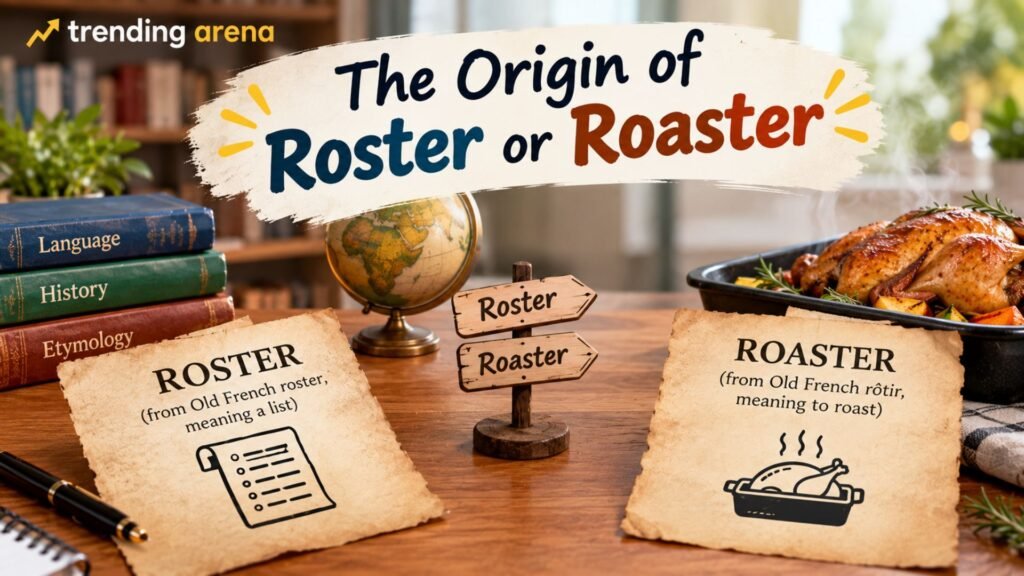
According to Etymonline, the word roster first appeared in English in 1727. It was used in a military setting to describe a list showing the turn or rotation of duty for people who relieve one another. The word was borrowed from Dutch rooster, which meant “table” or “list.” Before that, the Dutch word meant “gridiron,” the metal grate used for cooking meat over a fire. It comes from Middle Dutch roosten, “to roast.”
Why would a cooking grate become a list? The likely answer is visual. A sheet of paper ruled with parallel lines looks a lot like the bars of a grill. Someone saw the resemblance, and the kitchen word moved into the office. Wiktionary records the same Dutch borrowing.
By 1858, police departments used the word in their own jargon. By 1881, it had widened to mean any list or table of names, without any sense of rotating duty.
Roaster has a simpler backstory. Etymonline traces it to the mid-1400s, when it appeared as rostere, meaning one who roasts meat. It is just the verb roast plus the “-er” ending that turns an action into a doer or a tool. The sense of a roasting oven shows up by 1799. The meaning of a young animal or food suited to roasting dates to the 1680s.
Development
Over the next two centuries, both words grew in separate directions.
Roster moved from armies into factories, hospitals, airlines, sports leagues, and schools. Today it also appears in tech and business, as in “a roster of clients” or “a roster of speakers.” It also became a verb in British and Australian English. A manager “rosters” staff onto shifts, and people are “rostered on” for Saturday.
Roaster picked up new jobs. Coffee drove much of that growth. Etymonline records the verb roast applied to coffee beans by 1724, and the noun followed naturally. A “roaster” can now be the drum machine, the craftsperson running it, or the whole company. The word also gained a social meaning. The verb roast, meaning to tease someone for fun, is recorded from 1710. Vocabulary.com and Dictionary.com both list “a guest speaker at a roast” among the senses of roaster.
Here is the neat part. Both words come from the same root idea of roasting. One kept the cooking sense. The other turned the cooking grate into a list. That shared ancestry is exactly why people mix them up.
Is Roster or Roaster Correct?
Both are correct. They are different words with different jobs, and neither is a misspelling of the other. The only question is which one fits your sentence.
Think of it this way:
- If you could replace the word with “list of names” or “schedule,” pick roster.
- If you could replace it with “oven,” “pan,” “coffee maker,” “coffee company,” or “comedian at a roast,” pick roaster.
Merriam-Webster defines roster as a roll or list of personnel, or such a list giving the order in which a duty is to be performed. It also lists a broader sense: an itemized list. Merriam-Webster also notes the word’s first known use in 1727.
For roaster, Oxford Learner’s Dictionaries gives two main senses: a container, oven, or piece of equipment used for roasting, and a person or company that processes coffee beans. Dictionary.com adds the sense of an animal or food suited to roasting and a guest speaker at a roast.
So when a sentence has people, names, shifts, or teams, the answer is almost always roster. When it has food, heat, coffee, or comedy, the answer is roaster.
Roster vs. Roaster: Word Formation
Looking at how each word is built helps you spell it correctly.
Roaster = roast + -er. You take the verb “roast” and add the agent suffix, just as you add “-er” to “bake” to get “baker” or to “paint” to get “painter.” The “oa” is a vowel pair that makes a long “o” sound, as in “boat” and “toast.” If you can spot “roast” inside the word, you have the spelling right.
Roster has no “roast” hiding inside. It comes from Dutch, and it kept a short “o.” Think of it as “ros” plus “ter.” There is no “a” because the original Dutch word did not have one in the part that matters.
Here is a quick breakdown:
| Feature | Roster | Roaster |
| Letters | 6 | 7 |
| Structure | Borrowed Dutch word | Verb “roast” + “-er” |
| Contains “roast”? | No | Yes |
| Part of speech | Noun (also a verb in some regions) | Noun |
| Plural | Rosters | Roasters |
| Verb forms | Roster, rostered, rostering | Not used as a verb |
One more spelling tip: the pair “oa” appears in roaster, toaster, boat, and coat. Say “toaster” out loud and you will hear the long “o.” That sound belongs to roaster, not roster.
British English vs American English Spelling

Good news for anyone worried about regional rules. There is no British versus American spelling difference for either word. Both regions write roster and roaster the same way.
The differences you will notice are about pronunciation and everyday usage.
Pronunciation. Wiktionary lists the British pronunciation of roster as roughly “ROSS-tuh,” and the US pronunciations as “RAH-ster” or “RAWS-ter.” In other words, the first syllable sounds like “boss” or “toss,” not like “boat.” Roaster, on the other hand, rhymes with “toaster” in every major accent. Oxford Learner’s Dictionaries gives /ˈrəʊstə(r)/ for British English, and Britannica gives /ˈroʊstɚ/ for American English.
Everyday usage. In the UK, Australia, and New Zealand, “roster” is a workplace word for shift planning. People say “I’m on the Saturday roster” and managers “roster staff.” In the US, “schedule” often does that job in offices and shops, while “roster” stays strong in sports, schools, and military settings. That is a habit, not a rule.
Chicken sense. Britannica marks the “young chicken suitable for roasting” sense of roaster as chiefly US. British shoppers are more likely to say “roasting chicken.”
Usage Comparison
Seeing both words in action is the fastest way to lock them in.
Roster in a sentence
- The hospital updated the nursing roster for the night shift.
- A strong roster of speakers will headline the conference.
- Please check the duty roster before you swap shifts.
Roaster in a sentence
- The small-batch roaster behind the bakery sells out by noon.
- The stand-up comic was the star roaster at the charity dinner.
- Buying a commercial roaster is a big investment for a new coffee business.
Notice how the surrounding words signal the meaning. “Nursing,” “team,” “volunteer,” and “speakers” point to a list. “Bakery,” “turkey,” “coffee,” and “chicken” point to heat and food.
Key Insight
Roster is about people and order. Roaster is about heat and transformation. If a sentence is about who or when, it is a roster. If a sentence is about how something is cooked or who is teasing someone at a party, it is a roaster.
Roster or Roaster at a Glance
| Detail | Roster | Roaster |
| Core meaning | A list of names or duties | A device, person, or food used for roasting |
| Word type | Noun and verb | Noun |
| Typical settings | Work, sports, school, military, events | Kitchen, café, barbecue, comedy night |
| Dictionary example | “The team has a roster of 40 players.” | “A specialist coffee roaster buys beans from different regions.” |
| Pronunciation | ROSS-ter | ROH-ster |
| Origin | Dutch rooster, 1727 in English | English roast + -er, mid-1400s |
| Common phrases | Duty roster, team roster, roster spot | Coffee roaster, turkey roaster, pig roaster |
| Related words | Lineup, schedule, roll, register | Oven, grill, cook, comedian |
Also Read This Scary or Scarry Learn the Correct Spelling and Meaning
Which Spelling Should You Use?
The simplest method is to ask what your sentence is really about. Here are three common situations.
Workplace or Sports Context
If you are writing about people, shifts, or a team, use roster.
- Managers build a weekly roster for retail staff.
- Fantasy football fans obsess over their roster every Sunday morning.
- A club posts its player roster before the season starts.
- Teachers keep a class roster to track attendance.
You will also see the word in business writing. Agencies talk about their “client roster.” Talent firms keep a “roster of creators.” In each case, the word means a defined group of named people or entities.
Cooking Context
If you are writing about food, heat, or coffee, use roaster.
- A heavy roaster with a lid keeps meat moist.
- An electric roaster frees up your oven during the holidays.
- A fresh-roasted bag from a local roaster tastes brighter than supermarket beans.
- A “roaster” at a farm shop may also mean a plump chicken ready for the oven.
Merriam-Webster’s examples show how often the word appears in coffee news. Recent examples include company profiles describing a “third-wave coffee roaster” or a national roaster and distributor. When you write about coffee businesses, this is the word you need.
Easy Tip
Here are three memory tricks you can use right away.
- The “a” trick. Roaster has an “a” like aroma. Coffee and roast chicken have aroma. A list of names does not.
- The toaster test. If you can rhyme the word with “toaster,” it is roaster. If it rhymes with “foster,” it is roster.
- The list test. Replace the word with “list.” If the sentence still makes sense, it is roster.
A fourth trick comes straight from the word history. Think of a roster as a “grill of names.” The Dutch grid turned into a list. A roaster, meanwhile, still cooks on the grill.
Common Mistakes with Roster or Roaster
Even careful writers slip on this pair. Here are the patterns to watch for.
Mixing Up the Words
The most frequent error is swapping one for the other in a hurry.
- ❌ “The coach announced the final roaster for the tournament.”
- ✅ “The coach announced the final roster for the tournament.”
- ❌ “We bought a new coffee roster for the café.”
- ✅ “We bought a new coffee roaster for the café.”
The first sentence tells the reader the coach announced a cooking pan. The second says the café bought a list of coffee. Both are funny and both look careless in a professional document.
Context Confusion
Sometimes the word is spelled right but used in the wrong sense.
- “Our company has a roaster of experts.” This reads as if the experts are being cooked. Use roster.
- “The barista handles the roster.” Unless the barista is managing a schedule, the writer probably means roaster.
- Do not use “roster” to mean a person who teases others. That is a roaster.
Spelling Carelessness
Autocorrect and speed typing cause many errors. A few habits help.
- Proofread once for these two words. Search your document for “roaster” and “roster” and check each one.
- Do not rely on spell check. Both words are real, so no red line will appear.
- Read the sentence aloud. If you say “ROH-ster” and the sentence is about shifts, you have your answer.
- Watch for pronunciation spillover. People who say “roaster” when they mean “roster” aloud tend to type it that way too.
Roster or Roaster Meaning (Detailed)
Let us look at each word more closely, including the less common senses.
Roster Meaning
As a noun
- A list of personnel. This is the core meaning. Merriam-Webster describes it as a roll or list of personnel.
- A duty schedule. A list showing the order in which a duty is performed, such as a cleaning roster or an on-call roster.
- The people on the list. A coach may say, “Our roster is strong this year,” meaning the players themselves.
- An itemized list. The broader sense includes any set of named things, such as a roster of programs or a roster of products.
As a verb (mainly British and Australian)
- To place a person on a roster. Wiktionary gives the forms roster, rostered, and rostering. Example: “She was rostered on for the early shift.”
Phrases you may see:
- Duty roster
- Active roster
- Roster spot
- Roster cuts
- Client roster
- On the roster
Roaster Meaning
As a noun
- A cooking vessel or oven. Oxford Learner’s Dictionaries describes it as a container, oven, or piece of equipment used for roasting. This includes the covered electric roaster many families use for holiday meals and the large pig roaster used at outdoor events.
- A coffee machine. Equipment that heats green coffee beans until they develop flavor.
- A coffee person or company. Someone, or some business, that roasts and sells beans. Merriam-Webster examples often refer to a specialty roaster or a regional roaster.
- A food item suited to roasting. This applies to a chicken, pig, or similar animal. Britannica lists it as chiefly US for a young chicken suitable for roasting.
- A person who roasts in the comedy sense. Dictionary.com lists a guest speaker at a roast. Vocabulary.com also describes a harsh or humorous critic, sometimes meant as a playful compliment. Phrases you may see:
- Coffee roaster
- Electric roaster
- Turkey roaster
- Pig roaster
- Small-batch roaster
- Master roaster
Roster or Roaster in Everyday Examples
The best way to build instinct is repetition in real scenarios. Here are examples from four places you will actually meet these words.
Workplace
- “Please review the new shift roster by Friday.”
- “The HR team keeps a roster of trained first aiders.”
- “She was rostered on for the weekend.”
- “We need to update the on-call roster before the holiday.”
In workplace writing, roster is the word you want. It signals structure, order, and fairness. A good roster tells everyone who is doing what and when.
Sports
- “The team announced its 53-man roster on Tuesday.”
- “He was left off the tournament roster after an injury.”
- “Fans debated which free agents would join the roster.”
Sports is the home turf of the word. Broadcasters and bloggers use roster dozens of times per game. Roaster would only appear in a joke, such as a comic roasting a player at a charity dinner.
Kitchen
- “Lower the turkey into the roaster and cover it with the lid.”
- “The roaster frees up my oven for sides.”
- “Our local coffee roaster opens at seven.”
In the kitchen, roaster is a friendly word for a pan or appliance. At the café, it names the person or business behind the beans. If you are shopping for a roaster, look at capacity, lid fit, and heat control.
Roster or Roaster: Trends and Usage Data
A note on data first. The research behind this article drew on dictionary and etymology sources rather than a live Google Trends export, so no search-volume figures are quoted here. If you need exact numbers for your own project, open Google Trends and compare the two terms directly. The patterns below describe what the dictionary and usage evidence suggests.
Popularity
Both words are common in everyday English, but they peak in different places.
- Roster tends to rise around sports seasons, hiring periods, and school starts. Think of cut-down days in professional leagues, the start of a semester, or holiday staffing.
- Roaster tends to rise around holiday cooking, gift-buying, and coffee culture. Searches for a turkey roaster naturally climb before big family meals, and interest in coffee roasting equipment follows the growth of specialty coffee.
Because the words belong to different seasons and industries, they rarely compete with each other in real search behavior.
Usage Insight
Several things stand out in the dictionary evidence.
- Roster has a strong sports and workplace identity. Merriam-Webster’s recent examples lean heavily on professional sports, from football to hockey to mixed martial arts.
- Roaster has a strong coffee identity. The recent examples in Merriam-Webster and Dictionary.com are dominated by coffee companies and cafés.
- Confusion happens mostly in speech and typing. People who pronounce roster as “roaster” are likely to spell it that way. This is why the pair shows up as a common error.
- Both words are stable. Neither is a trendy slang term. They have been in English for centuries, and their core meanings have not changed.
Comparison Table: Roster vs Roaster
| Category | Roster | Roaster |
| Simple definition | List of people, names, or duties | Thing or person that roasts |
| Main field | Work, sports, military, education | Cooking, coffee, comedy |
| Part of speech | Noun, verb | Noun |
| First recorded in English | 1727 | Mid-1400s |
| Origin | Dutch rooster (“gridiron, list”) | English roast + -er |
| Vowel sound | Short “o” (ross) | Long “o” (rose) |
| Rhymes with | Foster | Toaster |
| Plural | Rosters | Roasters |
| Sample sentence | “The roster lists 25 players.” | “The roaster holds a 20-pound turkey.” |
| Common mistake | Spelled “roaster” by accident | Spelled “roster” by accident |
| Memory trick | List of names, no “a” | Aroma, toast, “oa” |
| Synonyms | Lineup, schedule, roll | Oven, cooker, coffee maker |
| Regional note | Used for work shifts in UK, Australia | “Roaster chicken” mainly US |
FAQs
What is the difference between roster and roaster?
A roster is a list of people or duties, such as a team lineup or shift schedule. A roaster is a device, person, or food item connected to roasting, including coffee roasters and cooking pans.
Are roster and roaster pronounced the same?
No. Roster is “ROSS-ter” with a short “o.” Roaster is “ROH-ster” and rhymes with “toaster.”
Is roster a verb?
Yes, mainly in British and Australian English. To roster someone means to put their name on a schedule, as in “She was rostered on for Saturday.”
Where does the word roster come from?
It comes from Dutch rooster, meaning gridiron or list, and entered English in 1727. The lined paper looked like a cooking grate.
Can a roaster be a person?
Yes. A roaster can be a person or company that roasts coffee beans, or a guest who delivers jokes at a comedy roast.
Is “roaster” ever a correct spelling of roster?
No. Each is its own word. Use roster for lists and roaster for anything about roasting.
Conclusion
Roster and roaster look alike, sound different, and mean very different things. A roster is a list of people or duties. A roaster is something or someone that roasts, whether that means a pan, a machine, a coffee business, a chicken, or a comedian at a roast.
Their shared history makes the mix-up understandable. Both trace back to roasting. The Dutch word for a cooking grate became a word for a ruled list, and that is how a kitchen tool turned an office tool. English then kept the cooking meaning in roaster and the list meaning in roster.
To choose correctly every time, remember these quick rules:
- If the sentence is about names, shifts, or teams, write roster.
- If it is about heat, food, coffee, or jokes, write roaster.
- Say the word aloud. “ROSS-ter” is the list. “ROH-ster” is the pan.
- Look for “roast” hiding inside the word. If you see it, the word is roaster.
Take a moment to proofread for this pair in your next schedule, press release, or menu. Spell checkers will not catch it, but your eyes will. Once the difference clicks, you will never second-guess it again.
into an office tool. English then kept the cooking meaning in roaster and the list meaning in roster.
To choose correctly every time, remember these quick rules:
- If the sentence is about names, shifts, or teams, write roster.
- If it is about heat, food, coffee, or jokes, write roaster.
- Say the word aloud. “ROSS-ter” is the list. “ROH-ster” is the pan.
- Look for “roast” hiding inside the word. If you see it, the word is roaster.