
You’re typing a caption for a Halloween photo, a review of a horror movie, or a message about a bumpy flight, and you stop mid-word. Is it “scary” or “scarry”? That second r looks like it might belong, and your brain can’t settle the question.
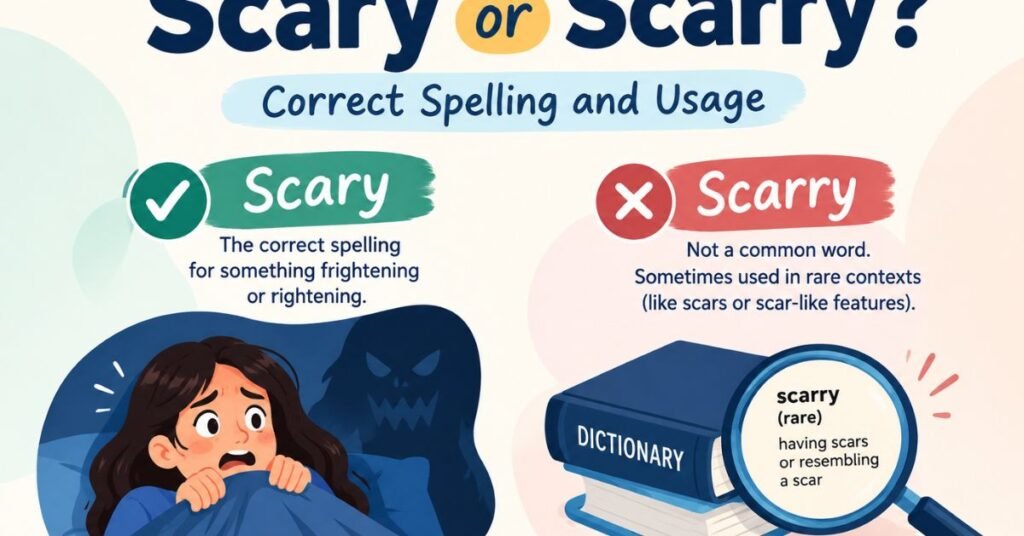
The correct spelling is scary, with one r. “Scarry” is not a standard English word. The rest of this article explains why, where the confusion comes from, and how to get it right every time.
The Short Answer: Scary Is Correct
Scary is the only correct spelling of the adjective meaning “frightening” or “causing fear.” It has two r’s in neither position, just one, sitting between the a and the y.
- Correct: The old house at the end of the street looked scary.
- Incorrect: The old house at the end of the street looked scarry.
“Scarry” does exist, but only as a proper name. You’ll see it most often as the surname of the children’s author Richard Scarry. As a regular word for describing something frightening, it’s always a misspelling.
What Does “Scary” Mean?
Scary is an adjective. It describes something that makes you feel fear, nervousness, or alarm. It can describe a monster in a movie, a dark road at night, or a medical test result.
Definition: Scary (adjective): causing fear or alarm; frightening.
The word is flexible, and you’ll meet it in several kinds of situations:
- Real danger: “Driving on that icy mountain pass was scary.”
- Entertainment: “We watched a scary movie on Friday night.”
- Worry or uncertainty: “It’s scary to start a new job in a new city.”
- Surprise or alarm: “It’s scary how quickly the kids are growing up.”
- Informal intensifier: “She’s scary good at chess.” Here scary means “remarkably” or “almost unnervingly.”
Dictionaries also record an older, now less common sense of the word, describing someone who is easily frightened. Today, when people say “scary,” they almost always mean something that causes fear rather than someone who feels it.
Why “Scarry” Is Wrong: The Spelling Logic
English spelling is famous for exceptions, but this one follows a rule you probably already use without thinking about it. Understanding it is the best way to stop second-guessing yourself.
Scary Comes From “Scare”
Start with the verb scare. It ends in a silent e, and that e makes the vowel before it long (the “air” sound in “scare”).
When you add the ending -y to turn a word into an adjective, English usually drops the silent e:
- scare → scary
- bone → bony
- shade → shady
- haze → hazy
- ice → icy
- spice → spicy
- wave → wavy
- shine → shiny
Nothing new is added to the middle of the word. The e disappears, the y takes its place, and the r stays single. That is the entire explanation for the spelling of scary.
Where the Doubled Consonant Rule Comes In
Here’s the rule that causes the trouble. When a short word ends in one vowel followed by one consonant, English often doubles that consonant before adding a vowel ending:
- star → starry
- sun → sunny
- fur → furry
- mud → muddy
- fun → funny
This is why “starry night” has two r’s and “furry” has two r’s. The doubling keeps the vowel sound short.
Now look at the starting word again. “Scare” doesn’t end in a single vowel plus a single consonant. It ends in a vowel plus a consonant plus a silent e. The doubling rule applies to words like star and fur, not to words like scare. So the “double the consonant” instinct, which is correct in so many other places, gives the wrong answer here.
The Word That Would Take Two R’s
There is a real word that comes close to “scarry” in spirit: scar, as in a mark left on the skin. If you added -y to scar following the doubling rule, you’d get “scarry,” meaning something like “full of scars.” You almost never see this in practice. The usual forms are “scarred” and “scarring.” But it shows why the double r is tempting: part of your mind may be building the word from scar instead of scare.
also read this:Emersion vs Immersion: Meaning, Differences & Usage
Why So Many People Write “Scarry”
If you’ve typed “scarry,” you’re in good company. Several things push people toward that spelling.
- Lots of common words end in -rry. Think of carry, marry, worry, hurry, sorry, berry, ferry, curry, flurry, scurry, and blurry. The pattern is so familiar that “scarry” looks as if it belongs in the group.
- Pronunciation hides the difference. In many American accents, “scary” sounds a lot like the first part of “scurry” or “carry.” Words like Mary, merry, and marry are pronounced identically by many speakers, and that blending makes it hard to tell by ear whether an r should be doubled.
- The famous name. Many people have seen the name Richard Scarry on a children’s book spine. When the same sound shows up in a different word, the memory of the double r can transfer.
- Rapid typing. Fingers sometimes hit r twice, especially when the word is typed quickly. This produces an accidental “scarry” even for people who know the right spelling.
- Autocorrect gaps. Because “Scarry” is a legitimate surname, some spellcheckers treat it as acceptable, especially when capitalized or when the software has learned it from your contacts. A missing red underline can make a typo look safe.
Knowing the reasons helps because you can spot the risk moments. When you’re writing quickly, or when you’re writing about something frightening and your mind is on the drama rather than the spelling, give the word an extra glance.
Scary and Its Word Family
Once you know the base spelling, the related forms are easy. The rule for adding endings to words that end in -y is straightforward: change the y to i before -er, -est, and -ness, and use -ily for the adverb.
| Form | Part of speech | Example |
| scary | adjective | That was a scary noise. |
| scarier | comparative adjective | The sequel is scarier than the first film. |
| scariest | superlative adjective | It was the scariest night of my life. |
| scarily | adverb | The car swerved scarily close to the barrier. |
| scariness | noun | The scariness of the story kept the kids awake. |
Notice that none of these has a double r. “Scarrier” and “scarriest” are also wrong.
Related words built from the same root, scare, include:
- scare (verb or noun): “Don’t scare the cat.” / “That was quite a scare.”
- scared (adjective): “I’m scared of heights.”
- scaring (verb form): “He keeps scaring his little sister.”
- scarecrow (noun): a figure placed in a field to frighten birds.
- scaredy-cat (informal noun): someone who is easily frightened.
- scare tactics (noun phrase): methods that rely on frightening people into acting.
Every one of these keeps the single r.
Scary vs. Scared vs. Scare vs. Scarred
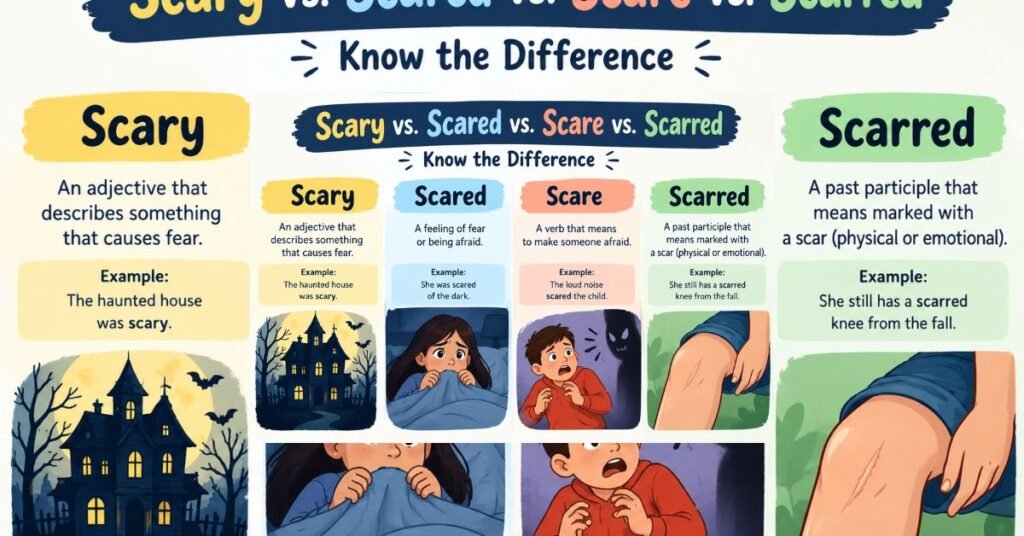
A few of these look similar enough to cause real mix-ups, and the difference is about more than spelling. Here is how they compare.
| Word | What it means | Example |
| Scary | Causes fear | The clown was scary. |
| Scared | Feeling fear | The child was scared of the clown. |
| Scare | To frighten, or a sudden fright | The loud bang gave me a scare. |
| Scarred | Marked by a scar, or deeply affected | The accident left him scarred. |
| Scarry | Not a standard word (surname only) | Richard Scarry wrote Busytown books. |
Scary vs. Scared
This is the pair that trips up even confident writers. A simple test: scary describes the thing that causes the fear, and scared describes the person who feels it.
- The movie was scary. (The movie causes fear.)
- I was scared. (I feel fear.)
Saying “I’m scary” means you frighten other people. Saying “I’m scared” means you are afraid. The same distinction exists in other pairs, such as boring/bored and exciting/excited.
Scarred vs. Scary
“Scarred” has a real double r because it comes from scar plus -ed, and the doubling rule applies correctly there. A scarred wall has marks on it. A scary wall might have a monster painted on it. The two are unrelated in meaning, though they sound similar enough to be confused when typing fast.
How to Remember the Right Spelling
If you want a quick way to lock in the correct spelling, try one of these.
- Start from “scare.” Say the verb, then drop the e and add y. Scare becomes scary. If you can spell the verb, you can spell the adjective.
- Match it to similar words. Say the words scary, wary, hairy, dairy, fairy, and vary together. They share the same “air” sound and the same single r. None of them has a double r, and neither does scary.
- Think of a short rule. “Scary has one r because scare has one r.” It’s easy to repeat and hard to forget.
- Use a visual trick. Some people like to picture the word with the second r removed because it has “scared away” the extra letter. It’s silly, but it works for many learners.
- Compare with its opposite. Words that describe the absence of fear, such as safe or calm, don’t have double letters, which can help you keep the single-letter pattern in mind when you’re describing the scary side.
Pick whichever feels natural. The best memory trick is the one that fires at the moment you hesitate.
Is Scarry Ever Correct?
Yes, but only in a very narrow situation: when you are writing the name Scarry.
Richard Scarry
The most famous bearer of the name is Richard Scarry (1919–1994), the American author and illustrator who created the beloved children’s books set in Busytown. His work includes Best Word Book Ever, which has charmed generations of young readers with its detailed, animal-filled illustrations. Characters such as Huckle Cat and Lowly Worm come from his world. His son, Huck Scarry, has continued illustrating in a similar style.
Elaine Scarry
Another well-known figure is Elaine Scarry, an American literary scholar and professor at Harvard, known for books such as The Body in Pain and On Beauty and Being Just.
How to Use It Correctly
When the name appears in your writing, capitalize it and keep both r’s:
- Correct: “My children grew up reading Richard Scarry books.”
- Incorrect: “My children grew up reading Richard Scary books.”
Here the pattern flips. In a person’s name, the double r is correct, and “Scary” would be the error. The key is to ask yourself one question: Am I writing a person’s name, or am I describing something frightening? If it’s a name, use Scarry. If it’s a description, use scary.
Searching for “scarry” online often leads people to this author for the same reason. Many searches that include that spelling are looking for the books rather than for the adjective.
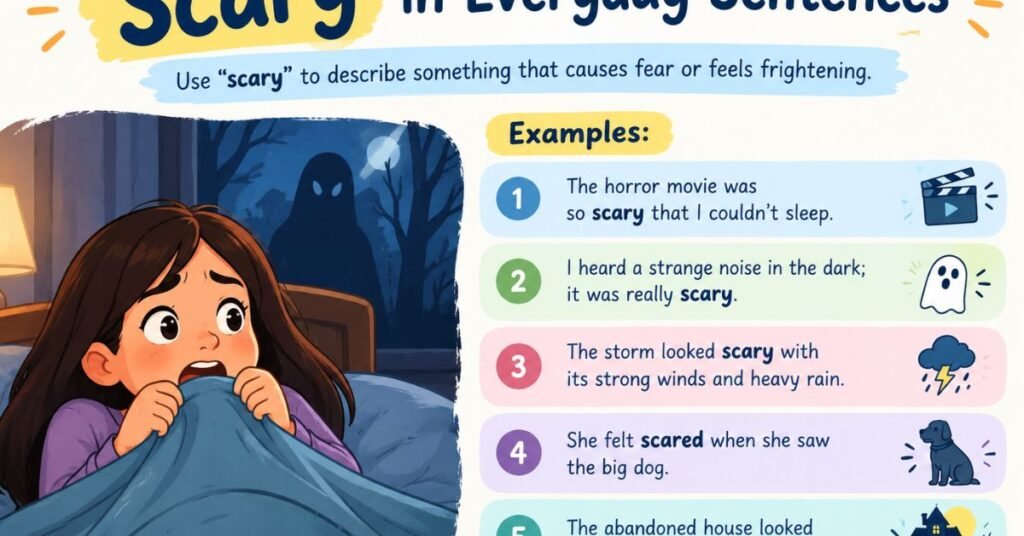
Scary in Everyday Sentences
Seeing the word in context is the fastest way to get comfortable with it. Here are examples grouped by situation.
Describing a frightening experience
- The thunderstorm was so loud it felt scary, even for the adults.
- Walking through the empty parking garage at midnight is scary.
Talking about movies, books, and games
- She doesn’t like scary movies, so we picked a comedy.
- Scary Stories to Tell in the Dark is a classic collection that many kids remember reading under the covers.
- The game gets scarier as you move into the basement level.
Expressing worry or uncertainty
- Making a big career change can be scary, but it can also be exciting.
- It’s scary how fast technology changes.
Using it casually
- That drummer is scary good.
- The resemblance between the twins is scary.
Using the other forms
- This ride is scarier than the one we took last year.
- That was the scariest thing I’ve ever seen.
- The dog barked scarily at the delivery driver.
In each case, a single r is all you need.
Scary Is Spelled the Same Everywhere
Many English words have different spellings in American and British English, such as color/colour and center/centre. Scary isn’t one of them. Whether you’re writing for readers in the United States, the United Kingdom, Canada, Australia, or anywhere else, the spelling is the same.
This makes your life easier. You don’t need to adjust “scary” for your audience. Only the pronunciation might vary slightly from accent to accent, and as explained earlier, that is part of why the spelling confusion happens in the first place.
Words You Can Use Instead of Scary
Sometimes the right word is a different one. “Scary” is general and a little casual. If you’re writing a review, a story, or a professional report, a more precise choice can make your point stronger. Here is a guide to common alternatives, ordered roughly by intensity.
| Level | Word | Best used for |
| Mild | unsettling | A situation that makes you uneasy |
| Mild | creepy | Something that gives you a shiver, often in a quiet or strange way |
| Mild | spooky | Playful or atmospheric fear, such as at Halloween |
| Medium | eerie | An odd, silent, or ghostly mood |
| Medium | alarming | News or facts that cause concern |
| Medium | frightening | A general, neutral replacement for scary |
| Strong | chilling | Something that makes you feel cold with fear |
| Strong | hair-raising | A tense or dangerous experience |
| Strong | terrifying | Intense, overwhelming fear |
| Strong | horrifying | Fear mixed with disgust or shock |
A few quick notes on choosing among them:
- Spooky is lighter and more fun than scary. A haunted house at a school fair is spooky, while a real break-in is not.
- Creepy suggests something that crawls under your skin, often a person or a place, not a loud, sudden danger.
- Alarming works well in serious or professional writing: “The report revealed alarming levels of pollution.”
- Terrifying and horrifying are strong. Saving them for genuinely extreme situations keeps your writing from sounding exaggerated.
None of these are a reason to avoid “scary.” It’s a perfectly good word. Variety simply helps when you’ve used it three times in one paragraph.
Tone and Register: When Scary Fits and When It Doesn’t
Because “scary” is a plain, everyday word, it works best in casual and general writing. It suits blog posts, conversations, social media, children’s writing, reviews, and most news features.
In formal or technical writing, such as academic papers, legal documents, or medical reports, writers usually prefer words like alarming, distressing, concerning, or hazardous, depending on what they mean. Medical writers, for example, tend to describe a symptom as “concerning” rather than “scary,” even though patients may use the second word freely.
That said, there’s no rule against using scary in serious contexts when it fits the voice. A personal essay about a health scare can use the word honestly and effectively. Let the audience and purpose guide the choice, not a fear of the word itself.
Common Misspellings to Watch For
“Scarry” isn’t the only way people go wrong with this word. These are the errors that come up most often.
- scarry, the double r. The most frequent mistake, as covered above.
- scarey or scarie, adding an e or an ie to the ending. The correct ending is a plain -y.
- scarrier / scarriest, carrying the double r into the comparative and superlative. The right forms are scarier and scariest.
- scarily typed as scarrily or scarely. The correct adverb is scarily.
- scary used when scared is meant (“I’m scary of spiders”). This is a grammar slip rather than a spelling one, but it’s just as common.
- scared used when scarred is meant, and vice versa, especially in emotional writing.
If you want a short checklist, read the word aloud in your head and ask: Is it describing the thing that causes fear (scary) or the person who feels it (scared)? Then confirm there’s a single r.
Proofreading Tips for Writers and Editors
If you write regularly, especially about horror, Halloween, thrillers, or anything emotional, “scary” will show up a lot. A few habits keep errors out.
- Use find-and-replace. Search your document for “scarry” before you publish. If the result isn’t Richard Scarry or Elaine Scarry, correct it.
- Don’t trust the spellchecker blindly. As mentioned, “Scarry” is a valid name, so some tools let it pass. A human second look is still the best check.
- Read headlines twice. Titles and headings are the easiest place for typos to hide because they get the least proofreading time and the most reader attention.
- Check social posts and captions. Short text is often written fast, and a mistake in a Halloween caption or a movie review can get shared widely.
- Add the word to a personal style note. If you write for a team or a brand, include the correct spelling in your style guide with a reminder that “Scarry” is only for the author’s name.
Teaching Scary to Kids and English Learners
Children and new English speakers meet the same confusion, and a clear explanation helps. A few approaches that work:
- Start with the verb. Have learners write “scare,” then cross out the e and add y. They see the change happen rather than memorizing it.
- Group it with look-alikes. Putting scary, wary, hairy, dairy, and fairy on one list shows the shared sound and shared single r.
- Contrast it with a double-r word. Place scary next to furry or starry and talk about why the first has one r and the others have two. The difference between a silent e and a short vowel makes the rule memorable.
- Use sentences, not just lists. Learners remember spelling better when it’s attached to a meaningful sentence, such as “The scary dog was actually very friendly.”
- Mention the author. For children who know Richard Scarry’s books, the name gives a built-in explanation: his name has a double r, but the word for frightening things doesn’t.
Scary in Names, Titles, and Pop Culture
The word is a favorite in entertainment, and the spelling is consistent across the examples people know best:
- Scary Movie, the horror-parody film franchise that began in 2000.
- Scary Stories to Tell in the Dark, the book series by Alvin Schwartz first published in the early 1980s, later adapted into a film.
- Scary Spice, the nickname of Mel B in the Spice Girls.
- Scary Monsters (and Super Creeps), a David Bowie album from 1980.
Each of these uses a single r. If you’re quoting a title or a name, copy it exactly. When in doubt, look at the original cover or official page.
Quick Reference Summary
Use this as a one-glance reminder.
- Correct spelling of the adjective: scary
- Incorrect spelling: scarry (unless it’s the surname Scarry)
- Comparative: scarier
- Superlative: scariest
- Adverb: scarily
- Noun: scariness
- Rule behind it: scare drops the silent e and takes -y, with no doubled consonant
- Don’t confuse with: scared (feeling fear) and scarred (marked by a scar)
- Same spelling in: American, British, Canadian, and Australian English
Conclusion
The question “scary or scarry?” has a simple, reliable answer: scary is the correct spelling whenever you mean frightening or fear-causing. The word comes from the verb scare, which drops its silent e before the -y ending, exactly like bone becomes bony and ice becomes icy. There is no reason to double the r.
“Scarry” earns its place only as a surname, most famously for Richard Scarry, the creator of Busytown, and for scholar Elaine Scarry. In those cases, keep both r’s and the capital S.
If you remember only a few things, make them these. Start from scare and swap the e for a y. Use scary for what causes fear and scared for who feels it. Remember that the comparative and superlative are scarier and scariest, never scarrier or scarriest. And before you publish anything, give the word one last look, especially in headlines and captions where a stray second r likes to hide.
Once the rule clicks, you won’t need to stop and wonder again. The spelling is as straightforward as the word is useful, and nothing about it needs to be scary.