

You’re typing a message to a friend. “Let’s go somewhere better next time.” Then you stop. Should it be “the next time”? Does the little word “the” change anything, or is it just noise?
It’s a fair question, and plenty of learners and native speakers pause over it. Both phrases show up in books, emails, news stories and everyday speech. Neither is a mistake. But they don’t always behave the same way, and picking the wrong one can make a sentence feel slightly off.
This guide explains the difference in plain language. You’ll see how each phrase works, where the two overlap, where they don’t, and which errors to watch for. There’s a practice section with answers at the end.
The Short Answer
Both “next time” and “the next time” are correct.
- Next time points to the coming occasion, counted from now. It’s the natural choice for plans, promises, and advice about the future.
- The next time points to the next occasion in a sequence, counted from a specific moment. It’s the better choice when you’re telling a story in the past, or when the occasion is tied to something you just mentioned.
- In many future-tense sentences, you can use either one and the meaning barely changes.
Quick test: if the sentence is set in the past, use “the next time.” If it looks forward from today, “next time” is usually the smoother pick.
Understanding the Basics: “Next Time” vs “The Next Time”
Start with what each phrase is built from.
“Next” is an adjective that means coming immediately after. “Time” here means an occasion, one instance of something happening. Put them together and you get “the occasion that follows.”
The difference lies in what that occasion follows. Here is a side-by-side look.
| Feature | Next time | The next time |
| Reference point | The present moment | A moment named or implied in the sentence |
| Typical tense | Future or present | Past, present, or future |
| Feels like | A general “coming occasion” | A specific “next one in the line” |
| Works as a stand-alone adverb | Yes (“I’ll try harder next time.”) | Rarely (needs a clause or context) |
| Introduces a clause | Yes (“Next time you visit, call me.”) | Yes (“The next time you visit, call me.”) |
| Common in past stories | Not usually | Yes |
Here are two quick examples.
- Next time I’m in Lahore, I’ll visit you. (From now, the coming trip.)
- The next time I was in Lahore, the shop had closed. (The trip after the one we’ve been discussing, told in the past.)
Notice that the first sentence looks forward from today. The second one looks forward from a point in the past. That’s the core of the whole topic.
also see: Congratulations On or For: Which One Is Correct?
The Role of “The” in English Grammar
To see why one little word matters, it helps to remember what “the” does. The definite article signals that the listener can identify exactly which thing you mean. “The car” means a particular car. “A car” means any car.
Now apply that to “next.” Grammar lessons usually split this into two patterns.
Pattern one: next + time word, no article. With words like week, month, year, Monday and summer, “next” works relative to today. “Next week” means the week after this one. “Next month” means the month after the current one.
Pattern two: the next + noun. When “the” is added, “next” picks out one item from a series. “The next train,” “the next episode,” “the next question.” The series can be anywhere, and the position doesn’t depend on today’s date.
“Time” is an interesting noun because it can follow either pattern. A corpus study published in the International Journal of Corpus Linguistics points out that “time” is unusual here. With most time nouns, adding or dropping “the” changes the reference. For example, “he said he’d come back next year” and “he said he’d come back the next year” point to different years. With “time,” both forms can keep the same reference. That’s why people find this pair so slippery.
So when does “the” actually make a difference with “time”? Mostly in two situations:
- When you’re anchored in the past. “The” helps tie the occasion to a past moment instead of today.
- When you want to emphasize one specific occasion. “The” adds a feeling of “that particular one, and no other.”
Think of “the” as a pointer. Without it, the phrase sounds open and general. With it, the phrase feels pinned down.
Context Is Key: Future Reference and Time Frames
Most confusion disappears once you ask one question: counting from when?
- If you’re counting from now, “next time” fits naturally.
- If you’re counting from another moment (a past event, a scheduled date, a point in a story), “the next time” fits naturally.
Here is the same idea shown on a simple timeline.
| Counting from | Example | Best choice |
| Today | “Bring snacks next time.” | Next time |
| A past event | “She apologized. The next time we met, she brought snacks.” | The next time |
| A future event | “After the exam, we’ll rest. The next time we meet, we’ll plan the trip.” | The next time |
| Unspecified, general advice | “Next time, double-check the address.” | Next time |
Specific vs. General Future Events
This is where many people ask the practical question: Does “the” make the future event more specific?
Often, yes. Look at these two lines.
- “Next time you see her, say hello.”
- “The next time you see her, say hello.”
Both work. The second one carries a slightly sharper feeling, like “the very next occasion, not some later one.” The first is a little softer and more open.
Here’s a pattern that shows up in real usage:
- General or casual intent leans toward “next time.” Think of promises, invitations and soft advice. “Let’s order dessert next time.”
- Specific or conditional intent leans toward “the next time.” Think of warnings, rules and cause-and-effect. “The next time the alarm sounds, leave the building at once.”
Warnings are a good example. When something could happen again and you want to stress the consequence, “the next time” adds weight. “The next time you miss a payment, the account will be locked” sounds firmer than “Next time you miss a payment, the account will be locked.” Both are grammatical. The first sounds more official.
Examples from Media and Literature
You can spot this pair at work in everyday media without quoting anyone.
Television recaps are a classic case. Shows announce what’s coming with the stock phrase “next time on…” That’s a general, forward-looking use counted from the present viewing. It points to the coming episode without naming it.
Narrative fiction behaves the opposite way. Storytellers working in the past tense often reach for “the next time” to link events: the next time a character shows up, the next time something goes wrong. The phrase works like a stitch between scenes. It tells the reader that the moment follows a previous one in the story’s own timeline, not the reader’s.
News writing uses both. Reports that look ahead often say “next time” in quotes from speakers (“We’ll prepare better next time”), while reporters describing a sequence of events lean toward “the next time” when they link one incident to another.
I’m describing patterns here instead of quoting specific books or shows. If you want to test it yourself, open any novel and search for “the next time.” You’ll likely find it clustered in past-tense scenes. Then search for “next time” and notice how many hits sit inside dialogue.
Differences in American vs British English
Here’s the honest answer: there isn’t a clear regional rule.
Dictionaries on both sides of the Atlantic list “next” with the same core meaning: coming right after in time or order. Both American and British speakers use both phrases, and a corpus study that looked at American English found that “time” accepts either form with the same reference.
A few small tendencies are worth knowing, though:
- “When next we meet” is a formal or literary option in both varieties. It sounds old-fashioned in everyday speech.
- “Next time around” and “next time round” show up in casual speech. “Round” is more typical in British usage.
- Business writing in both varieties tends to prefer “the next time” in policies and instructions because it sounds more precise.
If a style guide or exam board asks you to follow British or American conventions, you won’t need to change this phrase. Choose by meaning, not by country.
Common Scenarios for Using “Next Time”
“Next time” is the everyday workhorse. It fits any situation where you’re looking ahead from the present and don’t need to pin down the exact occasion.
1. Making a promise or plan
- I’ll bring the documents next time.
- We’ll book a bigger table next time.
2. Giving friendly advice
- Next time, check the weather before you leave.
- Take the earlier train next time.
3. Learning from a mistake
- I’ll save my work more often next time.
- Next time, I’ll read the instructions first.
4. Closing a conversation
- Thanks for having us. See you next time!
- Let’s pick this up next time.
5. Softening a refusal
- I can’t join today, but next time for sure.
Two grammar notes help here.
Punctuation. When “next time” opens a sentence and the main clause follows, put a comma after the whole opening phrase. “Next time you visit, bring photos.” If “next time” sits at the end, no comma is needed. “Bring photos next time.”
Tense. After “next time,” use the present simple to talk about the future. Say “Next time you visit, I’ll cook,” not “Next time you will visit, I’ll cook.” English uses the present simple inside time clauses for future events.
Real-Life Examples from Literature and Media
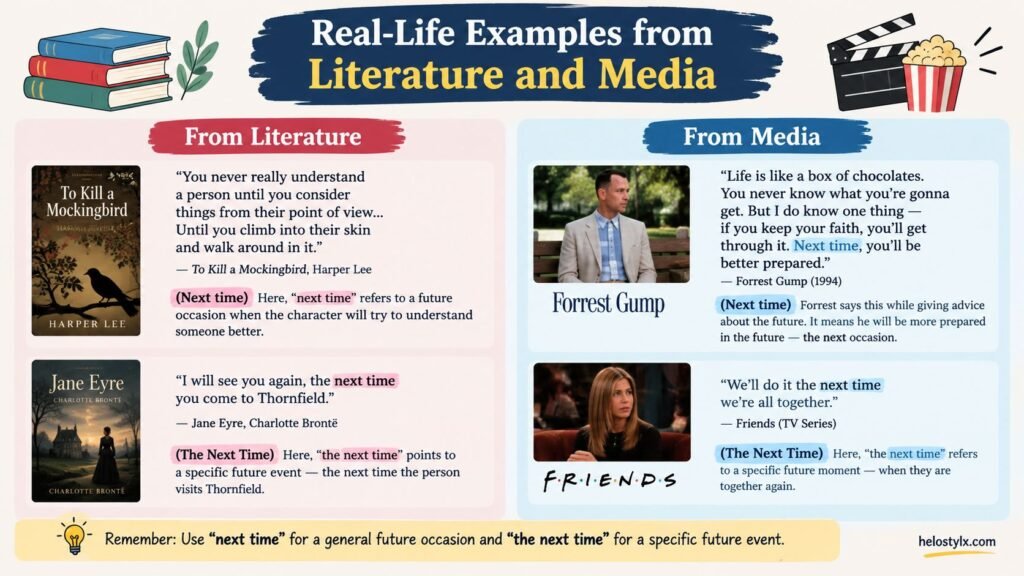
Here are original lines in the style you’d meet in different settings. They show the patterns without borrowing anyone’s words.
| Setting | Example | Why “next time” fits |
| Customer email | “We’ll offer faster delivery next time you order.” | Looks forward from now |
| Team meeting | “Next time, let’s share the agenda a day early.” | Open, friendly suggestion |
| Sports commentary | “He’ll aim higher next time.” | General future occasion |
| Parent to child | “Next time, ask before you borrow it.” | Soft rule, no fixed date |
| Chat message | “Coffee’s on me next time!” | Casual promise |
| Podcast sign-off | “Join us next time for another story.” | Forward-looking from the present episode |
Each of these is counted from the speaker’s present. None depends on a past event. That’s the signature of “next time.”
Using “The Next Time” in Sentences
“The next time” shines when you need to be exact, or when you’re telling a story.
1. Past narration
- She called on Tuesday. The next time she called, I let it ring.
- The next time I opened the door, the storm had passed.
In both examples, “next time” alone would sound a bit abrupt, because the sentence is anchored in the past.
2. Stressing a specific occasion
- The next time you see him, ask about the contract.
- The next time it rains, move the plants indoors.
3. Rules, warnings and consequences
- The next time the warning light comes on, stop the machine.
- The next time a form is incomplete, it will be returned.
4. As a noun phrase
Here “the next time” acts like a normal noun phrase, often with a relative clause.
- The next time we can meet is Friday.
- I’m looking forward to the next time.
- Keep this note for the next time.
Notice that in the last two examples, the phrase sits after a verb or preposition. “For the next time” works because “the next time” is now a noun phrase. You’d hear “for next time” too, as a casual set expression: “Save that question for next time.”
5. With “that” (optional)
- The next time that you visit, bring your laptop.
The word “that” is optional and often dropped in speech. Some grammar writers explain these sentences as a noun phrase followed by a relative clause with the linking word left out. You don’t need the theory to use it correctly, but it explains why both versions sound natural.
A quick rule of thumb
If you can replace the phrase with “the following occasion” or “the occasion after that one,” you’re probably looking at “the next time.”
Nuances with Time Expressions
Once you understand “next time,” other time phrases start to make sense. The same logic applies to “last” and “the last.”
- Last time means the most recent occasion before now. “Last time I checked, the store was open.”
- The last time can mean the most recent occasion, but it can also mean the final occasion ever. “That was the last time I saw him.” (Possibly never again.)
“The last time” has that extra meaning of finality. “The next time” has a milder version of that built-in ordering, but it doesn’t mean “the final time.” It simply means “the following one.”
Here’s a handy comparison.
| Phrase | Looks | Meaning |
| Last time | Backward from now | The most recent occasion |
| The last time | Backward, or the end of a series | Most recent, or final |
| Next time | Forward from now | The coming occasion |
| The next time | Forward from a reference point | The following occasion in sequence |
| This time | At the present | The current occasion |
| Every time / each time | Repeated | All occasions, one by one |
A few related patterns are also worth knowing.
“For the next + period.” This one needs “the.” “I’ll be busy for the next few days.” “We’ll be travelling for the next three months.” Don’t drop the article here. “For next few days” sounds wrong.
“Next” with days and dates. Without “the,” “next” counts from today. “Next Monday,” “next week,” “next month.” When you add “the,” the phrase becomes “the next Monday” and usually needs more context, like “the next Monday after the meeting.”
“Anytime” vs “any time.” As an adverb, “anytime” means at any moment (“Call me anytime”). When “time” is a noun, keep it separate (“Do you have any time this week?”). It’s a different pair, but people confuse it with “next time” because both involve “time.”
“Next to” is a different animal. “Next to” means beside or almost (“sat next to me,” “next to impossible”). Don’t mix it up with “next time.”
Collocations that always go bare. “Next door,” “next level,” “next of kin,” and “next time” all prefer no article. They behave as fixed expressions.
Common Errors and How to Avoid Them
Even confident writers slip here. These are the mistakes I see most often, with quick fixes.
| Mistake | Why it’s a problem | Fix |
| “Next time you will visit, I’ll cook.” | Uses “will” inside a time clause | “Next time you visit, I’ll cook.” |
| “He left. Next time I saw him, he was happy.” | Past narration without “the” can feel clipped | “The next time I saw him, he was happy.” |
| “For next few days, we’re closed.” | Missing “the” after “for” | “For the next few days, we’re closed.” |
| “The next time, I will try” at the start with no clause | Sounds unfinished without context | “Next time, I will try harder.” |
| “Next times I’ll bring it.” | “Time” is singular here | “Next time I’ll bring it.” |
| “The next time” used where “this time” is meant | Mixes up present and future | “This time I’ll pay.” |
| Missing comma: “Next time you visit, bring snacks.” | Hard to read | “Next time you visit, bring snacks.” |
Three habits that prevent most errors
- Ask “counting from when?” If the answer is “now,” use “next time.” If it’s a past or named moment, use “the next time.”
- Check the tense of the sentence. Past-tense story? Reach for “the next time.”
- Read it aloud. If the phrase feels stuck on the end of a sentence with no clause behind it, “next time” usually sounds better.
Is one of them ever wrong?
Not exactly wrong, but sometimes unnatural. “The next time” at the very end of a casual sentence, as in “See you the next time,” sounds odd to many ears, while “See you next time” sounds normal. And “next time” in a past narrative can look rushed. Use your ear along with the rule.
When precision matters
In contracts, manuals and policies, avoid vague wording. “Next time” may not tell the reader which occasion you mean. Prefer a clearer phrase such as “at the next scheduled review” or “the next time the system restarts.” That removes any doubt.
Putting It Into Practice: Examples and Exercises
Time to test yourself. Pick the better option for each sentence. Answers follow.
Exercise A: Choose the best option
- I forgot my charger. I’ll bring it (next time / the next time).
- She smiled at me on Monday. (Next time / The next time) I saw her, she waved.
- (Next time / The next time) you cook, add less salt.
- He fixed the problem once. (Next time / The next time) it broke, he fixed it again in minutes.
- Thanks for the lovely evening. See you (next time / the next time)!
- I’ll be offline (for next three days / for the next three days).
- (Next time you will see him / Next time you see him), say thanks.
- Save these questions (for next time / for the next time that).
Exercise B: Fix the mistake
- Next time I will arrive, I’ll text you.
- For next few weeks, the office will be closed.
Answers
- next time (looks forward from now)
- The next time (past story)
- Next time or The next time (both work; “next time” is softer, “the next time” is firmer)
- The next time (past story)
- next time (standard goodbye)
- for the next three days (this pattern needs “the”)
- Next time you see him (present simple in the time clause)
- for next time (the casual set expression; the second option is awkward)
- Next time I arrive, I’ll text you. (remove “will” from the time clause)
- For the next few weeks, the office will be closed.
A quick practice habit
Write five sentences this week using “next time,” then rewrite each one in the past tense with “the next time.” Compare them. You’ll feel the difference faster than any rule can explain it.
Conclusion
So, which one is correct? Both are, and the real skill is knowing which one fits.
Use “next time“ when you’re looking ahead from today. It’s friendly, flexible and perfect for promises, plans and advice.
Use “the next time” when you’re anchored to another moment, especially in past-tense storytelling, or when you want to point at one specific occasion. It’s also handy for rules and warnings, where precision builds trust.
In many future sentences, the two phrases swap places with almost no change in meaning. That’s normal, and it’s the reason the question keeps coming up. Don’t let it slow you down. Ask yourself “counting from when?”, check your tense, and trust your ear.
Keep these small points in mind: use the present simple after the phrase when you mean the future, add a comma after an opening “next time,” and never drop “the” in “for the next few days.”
Next time you’re unsure, come back to the table near the top of this guide. Or better yet, write the sentence both ways, read them aloud, and pick the one that sounds like something you’d actually say.


Pingback: Alright Meaning in Text: Definition, Usage, and Real-Life Chat Examples