

You have probably typed it in an email today without thinking twice. “Thank you so much for your help.” It feels natural, warm and polite. But then a doubt creeps in: is it actually correct English, or just a habit?
The short version is that it is correct, common and useful. This guide explains what “thank you so much” means, why the grammar holds up, when it fits, and when a different phrase will serve you better. You will also find real examples, comparison tables and a simple method for picking the right level of thanks every time.
Is It Correct To Say “Thank You So Much”? The Short Answer
Yes. “Thank you so much” is grammatically correct, widely accepted and appropriate in most spoken and written situations.
It is a stronger version of “thank you.” The words “so much” act as an intensifier. They tell the listener that your gratitude is bigger than a quick, polite acknowledgment.
Here is the quick summary:
- Correct? Yes, in formal and informal English.
- Meaning: I am very grateful to you.
- Best for: Favors, gifts, kind gestures, customer service, and professional emails.
- Watch out for: Overuse, flat delivery, and using it for tiny actions where a simple “thanks” is enough.
Grammar Breakdown: Why “Thank You So Much” Works
The phrase looks simple, but each word has a job. Taking it apart shows why it is sound.
| Word | Part of speech | Role in the phrase |
| Thank | Verb | The action of expressing gratitude |
| You | Pronoun (object) | The person receiving the thanks |
| So | Adverb | Intensifies the degree of thanks |
| Much | Adverb / quantifier | Tells how great the thanks is |
The full, older form is “I thank you so much.” Over centuries, English speakers dropped the subject “I” and kept the rest. This kind of shortening is called ellipsis, and it is completely normal in spoken English. We do the same in “Pleased to meet you” (instead of “I am pleased to meet you”) and “Sounds good” (instead of “That sounds good”).
How the intensifier works
“So” is a degree adverb. It strengthens whatever follows it. “Much” here works adverbially to modify the verb “thank,” showing how strongly the action is carried out. Together, “so much” answers the question “how much do you thank them?”
You can build the same pattern with other verbs:
- I appreciate it so much.
- I love this so much.
- We miss you so much.
Seen this way, “thank you so much” is not a special exception. It follows an ordinary English pattern.
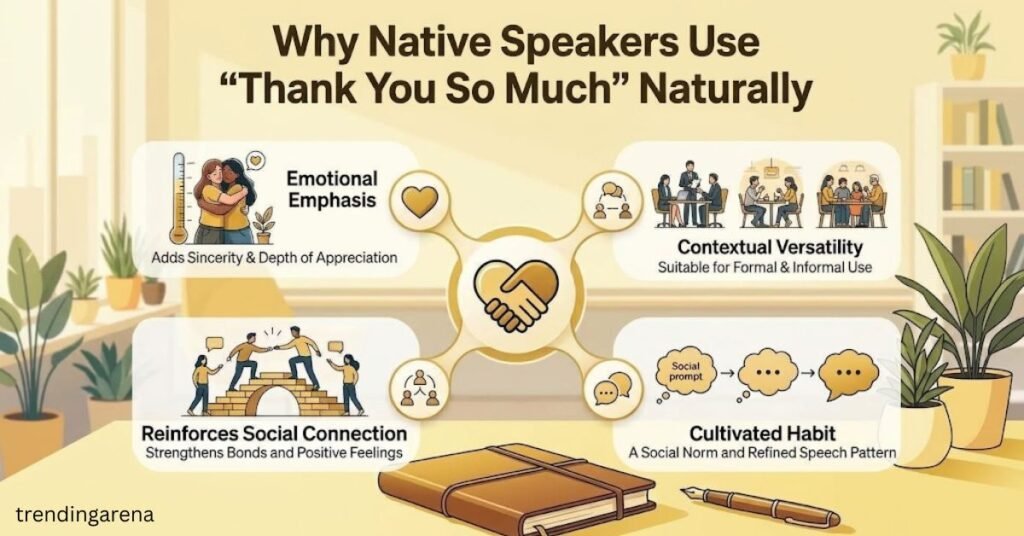
Why Native Speakers Use “Thank You So Much” Naturally
Native speakers reach for this phrase for a few practical reasons.
- It sounds friendly without sounding casual. “Thanks” can feel quick. “Thank you so much” feels warm but still polite.
- It softens requests and follow-ups. People often use it when they are asking for something else, such as “Thank you so much for sending this. Could you also share the report?”
- It fills the gap between two extremes. “Thank you” can feel too light for a real favor, while “I am deeply indebted to you” feels too heavy for most daily moments.
- It is easy to say. The rhythm is smooth, which is part of why it has become a default.
The language blog Grammarphobia traced the history and found that people have been saying “thank you so much” since the 1800s, while “thank you very much” goes back to the 1600s and plain “thank you” to the 1400s. So this is not a modern slang invention. It has a long record in English writing.
Tone Matters More Than Grammar Here
Nobody will mark you wrong for the grammar. What people notice is how the phrase sounds.
Think about these two situations:
- A colleague stays late to help you fix a presentation. You look at them, smile, and say, “Thank you so much. You saved me.”
- A cashier hands you a receipt, and you mutter “thankyousomuch” while looking at your phone.
The words are identical. The impact is not.
Sincerity comes from three things:
- Eye contact or a warm written tone. In text, that means a specific detail, not just the phrase.
- Pacing. Slow down slightly on “so much.”
- Context. The size of your thanks should roughly match the size of the favor.
When the tone is flat, “thank you so much” can come across as automatic or even sarcastic. When the tone is genuine, it is one of the most effective phrases in everyday English.
Why Is It Grammatically Correct?
If you want the technical reasons, here they are in plain terms.
- It is a complete utterance. English accepts short expressions of gratitude as full communicative acts, even without a subject.
- The structure is valid. Verb + object pronoun + adverbial intensifier is a standard pattern.
- Style guides and usage references accept it. Major dictionaries list “thank you so much” and “thank you very much” side by side as acceptable ways to emphasize gratitude.
- Historical use supports it. Written examples go back more than 150 years.
Some people feel “so much” is overused or slightly inflated. That is a matter of style preference, not a grammar rule. Language experts who looked at this complaint found no meaningful difference in meaning between “so much” and “very much.”
When You Should Use “Thank You So Much”
This phrase works best when someone has gone beyond the minimum for you.
Good situations
- Someone helps you with a task. “Thank you so much for covering my shift.”
- You receive a gift. “Thank you so much for the lovely scarf.”
- A colleague or manager gives feedback. “Thank you so much for taking the time to review this.”
- A customer service agent solves your problem. “Thank you so much. That fixed it.”
- You are responding to kindness during a hard time. “Thank you so much for checking in on me.”
- You are finishing a professional email. “Thank you so much for your time and consideration.”
When You Should Avoid or Adjust It
The phrase is safe, but it is not always the best fit.
Situations that call for a change
| Situation | Why “thank you so much” may not fit | Better choice |
| Tiny courtesy (door held open) | Slightly oversized for the moment | “Thanks” or “Thank you” |
| Very formal legal or official letter | Can feel conversational | “I sincerely thank you” or “Thank you for your attention to this matter” |
| A life-changing favor | May feel too light | “I cannot thank you enough” |
| Repeated use in one message | Loses power | Vary it or use one strong line |
| Cold, automated messages | Sounds scripted | Add a personal detail |
One habit deserves a note. “Thank you in advance” can sound presumptuous to some readers, as if you assume the request will be granted. “Thank you for considering this” is a safer way to write it.
Variations of “Thank You So Much” You Can Use
You do not have to repeat the same phrase every time. These variations keep the meaning and change the feel.
| Variation | Tone | Example |
| Thanks so much | Casual, friendly | “Thanks so much for the ride!” |
| Thank you very much | Slightly more formal | “Thank you very much for your assistance.” |
| Thank you so, so much | Very warm, emotional | “Thank you so, so much. I needed that.” |
| Thank you ever so much | Polite, British flavor | “Thank you ever so much for having us.” |
| Many thanks | Brief, professional | “Many thanks for your quick reply.” |
| Thanks a bunch / a lot | Informal | “Thanks a lot for dinner.” |
| Thank you from the bottom of my heart | Deeply emotional | “Thank you from the bottom of my heart for everything.” |
| I really appreciate it | Warm, direct | “I really appreciate your support.” |
One small grammar note: “a lot,” “a bunch” and “a ton” pair naturally with “thanks,” not “thank you.” So “Thanks a bunch” sounds right, while “Thank you a bunch” sounds off to most native ears.
The Psychology Behind Gratitude
Saying thanks is more than manners. Psychologists have studied gratitude for decades, and their findings help explain why a sincere “thank you so much” matters.
Gratitude strengthens relationships. Psychologist Sara Algoe developed the “find, remind, and bind” theory. It suggests gratitude helps us notice good partners (find), reminds us of the value of existing relationships (remind), and encourages us to invest in them (bind).
Gratitude benefits the giver and the receiver. Research by Robert Emmons and Michael McCullough found that people who regularly reflected on things they were grateful for reported higher well-being than comparison groups.
People underestimate how much thanks matters. A study by Amit Kumar and Nicholas Epley found that people who wrote gratitude letters expected recipients to feel only mildly pleased, while recipients reported feeling much happier than writers predicted. In other words, most of us hold back more appreciation than we should.
What this means for everyday language:
- A warm “thank you so much” is rarely wasted.
- The impact grows when you name what the person did.
- A short, honest message often lands better than a polished, generic one.
Common Mistakes People Make With This Phrase
Even confident English speakers slip up. Here are the most frequent errors.
- Writing “thankyou” as one word. The correct form is two words: “thank you.” The one-word version is acceptable only as a noun in “a thank-you note” (hyphenated).
- Saying “Thank you much.” This is not standard. Use “Thank you so much,” “Thank you very much,” or “Thanks much” in casual speech.
- Using “thanks you.” Wrong. It is “thank you” or “thanks.”
- Mixing “thank you” with “a lot/bunch/ton.” Say “thanks a lot,” not “thank you a lot.”
- Confusing “your” and “you’re.” In “You’re so kind,” the contraction means “you are.”
- Stacking intensifiers. “Thank you so very much indeed” is possible but feels theatrical in most settings.
- Forgetting the reason. “Thank you so much” is good. “Thank you so much for the detailed notes” is better.
- Using it as a script closer. If the message has no real gratitude behind it, readers sense that.
Cultural Context: How It’s Perceived Around the World
English is spoken in many regions, and each has its own habits of politeness.
| Region | Typical habit | How “thank you so much” is received |
| United States | Warm, enthusiastic tone is common | Very natural, even in service interactions |
| United Kingdom | Frequent “cheers,” “ta,” and “thanks” | Natural, though “ever so much” and “many thanks” are also common |
| Australia / New Zealand | Relaxed, informal | Fine, though “thanks heaps” or “cheers” appear often |
| South Asia | Warm, respectful English with local expressions mixed in | Widely understood; often paired with words like “shukriya” in multilingual speech |
A few cultural points are worth remembering:
- In some cultures, close family and friends do not thank each other for everyday help, because it is expected. A formal “thank you so much” in that setting can feel oddly distant.
- Some speakers use a long chain of thanks as a sign of respect. Others read it as too much. When writing to an international audience, a clear and moderate version is usually safest.
- In customer-facing roles in the United States, enthusiastic thanks is part of the service norm, so it may not signal deep emotion. It signals courtesy.
When in doubt, follow the other person’s lead. If they use warm language, match it. If they keep things short and formal, scale back.
“Thank You So Much” vs “Thank You Very Much”
These two are the most often compared. Both are correct and carry nearly the same meaning.
| Feature | Thank you so much | Thank you very much |
| Meaning | Strong gratitude | Strong gratitude |
| Formality | Neutral to warm | Neutral to slightly formal |
| Typical feel | Personal, friendly | Polished, measured |
| Common in speeches? | Yes | Very common |
| Common in casual texts? | Very common | Less common |
| Short form | Thanks so much | Thanks very much (less common) |
Which should you pick?
- Choose “so much” when you want warmth and a personal touch.
- Choose “very much” when you want a calm, professional register, such as in a formal letter or a public speech.
- Use either one in an email. Neither will raise eyebrows.
Language writers who have tracked usage over time note that “very much” has grown steadily over the last century, while “so much” rose until World War II, dipped, and then returned to everyday use. Neither is incorrect.
Real-Life Usage Examples You Can Copy
Use these as ready-made models and adjust the details.
In emails
- “Thank you so much for getting back to me so quickly. This helps a lot.”
- “Thank you so much for the introduction. I will follow up with her this week.”
- “Thank you so much for your patience while we resolved this.”
In job and business settings
- “Thank you so much for the interview opportunity. I enjoyed learning about the team.”
- “Thank you so much for the detailed feedback. I will revise the draft by Friday.”
In customer service
- “Thank you so much for your help. The issue is fixed now.”
- “Thank you so much for waiting. I appreciate your patience.”
In personal moments
- “Thank you so much for being there for me this week.”
- “Thank you so much for the birthday surprise. I did not expect it at all.”
Notice the pattern: each one has a reason after the phrase. That is the easiest way to make a thank-you feel real.
Case Study: How Tone Changes Meaning in Communication
To see how much tone matters, imagine four versions of the same email reply. A manager has just finished reviewing an employee’s report.
Version 1: Flat
Thank you so much.
It is polite, but it gives the manager nothing. It can feel rushed.
Version 2: Warm and specific
Thank you so much for reviewing the report. Your note about the budget section helped me spot a gap I had missed.
It is clear, specific and sincere. The manager knows the feedback mattered.
Version 3: Overloaded
Thank you so much, thank you so very much, I can’t thank you enough, thank you!
It feels excessive for a routine review and may seem insincere.
Version 4: Sarcastic in tone
Oh, thank you so much.
With the right stress or punctuation, this reads as irritation, not gratitude. In writing, a phrase like this can be misread, especially if the message follows a disagreement.
Better Alternatives
Sometimes the best way to say thank you is to avoid the stock phrase. Try these when you want your gratitude to stand out.
More specific
- “Thank you for staying late to help me finish this.”
- “Your advice on the contract saved me hours.”
More emotional
- “I am truly grateful for your support.”
- “This meant more to me than you know.”
- “I cannot thank you enough.”
More professional
- “I sincerely appreciate your time.”
- “Your assistance is greatly appreciated.”
- “Thank you for your prompt attention.”
A good rule: swap the generic phrase for a specific one whenever the favor is significant. Keep “thank you so much” for the moments when a warm, simple line is all you need.
Expert Insight: Why Intensifiers Matter in English
Linguists describe words like “so,” “very,” “really” and “extremely” as intensifiers. They add emphasis and help speakers show attitude, not just information.
A few ideas from this area help explain why the phrase works:
- They wear out. When a word is used constantly, it loses force. This is called semantic bleaching. “Awesome” and “terrible” are classic examples, and “thank you so much” can fall into the same pattern if used on every minor action.
- They fill social space. Politeness theory, associated with Penelope Brown and Stephen Levinson, describes how speakers use small linguistic cushions to protect relationships. Extra words in a thank-you act as such a cushion.
Save “so much” for moments that deserve it, and the phrase keeps its weight.
Practical Tip: How to Choose the Right Version
Also read this:Of Course or Ofcourse: Which Spelling Is Correct?
Use this simple decision path every time you are unsure.
Step-by-step method
- Measure the favor. Small, medium or large?
- Check the relationship. Close friend, colleague, client, stranger, senior leader?
- Pick the channel. Spoken, text, email, formal letter?
- Choose your version.
- Add one detail. Say what the person did and why it helped.
A simple formula for strong thank-you messages
Thank you so much for [specific action]. It [specific result or feeling].
Examples:
- “Thank you so much for sharing your notes. It made the exam far less stressful.”
- “Thank you so much for the recommendation. It helped me land the interview.”
Short, honest and specific beats long and generic every time.
Final Thoughts
“Thank you so much” is correct, natural and backed by centuries of use. The grammar is sound, and “so much” and “very much” mean almost the same thing, so pick whichever suits your tone.
What matters most is sincerity. Match your thanks to the favor, avoid overusing the phrase, and add one specific detail so your gratitude feels real.