
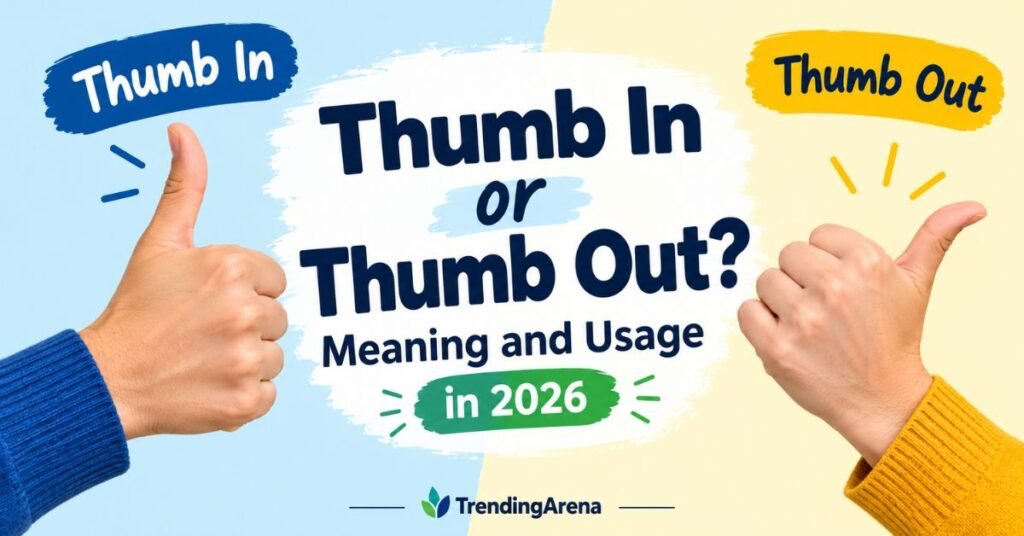

You have probably heard it from a driving instructor, a martial arts coach, or a parent in the passenger seat: “Keep your thumbs out.” But out of what, exactly? The phrase “thumb in or thumb out” refers to two everyday situations. Most people searching for it are asking about how to hold a steering wheel. The second is how to make a fist.
In both cases, the safer answer is the same: keep your thumb out. The details differ, though, and “out” doesn’t always mean what it sounds like. This guide explains both meanings in plain language, shows why the advice exists, and covers what has changed for drivers in 2026.
What Does “Thumb In or Thumb Out” Mean?
“Thumb in or thumb out” describes where your thumb sits when you grip something. On a steering wheel, “thumb in” means your thumbs hook around the inside of the rim. “Thumb out” means they rest along the outer face of the rim instead. On a fist, “thumb in” means tucked inside your curled fingers, and “thumb out” means folded across the outside of them.
Here is the short version:
| Context | Thumb in | Thumb out | Generally recommended |
| Steering wheel | Thumbs hooked around the inside of the rim | Thumbs resting along the face of the rim | Thumb out |
| Making a fist | Thumb tucked inside the curled fingers | Thumb folded across the outside of the fingers | Thumb out |
Some low-quality websites claim the phrase is a secret body-language signal. A later section covers why that doesn’t hold up.
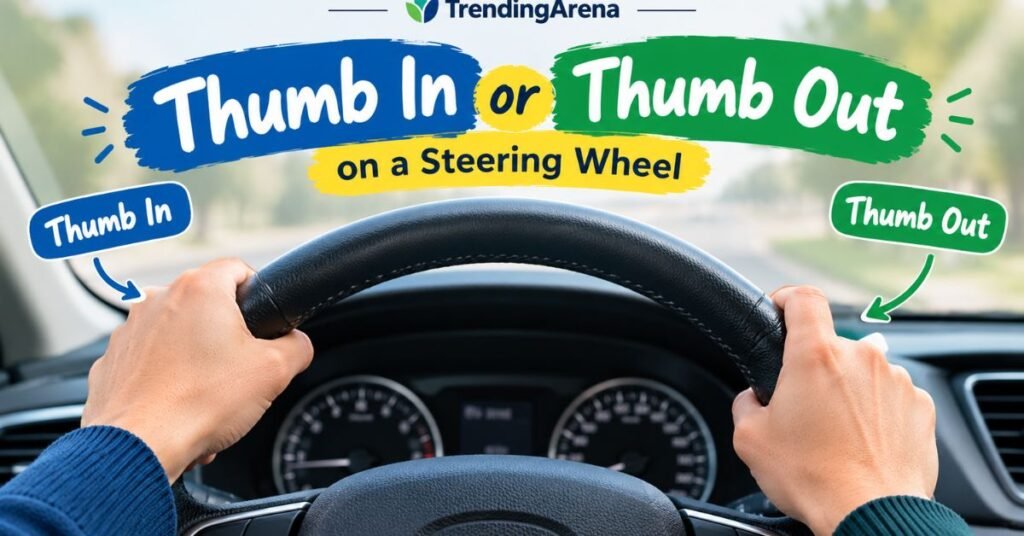
Thumb In or Thumb Out on a Steering Wheel
This is the meaning most people want. If you have ever caught yourself gripping the wheel with your thumbs wrapped around the inside, you were driving “thumb in.”
What each grip looks like
- Thumb in: Your fingers and thumb wrap fully around the rim, so the thumb passes through the open space between the rim and the spokes or hub.
- Thumb out: Your fingers wrap around the rim, but your thumb lies up along the front face of the rim, or rests on a thumb pad or control button, rather than looping through.
Some people describe “thumb out” as pointing the thumb away from the wheel. That isn’t the intent. The thumb stays in contact with the rim and simply doesn’t hook through the wheel.
Why thumb out is the recommended grip
Driving safety guidance has shifted over the years, and thumb position is part of that shift. Current U.S. National Highway Traffic Safety Administration guidance, as relayed by insurers, suggests holding the wheel at 9 and 3 and placing the thumbs along the top of the rim rather than wrapping them around it, to reduce injuries if an airbag deploys.
Three reasons come up most often.
1. Airbags deploy violently and fast. A driver’s airbag inflates in a tiny fraction of a second. If your thumb is hooked through the wheel, it can’t move out of the way. The force can bend or break it.
2. Steering kickback. Hitting a pothole, curb, or rock can snap the wheel sharply to one side. A hooked thumb can be wrenched or dislocated. This is why off-road drivers have long been taught to keep their thumbs on the outside of the wheel, long before airbags were common.
3. Calmer hands under stress. Defensive driving instructors point out that in an emergency, the instinct is to grip harder. A thumbs-out grip makes it easier to stay relaxed and make smooth steering inputs instead of clamping down.
also read this:Roster vs Roaster: Meaning, Usage, and Key Differences
What the evidence actually says
It helps to be honest about how strong the evidence is, because the story has been exaggerated.
The famous claim is that a deploying airbag can rip your thumbs off if you hold the wheel at 10 and 2. When the MythBusters tested this with ballistic gel hands, the airbag knocked the arms off the wheel but caused no visible damage to the thumbs at the 10-and-2 position, so they called that version of the myth busted. The same test did find that a Vulcan-salute-style grip, with the thumbs sticking up and out, caused serious thumb damage.
So the dramatic horror story is not accurate. But that doesn’t make thumb position irrelevant. Real injuries are documented. One EMS-focused article reports two state troopers who fractured their thumbs while resting them over the center airbag cover. The bigger concern in most crashes is where your hands and forearms end up. Hands high on the wheel can be thrown back toward your face by the airbag.
The balanced conclusion:
- Thumb out is a low-cost habit with a real, if modest, safety upside.
- Thumb in is not a guaranteed injury, but it adds a risk you don’t need.
- Hand position (9 and 3) probably matters more than thumb position alone.
- Nothing beats wearing your seatbelt and sitting at a sensible distance from the wheel.
Thumb in vs. thumb out: a side-by-side comparison
| Factor | Thumb in (hooked) | Thumb out (along the rim) |
| Airbag deployment | Thumb can be trapped or bent | Hands can fall away more freely |
| Sudden wheel kickback | Higher risk of sprain or dislocation | Lower risk |
| Feeling of control | Feels secure, especially for beginners | Feels looser at first, but fine with practice |
| Hand fatigue | Can tense the hand and forearm | Easier to keep a relaxed grip |
| Long drives | Grip tends to tighten over time | Easier to vary and relax |
| Recommended by driving safety guidance | Generally not | Yes |
Comfort is the main argument you’ll hear for thumb in. Some sources claim it gives better leverage. In everyday driving, though, good control comes from 9-and-3 positioning, a relaxed grip, and smooth steering technique, not from hooking your thumbs.
How to hold the wheel with your thumbs out
- Adjust your seat first. You should be able to reach the wheel with a slight bend in your elbows, with your back against the seat.
- Place your hands at 9 and 3. Picture the wheel as a clock face and put your hands at the middle of each side.
- Wrap your fingers around the rim. Use your fingers, not just your palms.
- Lay your thumbs along the face of the rim. They can rest on a thumb pad or the spoke area, as long as they aren’t looped through the wheel.
- Keep a firm but relaxed grip. A white-knuckle grip causes fatigue and slower reactions.
- Steer with push-pull. Push up with one hand and pull down with the other so neither arm crosses the airbag cover.
Common mistakes to avoid
- Resting a thumb or hand over the center of the wheel
- Driving with one hand draped over the top of the rim
- Holding the wheel at the very bottom, which limits control
- Wrapping your thumbs through the wheel and tightening up during a skid or swerve
- Letting your forearm rest on the wheel, which puts it in the airbag’s path
Where Should Your Hands Go? 10 and 2, 9 and 3, or 8 and 4
Thumb position and hand position go together, so it is worth comparing the options.
| Hand position | Where it comes from | Pros | Cons |
| 10 and 2 | The traditional rule from before power steering and airbags | Good for precise turns | Hands can be thrown toward your face in an airbag deployment; tiring on long drives |
| 9 and 3 | Widely recommended today | Good control, keeps hands and arms clear of the airbag path | Slightly less natural for some drivers at first |
| 8 and 4 | Sometimes suggested for long drives | Relaxed and low-fatigue | Less leverage for sudden maneuvers; arms may sit lower than ideal |
The 9-and-3 position is described as keeping good control of the wheel while reducing the risk of airbag injury. The same guidance favors the push-pull method of turning, where your hands never cross each other.
Hand-over-hand steering is still acceptable for low-speed moves like parking, but at speed it can put an arm across the airbag.
A practical rule: use 9 and 3 as your default, and don’t worry if your hands drift slightly lower on a long motorway stretch. Your thumbs stay out either way.
Thumb In or Thumb Out in 2026: What’s Different on Modern Wheels
Steering wheels have changed a lot since the 10-and-2 era, and a few details matter now.
Buttons, scroll wheels, and thumb pads
Many 2026 cars put volume controls, cruise settings, and menu scrolling on the spokes at roughly the 9-and-3 positions. These controls are designed to be reached with your thumbs, so thumbs-out is the natural grip. Some wheels include a molded thumb rest for the same reason. If your wheel has one, using it is an easy way to build the habit.
Driver-assist systems and hands-on detection
Many vehicles with lane-keeping or adaptive cruise control monitor whether your hands are on the wheel, through steering torque or touch sensors. A relaxed, stable grip at 9 and 3 usually works well with these systems. Gripping so lightly that the car thinks your hands are off, or draping one hand over the top, can trigger warnings. These systems assist the driver. They don’t replace a driver who is paying attention.
Flat-bottom wheels, yokes, and unusual designs
Sports wheels with flat bottoms and the few yoke-style wheels on the market change where your hands naturally rest. The general principle still applies: avoid hooking your thumbs through the wheel, avoid covering the airbag, and check your owner’s manual for the manufacturer’s guidance.
Seat distance still matters
Hand position is only part of airbag safety. Keep a comfortable gap between your chest and the steering wheel, about ten inches is the commonly cited minimum, and always wear your seatbelt. Driver-safety materials such as one state driver’s manual have long paired the “thumbs turned out” tip with advice to keep that distance. The seatbelt keeps your body in the right position when the airbag fires, and unbelted occupants face much higher risk from deployment.
The bottom line for modern cars
Nothing about newer technology reverses the old advice. If anything, better-designed wheels make thumbs-out easier. The only real adjustment is learning how your specific car’s controls and driver-assist sensors expect you to hold the wheel.
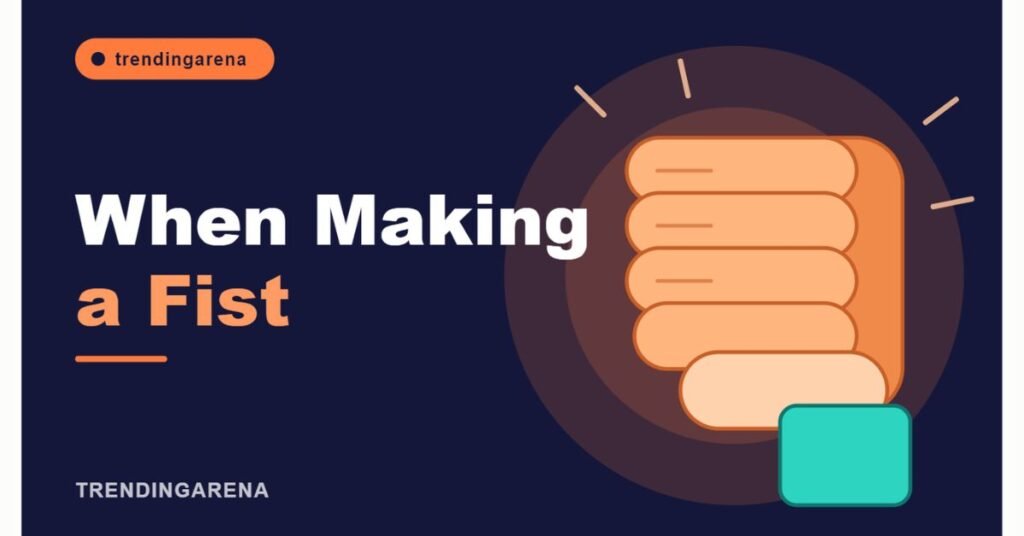
Thumb In or Thumb Out When Making a Fist
The second meaning comes from martial arts, boxing, and self-defense classes. Here the question is whether your thumb sits inside your curled fingers or outside them.
What each fist looks like
- Thumb in: You curl your fingers and tuck your thumb inside the fist, wrapped by your fingers.
- Thumb out: You curl your fingers and fold your thumb across the outside, pressing against the front of your index and middle fingers.
A caution about the wording: “thumb out” here does not mean the thumb sticks straight out like a hitchhiker’s. It means the thumb is folded over the outside of the fingers and stays tight against them.
Why thumb out is the standard
Most striking arts teach a thumb-outside fist for three reasons.
- Protection. A thumb tucked inside the fingers can get bent or jammed back on impact. Folding it across the outside lets it lock the fist in place and keeps it from being crushed inside.
- A tighter, sturdier fist. The thumb acts as a brace, helping hold the fingers closed.
- Better alignment. A well-formed fist lines up the wrist, forearm, and the two big knuckles at the front, so force travels in a straight line instead of bending the wrist.
One martial arts reference describes pressing the thumb into the gap at the second knuckle of the forefinger as part of building a solid fist, and notes that proper fist formation comes from squeezing the knuckles together, not stretching them apart. Styles differ on exact thumb placement. They almost all agree that the thumb stays on the outside of the curled fingers.
Some sources describe thumb-in as “safer” or “more traditional.” Be cautious with these claims. Many are unsourced, and the usual instruction from instructors points the other way.
Thumb in vs. thumb out for a fist: comparison
| Factor | Thumb in (tucked inside) | Thumb out (folded across the outside) |
| Thumb protection | Weak. The thumb can jam or be bent on impact | Better. The thumb is braced against the fingers |
| Fist tightness | Looser | Tighter |
| Wrist alignment | Harder to maintain | Easier when taught properly |
| Typical instruction | Discouraged | Standard in most striking arts |
| Common error | Thumb gets trapped and hurt | Thumb sticks out away from the fist |
How to make a fist with your thumb outside
- Open your hand with fingers extended.
- Curl your fingers into your palm, starting from the fingertips.
- Fold your thumb across the outside, pressing it against the front of your index and middle fingers.
- Squeeze firmly but briefly. Tension should come at impact, not constantly.
- Check your wrist. The back of your hand and forearm should form a straight line.
- Strike with the first two knuckles, the larger ones at the base of the index and middle fingers.
A note on hand injuries
A common punching injury is the boxer’s fracture, a break in the bone behind the pinky knuckle. It usually comes from striking with poor alignment or hitting a hard surface without the right technique. Thumb position doesn’t cause it directly, but a badly formed fist raises the odds of several hand injuries.
If you’re learning to punch, work with a qualified coach, use hand wraps and gloves on a heavy bag, and avoid striking walls or hard objects. If you hurt your hand or thumb and the pain, swelling, or limited movement doesn’t settle quickly, see a medical professional. This article is general information, not medical advice.
Is “Thumb In or Thumb Out” a Body Language Signal?
If you search the phrase, you may land on pages claiming it is a hand gesture that signals openness, guardedness, confidence, or skepticism, with a table of “cultural meanings.” Treat these claims with caution.
There is no established, widely recognized body-language code called “thumb in or thumb out.” Those pages often repeat the same vague language across different sites, offer no named researchers or studies, and give no concrete examples of real people using the gesture. That’s a red flag.
What is real:
- The thumbs-up gesture carries different meanings in different cultures. It means approval in many places and can be rude or offensive in others.
- Hand and thumb posture in body language research is part of broader nonverbal cues, such as open palms or crossed arms. No researcher treats a binary “thumb in / thumb out” as a reliable signal on its own.
- Context matters. Where you are, who you’re with, and what you’re saying shape any gesture’s meaning far more than thumb position.
If someone tells you thumb placement reveals a person’s mood or intentions, treat it as folk belief, not science.
Which Should You Choose? A Quick Decision Guide
| Situation | Best thumb position | Why |
| Everyday driving | Thumbs out, along the rim | Lower injury risk, relaxed grip |
| Driving off-road or on rough roads | Thumbs out | Protects against sudden kickback |
| Long highway drives | Thumbs out, at 9 and 3 | Less fatigue, easier to relax |
| Emergency swerve or skid | Thumbs out | Avoids clamping down; supports smooth steering |
| Learning to punch | Thumb folded across the outside | Protects the thumb and supports the fist |
| Self-defense practice | Thumb folded across the outside | Standard in most striking arts |
| Casual conversation or social media | Neither matters | There is no established meaning |

Why Habits Matter More Than Rules
Habits form in the moment you don’t think about them. You rarely decide where your thumbs go in a crash or swerve. Your hands go where they have gone a thousand times before. That’s why building thumbs-out habits during ordinary driving or practice is worth the small effort.
A few ways to make it stick:
- Check your hands when you start the car. It takes two seconds.
- Use your wheel’s thumb rests or controls as a reminder.
- Notice when you tighten your grip in traffic and consciously relax it.
- If you teach a teenager to drive, show them the grip early so they don’t have to unlearn the other one.
Conclusion
“Thumb in or thumb out” means two things: how you hold a steering wheel and how you make a fist. In both cases, thumb out is the safer choice. On the wheel, rest your thumbs along the rim at 9 and 3 instead of hooking them through it. In a fist, fold your thumb across the outside of your fingers.
The body-language meaning online has no reliable evidence behind it, so ignore it. In 2026 the advice still holds: relaxed grip, thumbs out, seatbelt on.