

Woman or women? It is a tiny pair of words, yet it trips up native speakers, language learners and working writers alike. The reason is easy to see. The two words look almost identical, sound almost identical, and grew from the same root. Only one vowel separates “one person” from “a group.”
This guide explains the difference between woman and women in plain language. You will find clear meanings, the history behind the odd spelling, pronunciation help, grammar rules, a comparison table, and examples for emails, news, social media and formal writing. By the end, you should be able to choose the right form in a couple of seconds.
Quick Answer
Woman (singular) means one adult female person. Women (plural) means two or more adult females. The spelling changes inside the word, from woman to women, rather than by adding an -s.
- One person: She is a woman.
- More than one person: They are women.
- Never write “womans” or “womens” as a plural.
- Possessives: a woman’s coat (one owner), women’s coats (many owners).
If the sentence needs is, a, an or this, choose woman. If it needs are, these, those or several, choose women.
The Meaning of Woman and Women
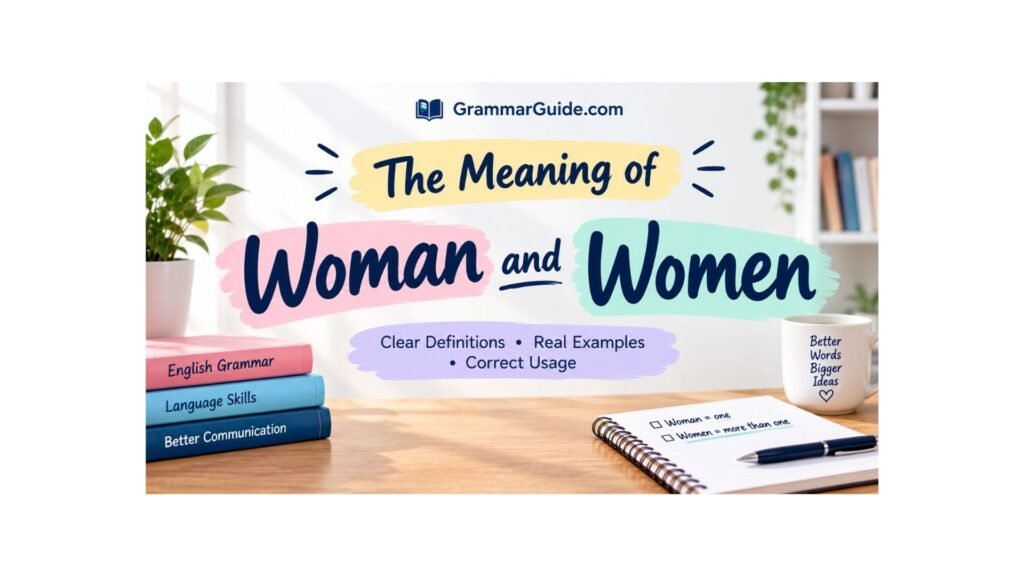
Both words describe adult female humans. The only real difference is how many people you mean. Still, each word has its own shades of use, so it helps to look at them one at a time.
Woman – Meaning
Woman is a countable noun for one adult female human being. Dictionaries mark it as singular, and it takes singular verbs: the woman is, the woman was, the woman has.
You will see it in three common roles:
- As a person: A woman waited at the counter.
- As a category: Every woman on the team received a copy.
- As a modifier: She is the first woman president of the club.
Woman usually signals adulthood. For a young person, English normally prefers girl, and for a young adult, writers often choose young woman.
Women – Meaning
Women is the plural of woman. It points to a group of two or more adult females, whether that group is five people in a room or half the population of a country.
Because it is plural, it takes plural verbs: the women are, the women were, the women have. It also appears in fixed phrases that name movements, events and topics, such as women’s rights, women’s health and International Women’s Day.
The Origin of Woman and Women
The spelling looks strange because the word is old. Etymology dictionaries trace woman to Old English wīfmann, a compound of two parts. The first, wīf, meant “woman” or “female,” and it survives today as wife. The second, mann, meant “person” or “human being,” not “male adult” the way modern man often does.
So the word started out as something like “female person.” Over the centuries, the pronunciation slid and the spelling shifted. The Old English plural wīfmen became wimmen in later stages of the language, and the single-person form became womman in Middle English before settling into today’s woman.
Two details are worth remembering:
- The wi- in wife explains why midwife and housewife still carry the old sense of “woman.”
- The plural women kept the older vowel sound, which is why it is pronounced with a short i even though it is spelled with an o.
Standard dictionaries also note that the modern women spelling is relatively late, and that it was shaped by the spelling of the singular. A playful respelling, wimmin, appeared in the early twentieth century and is still used on occasion in activist writing. It is not standard in ordinary prose.
Women or Woman Pronunciation Difference
Spelling is not the only place where the pair differs. They are pronounced differently too, although only in the first syllable.
| Word | Phonetic spelling | Sounds like | First syllable rhymes with |
| woman | /ˈwʊmən/ | WUUM-un | put, book |
| women | /ˈwɪmɪn/ | WIM-in | swim, him |
The second syllable is weak in both words, so it fades into a soft “un” or “in.” That is why the words can feel the same in fast speech.
Here is a quick way to hear the difference. Say a woman came in, then say three women came in. Notice how your lips round for the first vowel in woman and spread for the first vowel in women.
Why Is “Women” the Plural of “Woman”?
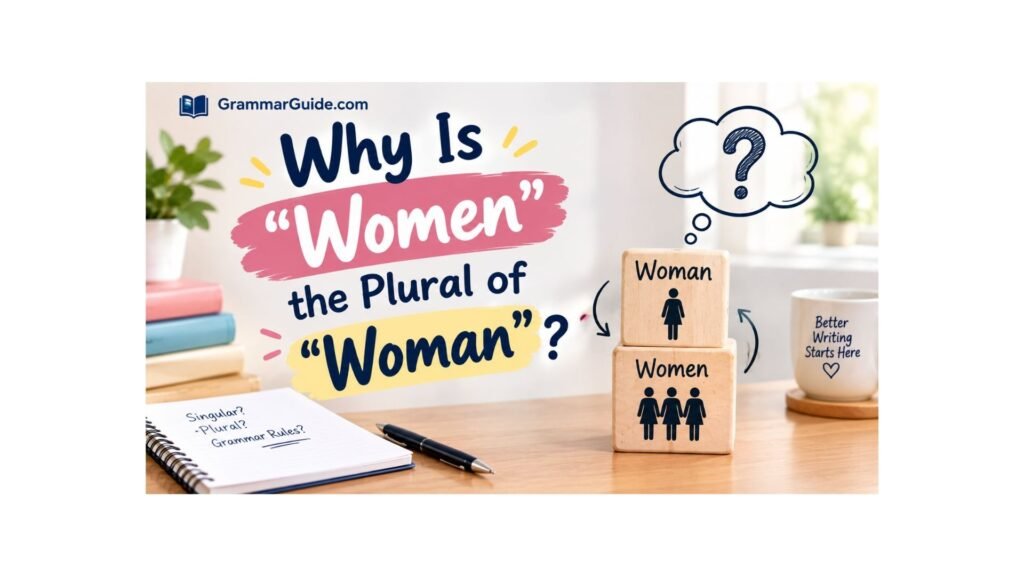
English forms most plurals by adding -s or -es. Woman does not follow that rule because it belongs to a small, very old group of irregular plurals that change an internal vowel.
Examples include:
- man → men
- foot → feet
- tooth → teeth
- goose → geese
- mouse → mice
Woman contains the word man, so it inherited the same pattern. When man became men, woman became women. The plural stayed tied to the original compound, and the vowel change never went away.
This also explains a common pattern: compounds that end in the word man usually follow the same rule. Chairman becomes chairmen, postman becomes postmen, and fisherman becomes fishermen. Words that only look like they end in man, such as human, German and Roman, are not compounds of man, so they take a normal -s: humans, Germans, Romans.
Adding -s to women gives you womens, which is a double plural. That is why womens is wrong as a plural noun.
British English vs American English Spelling
Good news: there is no spelling difference here. Both British and American English use woman for the singular and women for the plural. Canadian, Australian, Indian and other varieties do the same.
What does vary is the surrounding style:
| Feature | British usage | American usage |
| Singular spelling | woman | woman |
| Plural spelling | women | women |
| Possessive singular | woman’s | woman’s |
| Possessive plural | women’s | women’s |
| Common collective phrases | women’s rights, women’s institute | women’s rights, women’s studies |
Some regional differences appear in titles and phrases rather than in spelling. Names of organizations may carry their own punctuation, such as an apostrophe or no apostrophe. When you write the name of a group, copy its official spelling exactly.
Which Form Should You Use? (Audience-Based Advice)
Different readers care about different things. Use this short guide to match your choice to your audience.
- Students and exam takers: Count the people. One person means woman. Two or more means women. Check the verb, since is and was agree with woman, while are and were agree with women.
- English learners: Memorize the pair as one unit: one woman, two women. Say them aloud to lock in both the pronunciation and the spelling.
- Business writers: Be precise. Each woman on the board is singular. All women on the board is plural. Consistency is a trust signal in reports and proposals.
- Journalists and editors: Follow the house style guide for modifiers and capitalization, and keep the number clear. A woman identified by name is singular, while women may represent a statistic or a group.
- Marketers and social media managers: Pick the form that matches the audience you are addressing. Use women for a group, and woman when you want a personal, one-to-one tone.
- Parents and teachers: Explain the link to man and men. Children remember patterns better than rules.
Women or Woman in Grammar Rules
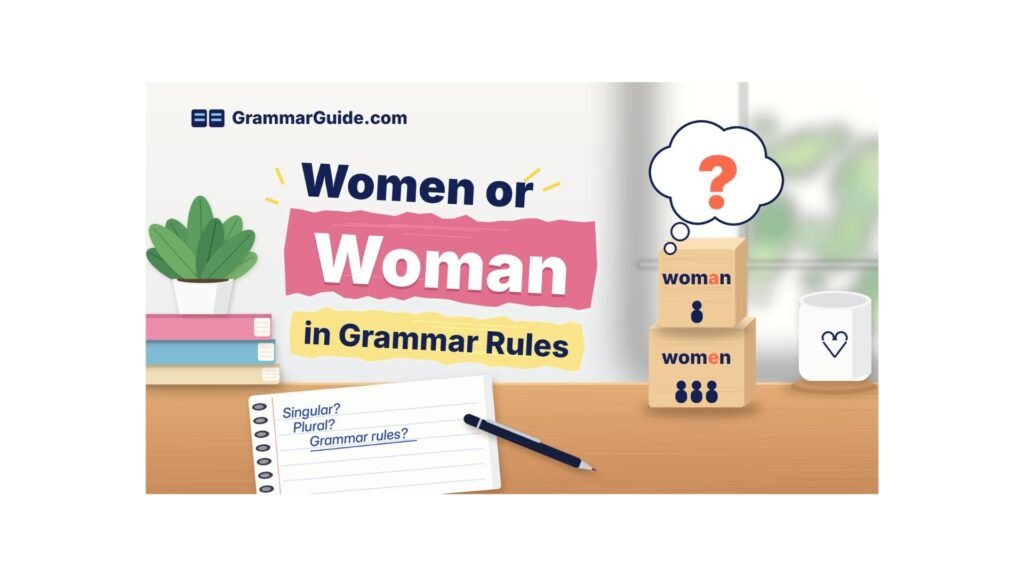
The core rule is about number, but several smaller rules sit around it. Learn these and almost every sentence will fall into place.
Rule 1: Match the verb. Singular subject, singular verb: The woman speaks. Plural subject, plural verb: The women speak.
Rule 2: Match the article. A and an go with singular nouns only. A woman is correct. A women is not. Plural nouns can take the, some, many or no article at all: the women, some women, women in business.
Rule 3: Match the pronoun. Woman pairs with she, her and hers. Women pairs with they, them and theirs. The woman said she would call. The women said they would call.
Rule 4: Match the quantifier. Use one, each, every and another with woman. Use two, several, few, many and all with women.
Rule 5: Watch “one of the women.” The phrase one of the women takes a singular verb: One of the women is a surgeon. But in a relative clause that follows, the verb agrees with women: She is one of the women who work here.
Rule 6: Handle “a number of” correctly. A number of women are attending is plural. The number of women is growing is singular, because number is the subject.
Rule 7: Choose the right possessive. Singular possessive adds ‘s to woman: the woman’s bag. Plural possessive adds ‘s to women: the women’s bags. The form womens’ is wrong, because women already shows plurality without an s.
Also Read This https://trendingarena.com/deactivate-vs-inactivategy/
Common Mistakes with Women or Woman
Most errors fall into a handful of patterns. Here are the ones that appear most often, with quick fixes.
| Mistake | Correct form | Why it is wrong |
| A women is waiting. | A woman is waiting. | A needs a singular noun. |
| Two woman arrived. | Two women arrived. | Two needs a plural noun. |
| The women is here. | The women are here. | Plural subject needs a plural verb. |
| The woman are here. | The woman is here. | Singular subject needs a singular verb. |
| Womans rights | Women’s rights | Womans is not a word. |
| Womens health | Women’s health | The plural possessive needs an apostrophe. |
| Womens’ day | Women’s day | Apostrophe goes before the s, not after. |
| Each of the woman | Each of the women | After of the, use the plural. |
| She is one of the best woman | She is one of the best women | One of the is followed by a plural. |
| Woman are strong. | Women are strong. / A woman is strong. | Keep number consistent. |
A fast self-check
Before you publish, run this three-step test on any sentence with woman or women:
- Count the people in your head.
- Check the verb that follows.
- Check the article before the word, if there is one.
If all three line up, you are safe.
Woman vs. Women: The Main Difference
The main difference is number. Woman is one. Women is more than one. Everything else, from pronunciation to verb choice, follows from that.
A helpful memory trick uses the last letters. Look at woMAN and woMEN. The ending -man is singular, as in one man. The ending -men is plural, as in several men. If you can tell man from men, you can tell woman from women.
A second trick works by substitution. Replace the word with man or men. If the sentence works with man, use woman. If it works with men, use women. For example, The ___ is on the phone works with man, so the answer is woman. The ___ are on the phone works with men, so the answer is women.
Women vs Woman in Everyday Examples
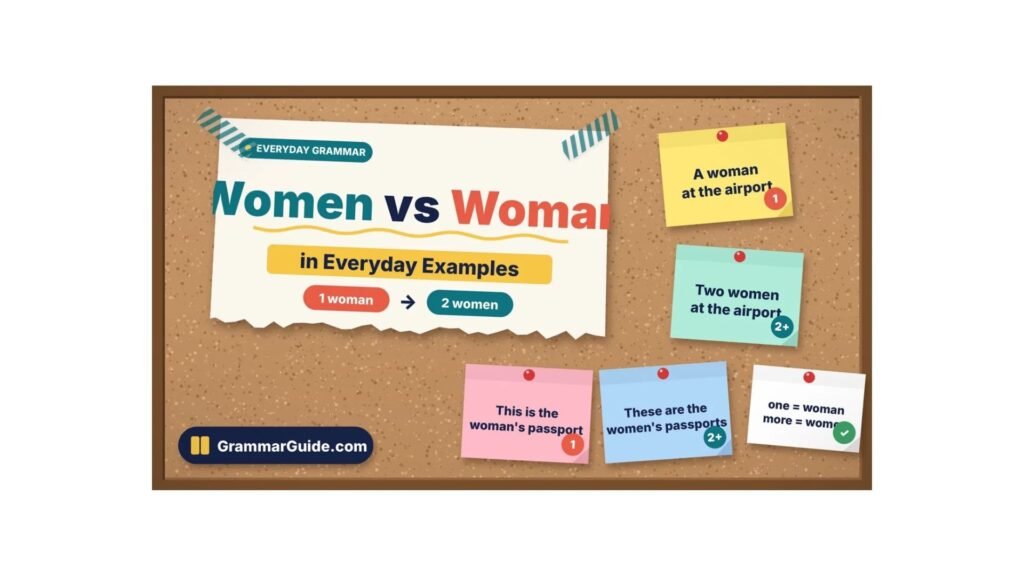
Real sentences stick better than abstract rules. Here are everyday examples in pairs so you can compare the forms side by side.
At work
- A woman from the finance team joined the call.
- Women from three departments joined the call.
At home
- The woman next door waters my plants.
- The women next door run a book club.
In school
- Our teacher is a woman who loves poetry.
- Our teachers are women who love poetry.
In public life
- She is the first woman to lead the committee.
- They are the first women to lead the committee.
In travel
- A woman at the airport helped me with directions.
- Two women at the airport helped me with directions.
With possessives
- This is the woman’s passport.
- These are the women’s passports.
Read each pair aloud. Notice that only the number and the matching words change. The meaning of the word stays the same.
Grammar Rule Behind the Difference
At the grammar level, woman and women are two forms of one noun. Linguists call the pattern number inflection. Most English nouns mark number with -s. A small group of nouns mark it through an internal vowel change instead, which is called mutation plurals.
Woman sits inside that group. Its plural is not an exception someone invented. It is a surviving piece of very old English grammar.
Three short rules sum up the grammar:
- Number decides the form. One person gets woman, and more than one gets women.
- Agreement carries the number forward. The verb, article and pronoun must match.
- Possessives add ‘s after the whole noun. The noun stays the same, and the apostrophe shows ownership.
Once you see the pattern, you stop memorizing and start recognizing.
Emails
Emails are quick, and small errors look careless to the reader. Here is how the choice plays out.
- Subject lines: Support for women entrepreneurs (plural, general group) or A note for one woman on our team (singular, specific).
- Greetings: Dear women of the Leadership Circle is correct for a group. Dear woman alone is not a natural greeting, so use a name.
- Closing lines: Please share this with any woman in your network who may be interested is singular because of any woman.
A good habit is to reread the first sentence of an email with the count in mind. If you wrote each, every or a, the noun should be singular. If you wrote all, both or a number, it should be plural.
News
Headlines favor short words, which makes the pair even more visible. Newsrooms generally keep the singular for individuals and the plural for trends or groups.
- Woman rescued from flooded car (one person)
- Women lead growth in small business ownership (a group trend)
- Women’s soccer team wins title (plural possessive modifier)
Journalists also follow house style on hyphenated terms such as woman-owned or women-led. Both appear in print. The practical rule is to match the number of the people involved, and then stay consistent within the same article.
Social Media
Social posts are informal, but the grammar still shapes how credible you look.
- Hashtags such as #WomenInTech use the plural because they address a community.
- A shout-out like This woman changed my career uses the singular because the post is about one person.
- Captions that read Women supporting women use the plural on both sides.
One common slip in captions is Support a women-owned business. The article a does not conflict with the compound modifier women-owned, since the modifier sits before business. The singular noun is business, so the article is correct.
Formal Writing
Reports, essays, legal documents and academic papers reward careful choices.
- Use woman for a single case or participant: The woman interviewed stated that…
- Use women for samples and groups: Women made up 54 percent of respondents.
- Avoid shortcuts such as females as a noun for people in neutral writing. Many style guides prefer women for adults, and reserve female for adjectives or technical contexts.
- Keep terms consistent across a document. If you start with women-led organizations, do not switch to woman-led later unless you mean one leader.
When citing an official name or program, copy its wording exactly, even if the style differs from your own.
Woman or Women – Comparison Table
Use this table as a quick reference. It brings together the key points from earlier sections.
| Feature | Woman | Women |
| Number | Singular | Plural |
| Meaning | One adult female | Two or more adult females |
| Pronunciation | /ˈwʊmən/ (WUUM-un) | /ˈwɪmɪn/ (WIM-in) |
| Old English root | wīfmann (singular) | wīfmen (plural) |
| Verb form | is, was, has | are, were, have |
| Article | a, an, the, this, that | the, these, those, some, many |
| Pronoun | she, her, hers | they, them, theirs |
| Possessive | woman’s | women’s |
| Typical quantifier | one, each, every | two, several, all |
| Example | A woman led the meeting. | Women led the meeting. |
Women or Woman: Google Trends & Usage Data
People look this pair up in several forms. Some searchers want the plain contrast between the two words. Others want a spelling check, a pronunciation guide, or help with a possessive. The queries tend to cluster like this:
| Search pattern | What the person usually wants |
| woman vs women | A quick difference between singular and plural |
| women or woman | A sentence-level choice |
| plural of woman | Confirmation of the spelling |
| woman’s or women’s | Help with the apostrophe |
| how to pronounce women | Audio or phonetic guidance |
| womens or women’s | A fix for a missing apostrophe |
This pattern shows why a complete guide has to cover meaning, spelling, pronunciation and possessives together, not only the singular-versus-plural rule.
I have not included raw search-volume figures, because trend numbers change constantly and a stale number would mislead you. To see current data, open Google Trends, compare woman and women, and check the related queries panel. Treat the result as a directional signal rather than a precise count.
Related Contexts & Semantic Usage
Many neighboring words get tangled with woman and women. Knowing how they relate improves both accuracy and tone.
Woman vs. female. Female is broader. It can describe humans, animals and plants, and it works well as an adjective: female athletes. As a noun for people, it can sound clinical or detached, so most writers prefer woman or women for adults.
Woman vs. girl. Girl refers to a child or young person. Woman refers to an adult. Calling adult women girls can come across as dismissive in professional settings, though it is common and friendly in some casual contexts among friends.
Woman vs. lady. Lady can be polite or formal, but it also carries class and etiquette overtones. Woman is neutral and is the safer default.
Woman vs. womanhood and womankind. Womanhood is the state of being a woman. Womankind is an older collective term for women as a whole. Both are singular in form.
Women’s vs. womens vs. womens’. Only women’s is correct for the plural possessive. The other two are common typos.
Related compounds. You will often see:
- women’s rights, women’s health, women’s studies
- businesswoman and businesswomen
- chairwoman and chairwomen
- congresswoman and congresswomen
- horsewoman and horsewomen
Notice that every compound ending in -woman follows the same plural pattern: -woman becomes -women.
FAQs
What is the difference between woman and women?
Woman is singular and means one adult female. Women is plural and means two or more adult females.
What is the plural of woman?
The plural is women. It follows the same vowel-change pattern as man and men.
Is “womens” a word?
No. Womens is a double plural and is never correct. Write women for the plural, and women’s for the plural possessive.
How do you pronounce woman and women?
Woman is pronounced WUUM-un, with the vowel of put. Women is pronounced WIM-in, with the vowel of swim.
Can I say “a women”?
No. The article a needs a singular noun, so the correct phrase is a woman.
Where do I put the apostrophe: woman’s or women’s?
Use woman’s for something that belongs to one woman, and women’s for something that belongs to several. Never write womens’.
Are woman and women spelled differently in British and American English?
No. Both varieties use woman and women.
Conclusion
The difference between woman and women comes down to a single question: how many people are you talking about? One person gets woman. Two or more get women. The spelling and the verb follow that choice.
The rest is pattern recognition. Woman grew from the Old English wīfmann, and its plural kept the old vowel change, just like man and men. Both words are spelled the same way in British and American English. The pronunciations differ only in the first vowel. Never add an -s to make a plural, and always place the apostrophe before the s in the plural possessive: women’s.