
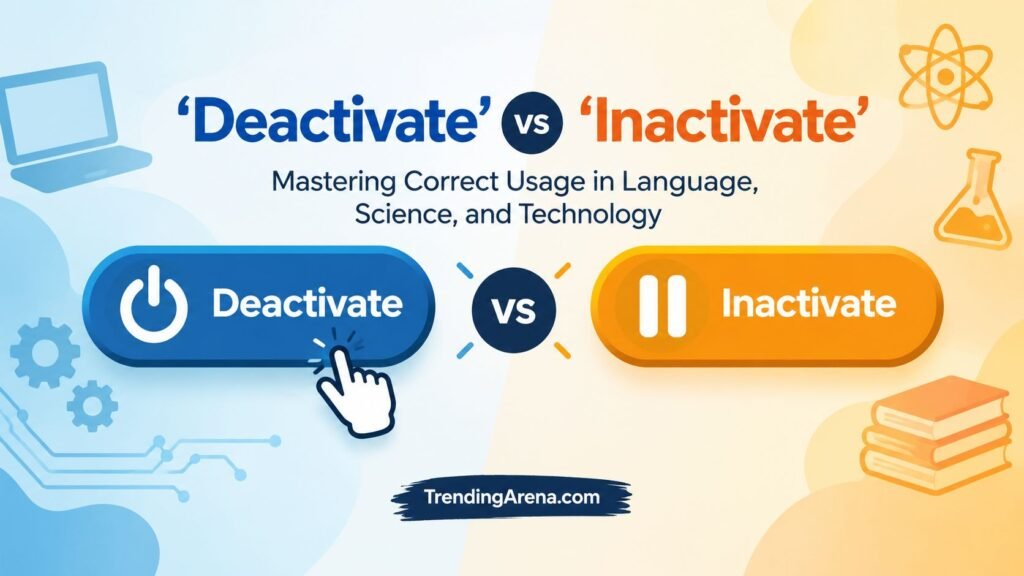

You close your social media account for a month. A few days later you read a lab report saying researchers “inactivated” a virus. Same idea, two different verbs. So which one is right, and does it even matter?
It does matter, mostly because readers notice when a word feels off. Say “I inactivated my Instagram” and people will understand you, but it will sound strange. Write “the virus was deactivated” in a scientific paper and a reviewer may raise an eyebrow.
Quick helanswer: Deactivate usually means a person or system switches something off on purpose: an account, an alarm, a card, a feature. Inactivate usually describes something losing its activity through a biological, chemical or physical process: a virus, an enzyme, a toxin. Dictionaries treat the two words as close relatives, so the split is a strong convention, not a law.
This guide explains where each word comes from, how professionals use them, where the two overlap, and how to choose the right one every time. You will also find a comparison table, real examples, common mistakes, and a short set of practice sentences.
Introduction: Why Word Choice Matters
Both words describe the same basic outcome: something that was active is no longer active. That shared outcome is exactly why people mix them up. Spellcheck tools don’t flag either one, and many dictionaries define one word using the other.
The difference lives in who or what causes the change.
- With deactivate, the focus is on control. Someone presses a button, changes a setting, or issues a command.
- With inactivate, the focus is on the state of the thing itself. Heat, chemicals, radiation or time change it, and it stops functioning.
Why does this matter in practice? Think about a few situations:
- Technical manuals need clear instructions. “Deactivate the alarm before entering” tells the reader to take an action.
- Scientific papers need precise methods. “The enzyme was inactivated at 60°C” tells the reader what happened to the enzyme and under which condition.
- Legal and policy writing needs unambiguous wording. “Deactivate user access” signals an administrative decision.
Using the expected word signals that you know the field. Using the unexpected one doesn’t make your sentence wrong, but it can make readers pause, and a pause costs trust.
A note on how to read this article: the rules below describe how the words are commonly used. Language is flexible, and you will find exceptions. I point those out where they matter.
Origins and Evolution of the Terms
Both words are built from the Latin-rooted verb activate plus a prefix.
| Word | Prefix | Literal idea |
| Deactivate | de- (undo, reverse) | Reverse an activation |
| Inactivate | in- (not) | Make not active |
That small difference in prefix explains a lot. De- implies there was an “on” moment that you are now undoing. Think of switching a system on, then switching it off. In- simply describes a lack of activity, which fits natural or induced changes in a substance.
How “deactivate” grew up
Merriam-Webster dates the first known use of deactivate to 1920. That timing matches the rise of machines, electronics, and military equipment. Engineers, technicians and security staff needed a verb for turning a system off without destroying it. You deactivate a bomb, an alarm, a mine, a device.
Later, digital life added more objects: accounts, subscriptions, licenses, profiles, notifications. Today most people meet this word through software settings, not factory floors.
How “inactivate” grew up
Inactivate is tied closely to biology, chemistry and medicine. Scientists use it when they describe what a treatment does to a biological agent: heat that inactivates enzymes, disinfectants that inactivate viruses, radiation that inactivates microorganisms.
It also appears in genetics (for example, a gene being inactivated) and in pharmacology (a drug being inactivated in the body). In everyday English, you rarely hear it.
The overlap is real
Here is the part many short guides skip. Dictionary entries show deactivate used in science too. Merriam-Webster’s own examples include deactivating a chemical compound and an enzyme. So the idea that “science always uses inactivate” is too strict. A better description: inactivate is the standard choice in many scientific fields, while deactivate is the default in technology and daily life.
When to Use Inactivate
Use inactivate when something loses its function because of a process, not because a person flipped a switch.
Typical situations
- Virology and vaccines: Researchers treat a virus so it can no longer replicate. Inactivated vaccines work this way.
- Biochemistry: An enzyme stops working after exposure to heat, extreme pH or an inhibitor.
- Microbiology and food safety: Heat treatment or radiation inactivates harmful microorganisms.
- Genetics: A mutation inactivates a gene, or a researcher inactivates it to study its role.
- Chemistry: A neutralizing solution inactivates a hazardous compound.
- Pharmacology: A medication is inactivated by the liver or by another chemical reaction.
Next Time vs. The Next Time: Which One Is Correct?
What the word signals
When you write inactivate, you tell the reader three things:
- A process caused the change.
- The subject is usually biological, chemical or technical in nature.
- The writing is formal and precise.
Example sentences
- Heat can inactivate many viruses.
- The disinfectant inactivated the bacteria within minutes.
- The protein was inactivated by a change in pH.
- A mutation in the gene inactivated the receptor.
One more use: organizations
In some formal settings, especially military and administrative writing, inactivate can describe taking a unit or organization out of active status. A division may be “inactivated” after restructuring. This is a narrow use, but it is legitimate, and it shows the word is about status as much as process.
When to Use Deactivate
Use deactivate when a person, an administrator, or a system intentionally turns something off or removes its access.
Typical situations
- Online accounts: You deactivate a social media profile, an email address, or a user login.
- Security: You deactivate an alarm, a badge, or an access code.
- Finance: A bank deactivates a lost debit card.
- Software: You deactivate a license, a plugin, or two-factor authentication.
- Devices: You deactivate Bluetooth, location services or notifications.
- Business operations: Human resources deactivates a former employee’s credentials.
What the word signals
Deactivate tells the reader:
- Someone chose to do this.
- The item can often be turned back on (reactivated), though not always.
- The context is practical or technical, not laboratory research.
Example sentences
- Please deactivate my account before the end of the month.
- The technician deactivated the alarm system.
- You can deactivate automatic updates in the settings menu.
- The bank deactivated the stolen card right away.
Deactivate is not delete
People often assume deactivating something removes it. Usually it does not. A deactivated account typically stays stored, so the owner can return. Deleting removes it. If your writing is about accounts, this distinction is worth stating clearly, because readers search for it constantly.
Core Meaning: Deactivate vs Inactivate
Here is the main idea in one line, and it is easy to remember:
Deactivate = you did it. Inactivate = it happened to the thing.
Let’s break that down across several dimensions.
| Dimension | Deactivate | Inactivate |
| Who or what acts? | A person, admin or system | A process (heat, chemicals, radiation, time) |
| Typical subject | Accounts, devices, alarms, features | Viruses, enzymes, toxins, genes, compounds |
| Typical field | Technology, business, security | Biology, medicine, chemistry |
| Tone | Neutral and everyday | Formal and technical |
| Common in daily speech? | Very common | Rare |
| Reversibility | Often reversible | Varies, depends on the process |
About reversibility
You will see guides claim that deactivation is always temporary and inactivation is always permanent. Others claim the exact opposite. Both claims fall apart under checking. A deactivated bomb is not coming back. An enzyme inactivated by gentle conditions may recover.
So don’t use reversibility as your deciding factor. Use cause and context instead. That rule holds up in far more cases.
Related forms
| Base verb | Past tense | Noun | Related adjective |
| deactivate | deactivated | deactivation | deactivated |
| inactivate | inactivated | inactivation | inactive |
Note that inactive is an adjective meaning “not active.” It is not a verb. “The account is inactive” is correct. “I will inactive the account” is not.
Everyday and Technical Contexts of Deactivate
Most readers meet deactivate far more often than inactivate. Here are the main places it shows up.
Technology and software
Apps and platforms use the word for almost every “turn this off” action. You can deactivate a profile, notifications, a browser extension, or a software license. Developers and support teams use it in help articles because it is short and clear.
Social media
Deactivating an account hides your profile and content without erasing it. This lets people take a break and come back. Platforms often use separate menu options for deactivation and deletion, which is why the two words are worth keeping apart.
Security and safety
Alarm systems, access cards, and security protocols are deactivated, not inactivated. The word fits because a person authorizes the action and the system can usually be armed again.
Banking and finance
Banks deactivate cards, online access, and recurring payments. The word suggests protection: stop use now, replace or restore later if needed.
Military and engineering
Technicians deactivate weapons, explosives, radar stations, and machinery during maintenance or for safety. These contexts are where the term began.
Workplace administration
HR and IT teams deactivate badges, email accounts, and system permissions when someone leaves. Notice the pattern: each example involves human authority over a system.
A short list of natural pairings
Words that often appear next to deactivate:
- account, profile, subscription, license
- alarm, security system, device, card
- notifications, feature, plugin, setting
Words that often appear next to inactivate:
- virus, bacteria, pathogen, toxin
- enzyme, protein, gene, receptor
- compound, catalyst, reagent
Learning these pairings helps your writing sound natural without memorizing rules.
Common Misuses and Pitfalls
Even careful writers slip here. These are the errors I would watch for most.
1. Using inactivate for accounts and devices
- Awkward: I inactivated my Facebook account.
- Better: I deactivated my Facebook account.
2. Using deactivate for biological agents in formal science writing
- Less precise: Researchers deactivated the virus.
- Preferred: Researchers inactivated the virus.
Readers will understand the first sentence. It simply doesn’t match the field’s usual vocabulary.
3. Treating the words as perfect synonyms
They overlap, but they are not mirror images. Choose based on the cause of the change and the field you are writing for.
4. Confusing inactivate with inactive
Inactive describes a state. Inactivate describes making it happen.
- The account is inactive. (state)
- The admin will deactivate the account. (action)
- Heat will inactivate the enzyme. (process)
5. Using “deactivated” as a vague synonym for “killed”
When describing a pathogen in a vaccine context, inactivated is the accepted term. Saying a vaccine contains a “deactivated” virus is understandable in casual talk, but the standard phrasing is “inactivated vaccine.”
6. Overcorrecting
Some writers become so worried about the difference that they twist sentences to avoid a word. Don’t. If the context is clear, pick the word that fits and move on.
Comparison Examples in Different Contexts
Seeing the same idea in different settings makes the pattern stick. The table below shows realistic situations and the word readers will expect.
| Situation | Expected word | Why |
| Closing your Instagram for a break | Deactivate | You chose it; account stays stored |
| Turning off a home alarm | Deactivate | Intentional control of a device |
| Stopping a stolen credit card | Deactivate | Administrative action |
| Making a virus safe for a vaccine | Inactivate | Biological process |
| Heat stopping an enzyme | Inactivate | Physical process affecting a protein |
| Neutralizing a toxin chemically | Inactivate | Chemical process |
| Ending an employee’s system access | Deactivate | Administrative control |
| Silencing a gene in a lab study | Inactivate | Genetic research term |
| Disabling a software license | Deactivate | System command |
| Taking a military unit out of active status | Inactivate | Formal organizational status |
Side-by-side sentence pairs
Technology
- Natural: Deactivate notifications for this app.
- Odd: Inactivate notifications for this app.
Biology
- Natural: The virus was inactivated by heat treatment.
- Odd in formal writing: The virus was deactivated by heat treatment.
Chemistry
- Natural: The solution inactivated the reactive compound.
- Acceptable but less standard: The solution deactivated the reactive compound.
Security
- Natural: The guard deactivated the alarm.
- Odd: The guard inactivated the alarm.
Notice that the chemistry example is “acceptable.” This is the gray zone. In chemistry, deactivate is often used for catalysts (a catalyst “deactivates” over time), so both words appear. When you work in a specialized field, follow the usage in that field’s journals and style guides.
Consequences of Incorrect Usage
Is a wrong choice really a big deal? Sometimes it is a small style issue. Sometimes it changes how a reader interprets your work.
Credibility
In technical and scientific writing, the right terminology signals competence. A methods section that says an enzyme was “deactivated” might make an editor ask exactly what happened. Was it denatured, inhibited, or switched off by a regulator? The more precise term saves that question.
Misreading of intent
Deactivate access implies someone decided to remove it. Inactivate access sounds vague, as if access simply stopped on its own. In contracts, policies, and compliance documents, that difference can matter.
Safety and procedure
In laboratory protocols, hospital documentation and manufacturing instructions, clear wording helps people handle materials correctly. If a protocol says a sample must be “inactivated” before it leaves a biosafety area, that word refers to a specific validated step. Replacing it with a looser word could cause confusion.
Search and clarity for readers
If you write help articles or website copy, using the word your audience searches for matters. Most people looking to turn off an account type “deactivate.” Using “inactivate” in a help center could make the page harder to find and harder to understand.
The practical takeaway
- For general audiences, default to deactivate.
- For scientific or medical audiences, default to inactivate when describing a process acting on a biological or chemical agent.
- When unsure, check how recent articles in your own field phrase it.
Tips for Choosing the Right Word
Rules are easier to apply when they are short. Try these in order.
Step 1: Ask the cause question
Did someone choose to switch it off, or did a process cause it to lose function?
- Choice leads to deactivate.
- Process leads to inactivate.
Step 2: Check the subject
- If the subject is an account, device, feature, alarm or permission, use deactivate.
- If the subject is a virus, enzyme, protein, gene, toxin or chemical, use inactivate.
Step 3: Think about your reader
- Writing for a broad audience? Deactivate.
- Writing for researchers, clinicians or lab staff? Follow the field, which usually means inactivate for biological agents.
Step 4: Use a memory hook
- D for Devices and Decisions: deactivate.
- I for Infections and In the lab: inactivate.
- If you can touch it or click it, you probably deactivate it. If you study it under a microscope, you probably inactivate it.
Step 5: Test with a swap
Read the sentence out loud with both words. Whichever sounds stranger to a native speaker in that field is usually the wrong one.
Quick decision checklist
- [ ] Is a person in control of the action?
- [ ] Is the subject a system, account, or device?
- [ ] Could the item be switched back on?
If you answered yes to most of these, write deactivate.
- [ ] Is a physical, chemical or biological process responsible?
- [ ] Is the subject a virus, enzyme, protein, gene or compound?
- [ ] Is the text formal, scientific or medical?
If you answered yes to most of these, write inactivate.
Real-World Case Studies
These scenarios show how the words work in practice. They are illustrative examples built from common situations, not records of specific incidents.
Case 1: A social media break
Maya wants to step away from social platforms during exam season. She opens her settings and picks the option to hide her profile. Her messages and photos stay saved. Platforms call this deactivating the account. When she logs back in months later, everything returns. If she had chosen to delete the account, the data would eventually be removed.
Why deactivate: the owner makes a deliberate choice, and the account is preserved.
Case 2: Preparing a vaccine
A research team grows a virus in a controlled setting. Before it can be used in a vaccine, they treat it with a method that stops it from replicating while keeping its surface structure recognizable to the immune system. Scientists describe the result as an inactivated virus.
Why inactivate: a scientific process acts on a biological agent, and the field uses this term as its standard.
Case 3: A bank and a lost card
A customer loses a debit card while traveling and calls the bank. The agent immediately deactivates the card to block new transactions and issues a replacement.
Why deactivate: an authorized person takes a clear administrative action.
Case 4: Stopping an enzyme reaction
In a lab protocol, a technician heats a sample so the enzyme stops catalyzing a reaction at a precise time. The write-up states that the enzyme was inactivated by heat at a set temperature for a set time.
Why inactivate: the cause is a physical process, and the wording matches common methods sections.
Case 5: Bomb disposal
A bomb squad makes an explosive device safe. News reports say the team deactivated the device.
Why deactivate: it is a deliberate action on a mechanism, and the word has long been used in this context.
Case 6: A catalyst that wears out
In chemical engineering, a catalyst slowly loses effectiveness through use. Engineers often talk about catalyst deactivation. This is a good example of overlap: the change is a process, yet deactivate is the standard word in that specialty.
Lesson: follow your field’s own vocabulary when it has established one.
Practical Exercises for Readers
Try these without looking back at the article. Answers follow.
Exercise 1: Choose the correct word
- Before leaving the office, please ______ the security system.
- Heat treatment can ______ many harmful bacteria in food.
- I need to ______ my streaming subscription this month.
- The researchers ______ the virus before using it in the vaccine trial.
- HR will ______ his email account on Friday.
- A change in pH can ______ the enzyme.
Answers
- deactivate
- inactivate
- deactivate
- inactivated
- deactivate
- inactivate
Exercise 2: Fix the sentence
Rewrite each sentence so the verb fits the context.
- I inactivated my Twitter account for a week.
- The lab technician deactivated the toxin with a chemical solution.
- The administrator inactivated the user’s login.
Suggested answers
- I deactivated my Twitter account for a week.
- The lab technician inactivated the toxin with a chemical solution.
- The administrator deactivated the user’s login.
Exercise 3: Decide the best word and explain why
For each item, write the word and a one-line reason.
- A phone’s location tracking is turned off in settings.
- A disinfectant stops a pathogen from infecting cells.
- A guard disarms a motion sensor.
Check your reasoning against the cause question: did a person choose it, or did a process do it?
Exercise 4: Write your own
Write two sentences, one with deactivate and one with inactivate, using subjects from your own work or hobbies. Reading them aloud to a colleague is a good test. If they hesitate, rewrite.
Mini Comparison Table
Here is a compact reference you can bookmark or copy into your style notes.
| Feature | Deactivate | Inactivate |
| Core meaning | Turn off or disable on purpose | Make something lose activity through a process |
| Who acts | Person, admin, system | Heat, chemicals, radiation, biology |
| Common subjects | Accounts, alarms, devices, cards | Viruses, enzymes, toxins, genes |
| Common fields | Technology, business, security | Biology, medicine, chemistry |
| Everyday use | Very common | Rare |
| Tone | Neutral | Formal, technical |
| Example | Deactivate the alarm | Inactivate the virus |
| Memory hook | You did it | It happened to the thing |
| Watch out for | Using it for lab agents in formal papers | Using it for accounts and devices |
Three-second rule
Switch or setting? Deactivate. Heat, chemical or biology? Inactivate.
Conclusion
Deactivate and inactivate both describe something going from active to not active. The useful difference is in the cause and the context. Use deactivate when a person or system intentionally turns something off: an account, an alarm, a card, a feature. Use inactivate when a biological, chemical or physical process removes the function of something like a virus, an enzyme or a toxin.